
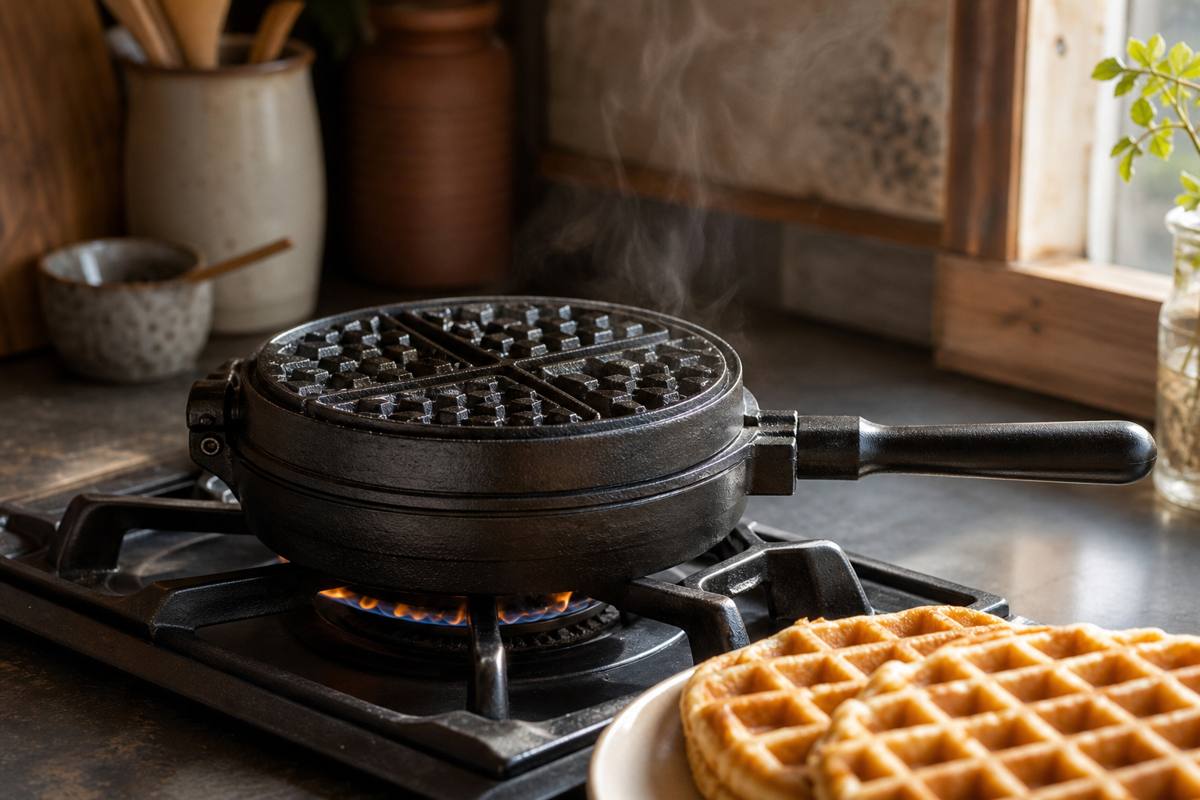
A stovetop cast iron waffle iron weighs 16 pounds, has no dial, no light and no beep, and makes a better waffle than the $200 electric machine next to it. Here is why — and who should not buy one.
Some brands we cover are clients of our publisher. What we recommend is decided by our editors, and prices are read on the date noted in each article. Our standards.
Quick take
An electric waffle maker manages heat for you with a thermostat, which is exactly why its waffles go soft: the plates dip in temperature the moment cold batter lands. Cast iron does the opposite — it stores heat and gives it back, which is what makes an audibly crisp shell. The trade is that you run it by feel. If you want the crust, the current cast iron options are narrower than the internet suggests: essentially Appalachian’s two stovetop irons at $225–$235, or Rome Industries’ campfire irons at $39–$48. Lodge and Le Creuset do not currently sell one at all.
The waffle iron is one of the few pieces of cookware where the electric version genuinely replaced the original rather than sitting beside it. Almost nobody under fifty grew up with a waffle iron that goes on a burner. And the reason to care about the old kind is not nostalgia; it is a specific, measurable property of the metal.
Thermal mass, and why waffles are the extreme case
A waffle is a batter with a lot of water in it, poured onto a hot surface, where the surface has to do two jobs at once: drive water out as steam to set the crust, and cook the interior through. Both jobs draw heat out of the plates fast. What happens next decides whether you get a crisp waffle or a pale, bendy one.
An electric machine has thin plates and a thermostat. When the temperature drops, the element switches back on — but the recovery lags behind the batter, so the first minute of cooking happens on a cooling surface. Cast iron has no element and no thermostat, and it does not need them: a heavy iron waffle iron holds so much heat in the metal itself that pouring batter barely moves the needle. Appalachian Cast Iron, whose Great Belgian Waffle Iron assembly weighs a stated 16 pounds, makes the point directly on its own page — the cast mass “makes for exceptionally even heating,” with a shorter recovery between waffles.
That is the whole argument, and it applies identically to searing a steak in a cast iron skillet. Waffles just make it more obvious, because the crust is the product.
Every price and specification here was read off the manufacturer’s own live product page on 4 September 2026, including the confirmation that Lodge’s and Le Creuset’s own site searches return no waffle iron.
What you give up
Five real costs, none of which show up in the marketing.
You judge doneness yourself. There is no indicator light. Appalachian recommends an infrared thermometer and a plate temperature of 400–430°F, and notes that experienced cooks read the heat instead by the sizzle of a few drops of water. In practice you learn to watch the steam: heavy steam at first, then a noticeable slowing, then it is done.
You flip it by hand. Stovetop irons sit in a ball-and-socket base so the whole head rotates. Appalachian tells owners to lift the stay-cool spring handles and rotate roughly every minute so both paddles heat evenly. An electric machine latches and does this for you, or does not need to.
Your burner may not be up to it. Uneven burners matter far more with a heavy iron head than with an electric plate, which is what the rotating is for. Induction is the bigger catch: Appalachian states its irons work on gas, coil and glass tops and on most induction ranges, but explicitly not on Bosch and some LG models, and suggests testing whether your hob will excite a metal surface half an inch above the burner.
It is heavy and it is hot. Sixteen pounds of iron at 400°F is not a thing you move casually, and the base takes up a burner for the whole session.
Seasoning is on you. Both Appalachian irons ship pre-seasoned with certified kosher grapeseed oil and no PFOA or Teflon, but ongoing care — dry it, oil it lightly, do not leave it soaking — is the owner’s job, exactly as with a skillet. This is a maintenance habit, not a ritual, and it is the reason iron cookware outlives the people who buy it.
What you can actually buy right now
This is where the category gets interesting, because it is much smaller than its reputation. Lodge, the default answer for anything cast iron, sells no waffle iron — a search for “waffle” on lodgecastiron.com returns zero results. Le Creuset does not sell one either. Older articles that recommend either are describing products you cannot buy new.
What remains splits cleanly into two very different groups.
Kitchen stovetop irons: Appalachian Cast Iron
Appalachian makes two, both cast in a US foundry and hand-finished in Tennessee, both producing a 7-inch round waffle, both sharing the same base, ball joint and spring handles, and both carrying a lifetime warranty on materials and workmanship.
- The Great American Waffle Iron — $225.00. Produces a half-inch-thick waffle: the American style, crisper edge to centre because there is less interior to cook.
- The Great Belgian Waffle Iron — $235.00. Produces a one-inch-thick waffle with deeper pockets, and weighs more; the entire assembly is a stated 16 pounds. Ideal plate temperature 400–430°F.
The detail worth knowing before you choose is that current-production paddles are interchangeable between the two. Buy both irons and you can run one American paddle against one Belgian paddle to make a three-quarter-inch waffle with stars on one face and squares on the other. Buy one and you are choosing a waffle thickness for the next few decades, so think about which you actually eat.
Campfire irons: Rome Industries
Rome has been making cast iron pie irons and waffle irons since 1964, and its waffle irons cost a fraction of the kitchen ones — but read the intended use carefully, because it is not the same product.
- Chuckwagon Waffle Iron #1028 — $48.00. Cast iron head 6.75 inches across, chrome-plated steel rods and wood handles, 23 inches overall, built for a campfire, camp stove or grill. Ten-year warranty.
- Old Fashioned Waffle Iron #1100 — $39.00. The nostalgic short-handled shape, 6.75-inch head, 10 inches overall. Rome states it is not for direct stovetop use unless a trivet lifts it off the burner — which rules it out for most people shopping this article.
- Waffle Iron with Long Rods #1405 — $40.00. A rectangular 3.625 by 6.5-inch head on 30-inch handles, designed to be held over a fire.
None of the Rome irons state that they arrive pre-seasoned, and all three are long-handled tools rather than based irons you rotate on a burner. If you camp, they are excellent and cheap. If you want Sunday breakfast on a gas range, they are the wrong tool.
The lighter middle: cast aluminium
There is one more honest option, and it is not iron. Nordic Ware’s Original Stovetop Belgian Waffler is $80.00: cast aluminium with a PFAS-free nonstick coating, 15.4 by 8.5 inches overall, four deep square pockets, a ten-year warranty and no seasoning required. It works on gas, electric and ceramic tops. Nordic Ware also makes a heart-shaped Sweetheart Waffler in the same material.
Cast aluminium heats evenly and weighs a fraction of iron, and the nonstick surface removes the learning curve entirely. What it does not have is thermal mass, which means it behaves more like an electric machine in the one moment that matters — the pour. Treat it as a different category that happens to share a burner, not as a cheap cast iron iron.
Using one without ruining the first six waffles
- Preheat longer than feels reasonable. Iron takes minutes, not seconds. Medium heat, both sides, rotating every minute or so, until a few flicked drops of water sizzle sharply and vanish.
- Aim for 400–430°F on the plate, per Appalachian’s own guidance, and raise the heat slightly after the first waffle — the first pour takes the most out of the metal.
- Oil the paddles, not the batter. A thin wipe of a neutral, high-smoke-point oil on both faces before the first waffle; after that, a well-seasoned iron mostly looks after itself.
- Do not fill it. Batter expands into the pockets and out of the seam. Slightly less than looks right is right.
- Rotate on a timer at first. Roughly every 60 seconds until you know your burner, then by steam and smell.
- Resist opening early. The crust sets in the last 30 seconds. If it sticks when you peek, it was not done.
- Clean it like a skillet. Hot water, a stiff brush, dry it on the burner, a whisper of oil. No soaking, no dishwasher.
Who should buy one
Buy a stovetop cast iron waffle iron if you make waffles regularly enough to learn a piece of equipment, cook on gas or a compatible hob, and care about the shell more than the convenience. At $225–$235 it costs about what a high-end electric machine costs and it will outlive several of them; the lifetime warranty on materials and workmanship is close to free for a manufacturer of iron goods, but it tells you what they expect the thing to do.
Do not buy one if you make waffles three times a year, cook on an incompatible induction range, or want to pour batter and walk away. In that case an electric machine is not a compromise, it is the correct appliance — and the $80 cast aluminium stovetop version sits neatly in between, provided you know you are buying convenience rather than crust.