
A $140 bowl and a $2,880 bowl can both be “99.9% quartz, tuned to 432 Hz.” Here is what actually separates them, in plain language, with prices read on September 16, 2026.
Some brands we cover are clients of our publisher. What we recommend is decided by our editors, and prices are read on the date noted in each article. Our standards.
The quick take
- Material is not the differentiator. Nearly every clear or frosted bowl on the market is fused silica — quartz sand melted and spun into shape. “99.9% pure quartz” describes almost the whole category, not a premium tier.
- Size sets the note, not the quality. A bigger bowl sings lower. A 12-inch bowl in the third octave and a 6.75-inch bowl in the fourth octave are doing different jobs, not better and worse ones.
- Price tracks scarcity and finish. Metal- and mineral-infused bowls, hand-fused “alchemy” pieces and handled practitioner bowls run four figures. Plain frosted and clear bowls start under $200.
- 432 Hz vs 440 Hz is a tuning preference, not a grade. Both exist across every price band; pick the one that matches whatever else you play.
- Check what is in the box. Ring, mallet, case and shipping are worth $50–$550 on their own, and most crystal bowl sales are final.
Why the price range is so wide
Walk into the crystal singing bowl market with no reference points and the pricing looks arbitrary. An 8-inch bowl can cost $140, and a 12-inch one $2,880. Both listings will tell you the bowl is pure quartz and precision-tuned, and both will be telling the truth.
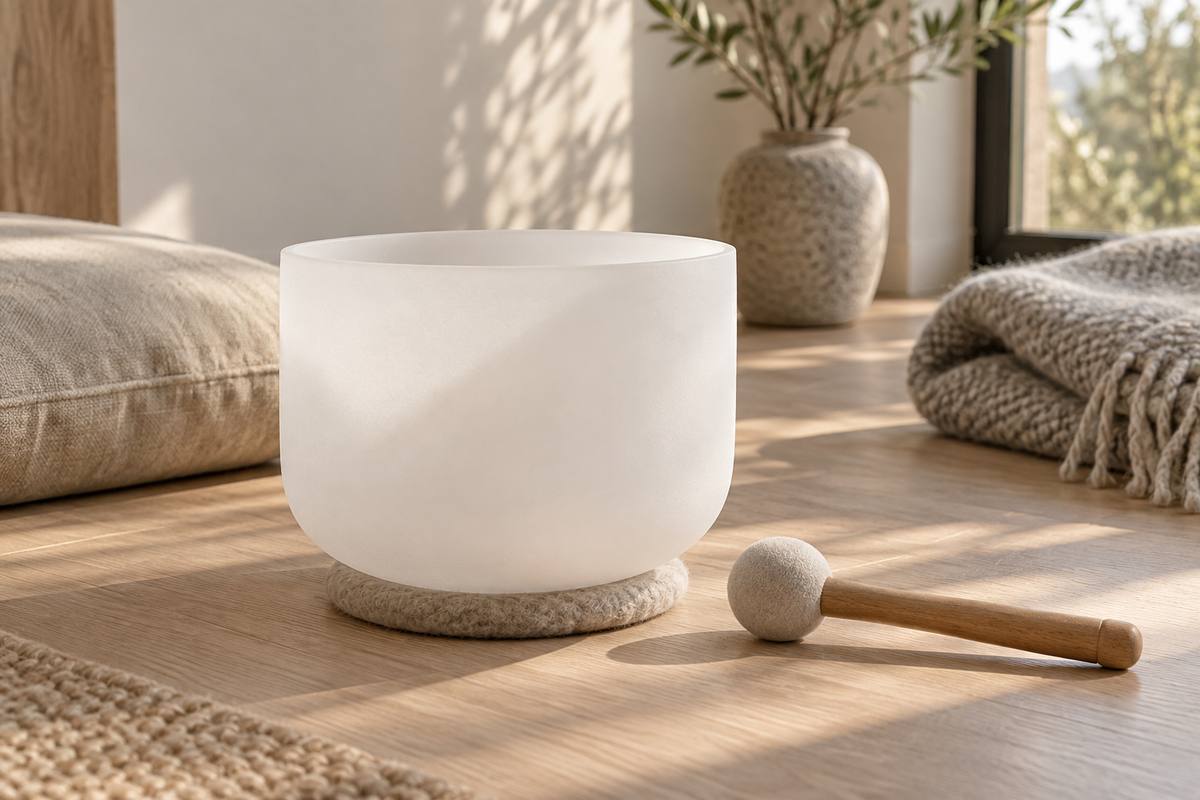
The raw material is genuinely commodity-grade. Industrial silica sand is one of the most widely produced non-metallic minerals in the United States, tracked by the U.S. Geological Survey alongside sand and gravel. Melted at furnace temperatures and spun in a centrifugal mould, it becomes the frosted white bowl that anyone who has been to a sound bath will recognize. The clear bowls come out of a different process that leaves the wall glassy rather than matte, which is why they tend to cost more per inch even from the same maker.
What you pay above that baseline is a mix of four things: the size of the bowl, how tightly it was tuned, what was fused into or onto the quartz, and how much hand-work the shape required. Everything else in the marketing copy is atmosphere.
Editors’ note: We describe these as instruments. Plenty of listings in this category make claims about chakras, cellular structure, brainwaves and healing; some of the product pages we link below do exactly that. We have not verified any health claim, we do not repeat them as fact, and nothing here is medical advice. Buy a bowl because you want to hear it.
What the physics actually says
The sound is real and well studied, even if the surrounding language is loose. A bowl is a shell that rings in a set of vibration modes, the same family of behaviour as a wine glass or a standing bell. Rubbing the rim with a mallet is a stick-slip process: the mallet catches, releases and re-catches hundreds of times a second, feeding energy into one mode until it dominates. Researchers reviewing the dynamics of metal singing bowls in the journal Nonlinearity describe the same mechanism, including the wobbling water surface you see when a filled bowl is played.
Two practical consequences fall out of that. First, the fundamental pitch falls as the bowl gets wider and thinner, which is why sellers list diameter and note together — a 12-inch bowl at 173 Hz sits nearly an octave under a 6.75-inch bowl at 466 Hz. Second, a bowl is never exactly one frequency. Hand-made shells are slightly asymmetric, so the tone drifts and beats. Good sellers quote that drift honestly in cents.
How to read a listing in sixty seconds
- Size and octave — the only spec that determines how low it sounds
- Tuning and cents — 432 or 440, and how far off the maker allows
- Finish and infusion — frosted, clear, metal-infused, handled
- What is included — ring, mallet, case, shipping
- Returns — most crystal bowl sales are final
1. Size and octave set the voice
Diameter is the spec to read first. At Bowls of Sound, a 6.75-inch frosted bowl is listed at A#+3 in the fourth octave, 466 Hz, for $333.75. The same shop’s 12-inch Harmonic Sunrise is F-13 in the third octave, 173 Hz, at $2,880 — a much bigger piece of fused quartz, a much longer decay and a price to match. Neither is the “better” bowl. Small bowls carry in a room with other instruments; large bowls are what people mean when they describe a sound bath as something you feel in your chest.
Prices read September 16, 2026.
2. Tuning is a preference, and cents are the honest number
Every serious seller now offers both concert pitch (A=440 Hz) and the alternative A=432 Hz tuning, at the same price. Healing Sounds sells its clear rainbow quartz bowl at $299.99 for a 6-inch, with 432 Hz and 440 Hz sitting side by side as variant options for every note — proof, if you needed it, that the tuning is a dropdown and not a grade of craftsmanship.
The number worth hunting for is tolerance. Myriad Melodies states plainly that it aims for ±5 cents and asks buyers to allow up to 10 on its 8-inch 432 Hz B-note bowl, which starts at $140 without a tuning fork and $160 bundled with one. A shop that publishes its error range is easier to trust than one that just says “perfect pitch.”
Prices read September 16, 2026.
3. Finish and infusion explain the four-figure bowls
Once you leave plain frosted and clear quartz, you are paying for what was fused into the surface. Bowls marketed as alchemy or practitioner pieces are made with added minerals and metals, and handled versions bond a quartz stem to the base so the bowl can be played in the air. A 7-inch A#+5 Ocean Indium practitioner bowl at Sacred Sound of the Soul, a Crystal Tones dealer, is $1,643 with ring and wand included, and the same shop’s etched and platinum-finished pieces run past $4,000.
Hand-shaped chalice forms sit in the same bracket for a different reason: the stem and bowl have to be worked individually. Our publisher’s client Tribu Spirit stocks that style, including a 7.5-inch chalice grail in G, tuned to 432 Hz, at $460 — cheaper than a comparable mineral-infused bowl, more than a plain frosted one of the same width. The shape, not the mineral, is what you are buying there.
Prices read September 16, 2026.
4. Count what is in the box before you compare prices
A bowl on its own is not playable or storable. It needs an O-ring to sit on, a mallet, and a case if it ever leaves the house, and those extras are priced separately more often than you would expect. Bowls of Sound includes carrying case, ring and mallet with the 12-inch bowl above; Unlimited Singing Bowls ships its set of three Pure Soul bowls at $487 with a pillow for each bowl and two suede mallets, and also sells $19.99 wooden holders separately for smaller bowls. At the top of the market, hard cases are a line item of their own — Sacred Sound of the Soul lists a wheeled 16-inch case at $549.
Set listings are usually the cheaper route into a second and third note, with one caveat that Unlimited states openly: the 5-inch bowls in its trio are meant to be chimed and do not sing under a mallet as easily as bigger ones.
Prices read September 16, 2026.
5. Returns, breakage and the entry-level question
Read the policy before you check out. Bowls of Sound states that all crystal singing bowl sales are final, which is common across the category — these are single-piece fused quartz shells that do not survive a drop, and shops that hand-pick and record each bowl cannot restock a returned one.
If you are not ready to commit four figures, the entry tier is real. Shanti Bowl sells a single frosted crystal bowl at $187.50 in any of seven notes, and its hand-hammered metal Tibetan bowls start at $64.50 for a 4.5-inch and $94.50 for a 5.5-inch. Metal and quartz are not interchangeable — hammered bowls are darker and more complex, quartz bowls are purer and hold a note far longer — but a cheap metal bowl is the least expensive way to learn whether you actually enjoy playing one.
Prices read September 16, 2026.
How we chose what to look at
We opened every product page cited here on September 16, 2026 and read the price, size, note and included accessories off the live listing rather than a press kit. We did not test these bowls; nothing in this article is a performance ranking. Where a seller’s own copy makes health or energy claims, we left those claims on the seller’s page. Our approach to product coverage is set out in how we choose and how we test, and mistakes get fixed under our corrections policy.
What we would tell a friend
Decide the note and the room first. If the bowl is for a small home practice next to a speaker or a guitar, a 6- to 8-inch bowl under $350 in whichever tuning your other instruments use will do everything you need, and the money saved buys a second note. If you are playing for other people in a large room, diameter is the upgrade that matters and it is worth more than any finish.
Beyond that, treat the spec sheet as the honest part of the listing and the cosmology as decoration. Diameter, note, octave, cents of drift, what ships in the box, and whether you can return it — those six facts explain the entire price range from $64 to $4,000, and they are all printed on the page if you look for them.