
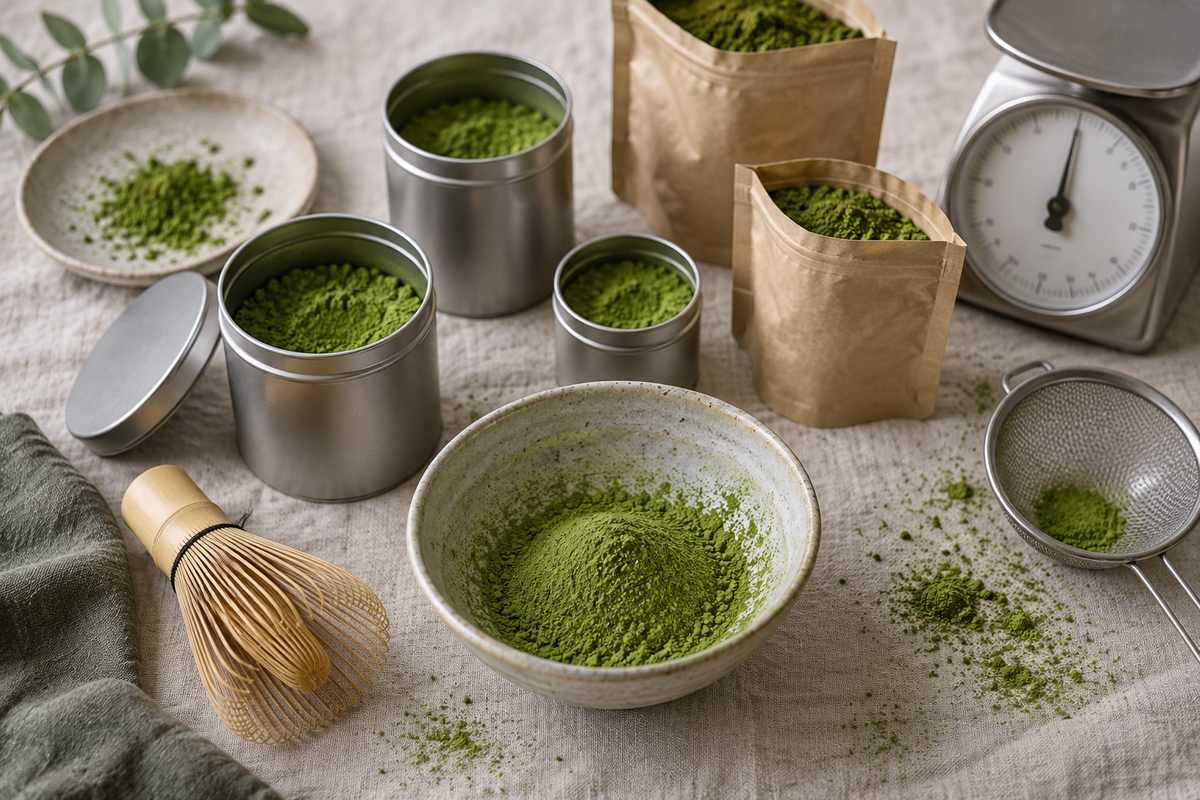
Matcha tins are sold in 20g, 30g, 40g and 100g sizes at prices that look nothing alike until you do the division. Here are ten ceremonial-grade tins we priced on September 19, 2026 — ranked by what a gram actually costs.
Some brands we cover are clients of our publisher. What we recommend is decided by our editors, and prices are read on the date noted in each article. Our standards.
The quick take: Ceremonial matcha in September 2026 runs roughly $0.40 to $1.45 per gram among the tins below. The cheapest gram in this group is Naoki’s Superior Blend in the 3.5 oz size ($39.99, about $0.40/g); the most expensive is Kettl’s Kogetsu ($29 for 20g, $1.45/g). A 20g box is not a deal because the number is small, and a 100g bag is not automatically thrift either — Jade Leaf’s Teahouse Edition is $59.99 in both a 100g tin and a 100g pouch today. Do the per-gram math before you do anything else.
Why matcha pricing is so hard to compare
Almost every other pantry item you buy has a unit price printed under it. Matcha does not. It is sold in tins and pouches whose sizes were set by Japanese packing conventions — 20g, 30g, 40g, 100g, 1kg — and priced in round dollar figures that hide how much tea you are getting. A $17 box and a $50 can can be the same tea quality at a different weight, and a $20 tin can be twice the price per gram of a $40 one.
The other reason it is hard: the word “ceremonial” is a marketing term, not a graded standard. There is no government or trade body assigning it, which is why you will see it on a $0.40/g blend and a $1.45/g single-farm lot in the same week. What is verifiable on a label is narrower and more useful: the prefecture or farm, the cultivar names, the harvest (first harvest or later), and organic certification. USDA organic claims are enforceable under the National Organic Program; “ceremonial grade” is not enforceable at all.
One more practical number: a standard bowl uses about 2g of powder, which is why brands quote “15 cups” for 30g and “20–25 servings” for 40g. If you drink one bowl a day, a 40g tin is about five to six weeks. Matcha also carries real caffeine — the FDA’s general guidance for healthy adults is up to about 400mg a day from all sources, worth remembering if matcha is landing on top of coffee.
Editors’ note: We did not taste these side by side and we make no claim that a more expensive gram tastes better to you. Everything below is read off each brand’s own live product page on September 19, 2026 — price, size, region, cultivar — and per-gram figures are our arithmetic on those two numbers. Flavour descriptions are the brands’ own words, attributed as such. Matcha stock in this category turns over quickly and several tins we wanted to include were sold out today; prices and availability will have moved by the time you read this.
How we chose
We started from tins described by their sellers as ceremonial grade (or the seller’s own top drinking grade) and in stock today, then required each one to state something checkable about the tea: origin, cultivar, harvest, or certification. We kept a spread from $17 to $59.99 and from 20g to 100g so the per-gram comparison has something to say, capped the list at one pick per brand, and dropped anything whose listing was ambiguous about weight — if we could not read the gram count off the page, we could not price it per gram, so it is not here. Bundles, latte mixes, sweetened sticks and culinary grades were left out. More on how we choose and corrections.
- Best per-gram value in a large size — Naoki Superior Blend, $39.99 / 3.5 oz
- Best organic at the 60g size — Encha Ceremonial Grade, $34.99 / 60g
- Best 40g daily tin — Mizuba Daily Matcha, $25 / 40g
- Best stock-up bag — Jade Leaf Teahouse Edition, $59.99 / 100g
- Best inexpensive starter box — Ippodo Ikuyo, $17 / 20g
- Best single-farm 20g — Tezumi Rikyū (Nukata), $19.20 / 20g
- Best latte-friendly blend — rocky’s matcha Osada Ceremonial Blend, $20 / 20g
- Best all-in starter with tin and scoop — More Than Matcha Ceremonial Matcha Powder, $45 / 40g
- Best single-origin 30g — Matchaful Hikari, $42 / 30g
- Best splurge from a named blender — Kettl Kogetsu, $29 / 20g
The ten tins, cheapest gram first
1. Naoki Superior Blend Matcha — $39.99 for 3.5 oz (about $0.40/g)
The least expensive gram in this roundup, and not by a small margin. Naoki lists Superior Blend at $24.99 for 1.4 oz, $25.99 for 1.75 oz and $39.99 for 3.5 oz — so the big bag costs 60% more than the small one and gives you two and a half times the tea. The brand describes it as its best seller from Uji, Kyoto, with low bitterness, some umami and a smooth mouthfeel, and recommends it as a starting point. If you drink matcha daily and you are not chasing a specific farm, this is where the arithmetic points.
Good to know: the three sizes are priced so unevenly that buying two 1.4 oz tins ($49.98) costs more than the 3.5 oz bag for less powder.
2. Encha Ceremonial Grade Matcha Powder — $34.99 for 60g (about $0.58/g)
Encha prices its ceremonial tin at $19.99 for 30g, $34.99 for 60g and $189.99 for 500g today, plus $39.99 for a 30-pack of single-serve sticks. The 60g tin is the sweet spot: $0.58 a gram against $0.67 for the small one. Encha says the powder is USDA certified organic, master-blended from six cultivars across Kagoshima, Miyazaki, Shizuoka and Uji, stone-ground, and third-party tested for purity — and that it is best whisked with water alone.
Good to know: the sticks are convenient and expensive — $1.33 per stick, against $0.38 a gram in the 500g size.
3. Mizuba Daily Matcha — $25 for a 40g tin (about $0.63/g)
The clearest label in the group: Mizuba states the size (40g tin, 20–30 servings), says the tea is non-GMO and certified free of radiation and heavy metals, and notes it is suitable for koicha — the thick preparation that tends to expose a harsh matcha. Mizuba’s own brewing note is 1.5–2g in a warmed chawan with 160–175°F water. At $25 it is the cheapest genuine 40g daily tin here.
Good to know: Mizuba’s catalogue runs up to $83 for its Asahi lot, so “Daily” is deliberately the entry point of a much deeper shelf, not the whole range.
4. Jade Leaf Organic Ceremonial Matcha, Teahouse Edition — $59.99 for 100g (about $0.60/g)
Jade Leaf’s top drinking blend is $22.99 for a 30g pouch, $26.99 for a 30g tin, $59.99 for either the 100g tin or the 100g pouch, and $189.99 for a 1 lb pouch. Note what that pricing does: the pouch saves you $4 at 30g and nothing at all at 100g, so if you are buying the big size, take the tin. The brand lists the cultivars — Okumidori, Kanayamidori, Sayamakaori, Samidori, Yabukita — and describes the tea as USDA organic, first-harvest and farm-direct.
Good to know: Jade Leaf’s listing includes wellness language about antioxidants and L-theanine that we have not evaluated; buy it for the cultivar list and the price per gram.
5. Ippodo Ikuyo Matcha — $17 for a 20g box (about $0.85/g)
Ippodo is a Kyoto tea house with a deep matcha list, and Ikuyo is its accessible end: $17 for 20g, described by the house as medium-bodied with a refreshing bitterness slightly more noticeable than its sweetness and umami. That is an unusually honest product description in a category that mostly promises sweetness, and it makes Ikuyo a good way to learn what bitterness in matcha actually tastes like before you spend more.
Good to know: within the same catalogue today, Sayaka is $50 for a 40g can ($1.25/g) and Kanza is $104 for 20g ($5.20/g) — the house ladder is steep, so start low.
6. Tezumi Rikyū, Nukata Matcha — $19.20 for 20g (about $0.96/g)
Tezumi’s Rikyū comes from Miyazakien in Aichi Prefecture and is listed as that producer’s highest grade, described as bright, snappy, fresh and herbaceous. Two things make it worth the dollar-a-gram: the tea is traceable to one producer rather than a blend, and Aichi is not the region most Western matcha shelves default to, so it tastes like a different place rather than a different price tier.
Good to know: Tezumi’s Uji list climbs fast — $24 for Betsugi, $58 for Kotobuki at the same 20g — which is a useful illustration of how much of a matcha price is region reputation.
7. rocky’s matcha Osada Ceremonial Blend — $20 for 20g (about $1.00/g)
Developed with Osada Tea and sourced from Kagoshima and Shizuoka, this blend names six cultivars — Tsuyuhikari, Asatsuyu, Saeakari, Meiryoku, Yabukita and Saemidori — and is pitched by the brand at newcomers and at lattes, with a subtly roasted flavour that holds up against milk and sweeteners. It is the pick here if most of your matcha ends up iced in a glass with oat milk, where a delicate single-cultivar tea is wasted.
Good to know: the same blend is $78 for 100g ($0.78/g) if you settle on it, and the shop’s single-cultivar tins run to $88 for 20g.
8. More Than Matcha Ceremonial Matcha Powder — $45 for 40g (about $1.13/g)
More Than Matcha’s single powder is organic, first-harvest, shade-grown and freshly ground in Kagoshima, and the 40g size is quoted at 20–25 servings. It ships in the brand’s tin with a teaspoon, which is the reason to start here rather than with a bare pouch — and once you have the tin, the 40g refill packet is $40, a figure the brand itself prints as $1.00 per gram. Buying the first tin and then refilling is the cheapest way to stay in this brand, and it is also the least packaging.
Good to know: the catalogue is deliberately tiny — powder, refill, a $22 whisk and sift set, an $89 ceramic essentials set — and the $39 travel sticks are sold out today. Disclosure: More Than Matcha is a client of our publisher; it is on this list because its stated origin and grind are specific and its refill pricing is transparent, which is rarer here than it should be.
9. Matchaful Hikari Single Origin — $42 for 30g (about $1.40/g)
Hikari is single-origin from Hattori Tea Farm in the hills of Shizuoka, which is what you are paying the premium for: one farm, no blending with other lots or green tea. Matchaful describes it as smooth and creamy with notes of walnut, lemon and butter, and robust enough for lattes and smoothies. The 100g tin is $79 ($0.79/g) if you get attached.
Good to know: Matchaful’s Kiwami single-cultivar is $49 for 30g and its Tsuyuhikari limited reserve $55 for 30g, so Hikari is the everyday tier of a specialist line rather than the cheap one.
10. Kettl Kogetsu — $29 for 20g (about $1.45/g)
The most expensive gram here, and the most specific story. Kogetsu comes from Maruyasu, a Shiga producer open since 1872, blended by Yasuharu Maeno — whom Kettl describes as a level-9 chashi and one of the most respected tea blenders in Japan. Kettl calls it a rich profile led by a toasty aroma, and prices it well below most of its own list, where 20g tins reach $150. If you want to taste what a named blender does rather than what a region does, this is the cheapest door into that.
Good to know: Kettl’s stock moves constantly — many of the tins on its site were sold out when we checked today — so if a specific lot matters to you, buy it when you see it.
How to use the per-gram number without overthinking it
Three rules survive all of this. First, convert everything to dollars per gram before you compare, because the industry will not do it for you: $17, $25 and $45 tins in this list work out to $0.85, $0.63 and $1.13 a gram respectively, which reverses the order you would guess from the sticker. Second, buy the size you will actually drink within a couple of months — matcha is a ground powder that fades, and a 100g bag at $0.60 a gram is worse value than a 40g tin at $0.63 if the last third goes stale. Third, pay the premium for things you can verify on the label: farm, prefecture, cultivar, harvest, certification. “Ceremonial” tells you nothing; “Hattori Tea Farm, Shizuoka, single origin” tells you something.
And if a tin does not print its weight, treat that as the answer. We dropped several otherwise appealing options from this list for exactly that reason.
All prices and sizes were read on each brand’s own product page on September 19, 2026. See also how we test and our affiliate disclosure.