
A grip sock listing is a small spec sheet in disguise. Here is how to read one — grip coverage, toe style, fiber content, sizing, return terms and price per pair — using six brands’ live pages as worked examples.
Some brands we cover are clients of our publisher. What we recommend is decided by our editors, and prices are read on the date noted in each article. Our standards.
Quick take: Six things decide whether a pair of grip socks suits you: where the grip sits, whether your toes are covered, what the knit is made of, which shoe sizes each size covers, whether you can send them back, and what one pair really costs once multipacks are divided out. On the pages we read, single pairs ran from $9.98 to $25, and multipacks ranged from a meaningful discount to almost none. The size chart matters most when a store sells everything as final.
Why a sock needs reading at all
Most studios that ask for grip socks say “grip socks required” and leave the rest to you. So the choice happens on a product page, and those pages mix useful specs with a lot of mood copy. “Non-slip,” “secure,” and “designed for Pilates” appear on almost every listing. They don’t help you compare anything.
The useful parts are more concrete, and some of them are required by law. The Federal Trade Commission’s guide to the Textile and Wool Act labeling rules says covered products must list generic fiber names and their percentages by weight, in descending order. It also says online and catalog descriptions must state whether a product was made in the U.S.A., imported, or both. The FTC’s guide to the Care Labeling Rule adds a sock-specific wrinkle: hosiery products, including anklets, don’t need a permanent sewn-in care label. They do need care instructions on a hang tag, the package, or somewhere else conspicuous. The rule text itself sits in 16 CFR Part 303. In practice, the package is where a grip sock’s paperwork lives, and the product page is your only look at it before you pay.
Editors’ note: We did not wear or test any of the socks below. Every price, fiber percentage, size range and policy was read off the brand’s own live pages on September 24, 2026. Where a page left something out or stated it ambiguously, we say so rather than fill the gap. Grip socks don’t replace your instructor’s guidance on footing or equipment.
How we chose the examples
We picked six brands that sell grip socks directly and publish enough on their own pages to compare: Souls (a client of our publisher), Arebesk, ToeSox, Pointe Studio, Gaiam and Sticky Be. For each brand we read at least one in-stock listing in full, plus its return policy. We left out listings whose fiber details contradicted their own titles, and we didn’t use clearance prices as a brand’s typical price. Background on our approach is in how we choose.
1. Where the grip sits, and what it’s made of
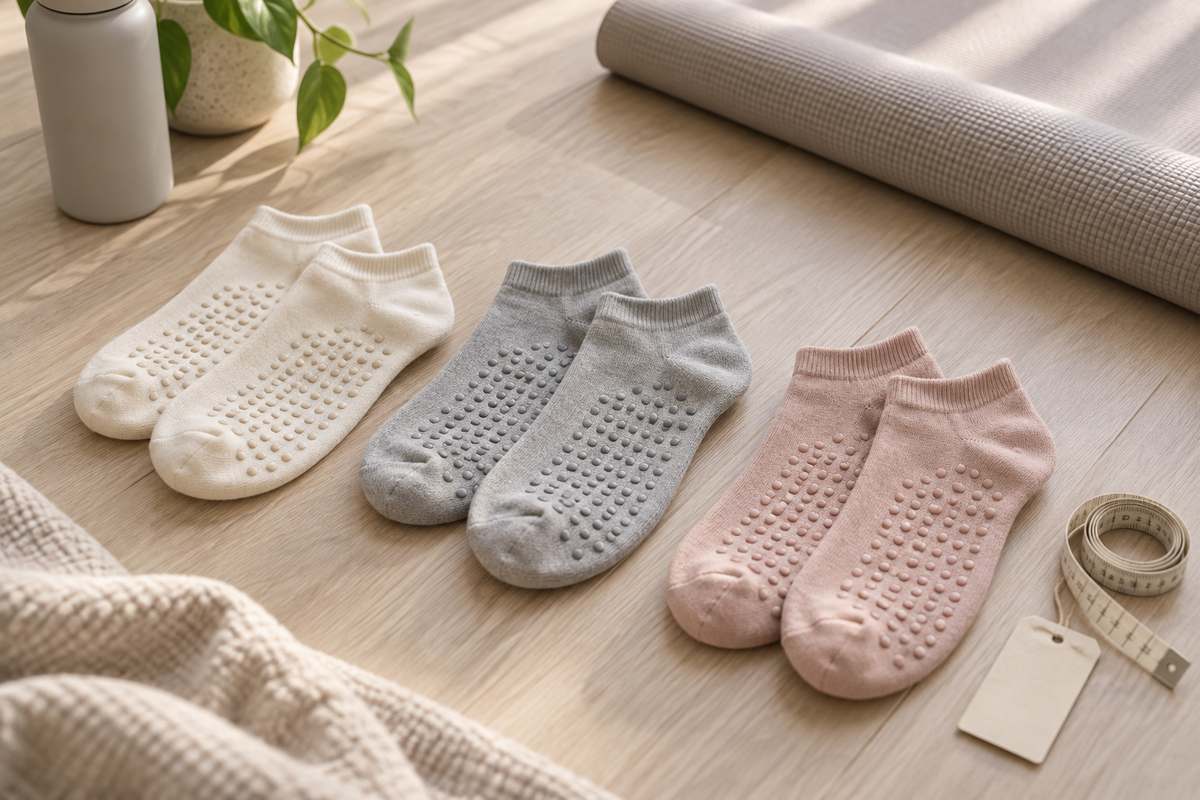
Listings describe grip in two ways: full-sole coverage or targeted zones. Souls says its Body & Soul pair has full-coverage silicone grips. Arebesk says its Koko Grip Sock ($25) puts extra silicone on the ball and heel, which it calls the high-contact areas. Gaiam describes “targeted traction zones” on its toeless style. Pointe Studio’s full-foot styles, as the name says, carry grip across the whole sole. Its listing for the Abstract Full Foot (sold out when we checked) is one of the few that names the grip material outright: PVC.
Most pages never say what the dots are made of, so “silicone” versus “PVC” is often something you can’t compare. What you can compare is placement. A full sole puts grip wherever your foot lands. Targeted zones leave the arch free and grip where most of your weight goes. If your class involves a lot of sliding on a carriage or a sliding board, check your studio’s preference first.
2. Toes in, toes out, and how high the cuff goes
Most grip socks are closed-toe. ToeSox builds everything around individual toes and sells two versions of most styles: Full Toe, with each toe covered, and Half Toe, with the tips exposed. Its Full Toe Ultra Fine Knit Bellarina ($22) is a Mary Jane cut with a 200-needle knit, according to the listing. Sticky Be also sells half-toe styles alongside full-toe ones. Gaiam sells a toeless 2-pack next to its full-toe Yoga-Barre pair.
Cuff height is the other variable. The range runs from ballet-style strap socks (ToeSox, Arebesk, Gaiam) through ankle cuts to crew socks, which Souls sells as a separate men’s line. This is taste more than function, but a higher cuff covers more skin where your ankle touches the equipment.
3. Fiber content: look for percentages that add up
This is where listings differ most, and where the FTC rule helps you. A fiber line should read like “80% cotton, 20% spandex.” Anything vaguer, like “soft cotton blend,” tells you less than the label on the package will.
- Arebesk Koko: 80% cotton, 20% spandex.
- Pointe Studio Varsity Ankle ($18): 55% cotton, 40% nylon, 5% spandex, with a cushioned terry footbed.
- Gaiam Grippy Yoga-Barre Socks ($9.98): 98% polyester, 2% spandex.
- Sticky Be: its half-toe listing states 80% cotton, 20% spandex/elastane.
- ToeSox Ultra Fine Knit Bellarina: 69% organic cotton, 14% polyester, 3% elastane. That adds up to 86%, so part of the blend isn’t accounted for on the page.
- Souls Body & Soul: described as a “soft, breathable cotton blend,” with no percentages in the listing text.
What the numbers tell you: high cotton usually means a softer, more absorbent sock. High polyester or nylon usually means faster drying and more durability. The spandex (called elastane in ISO naming, as the FTC guide notes) is what makes the sock hug your foot. When a page leaves percentages out, or they don’t add to 100, the package label is where the full breakdown should be. Ask the brand before ordering if it matters to you.
4. Sizing: read the ranges, not the letters
“S/M” means different things at different brands, and the seams between sizes are where people get caught.
- Souls: S/M fits women’s US 5.5–7 and M/L fits 7.5+ on its bundle and single pages. Its men’s crew is sold separately.
- Arebesk: Small 6–8, Medium 8.5–10.5, Large 11–12, with EU sizes too. The Koko itself was offered in Small and Medium.
- ToeSox: S 6–8, M 8.5–10.5, with L 11–13 on some styles.
- Pointe Studio: S/M 5–7 and M/L 8–10 on the Varsity page, with advice to size up if you’re between sizes. A size 7.5 sits in that gap.
- Gaiam: a single S/M covering women’s 5–10.
- Sticky Be: “unisex one size fits most,” with no shoe-size range in the listing we read.
A snug fit matters more for grip socks than for everyday socks. If the sock twists, the grip rotates away from your sole. So a brand whose ranges start and stop right at your size is worth a second look, and a single wide size is a trade-off.
5. Returns: the policy decides how careful you need to be
Return terms on these six sites vary more than prices do. Souls’ store policy is no refunds or exchanges on any purchase, and it asks shoppers to review product details before buying. That makes its size chart the whole decision. Arebesk accepts unworn, unwashed items in original packaging within 30 days, and the customer pays shipping. Pointe Studio allows returns within 14 days for unworn, unwashed items with tags, and excludes final-sale and promotional items. Gaiam asks you to contact customer care within 30 days. ToeSox runs the most permissive-sounding policy: it invites you to try the socks on and work out in them, and offers prepaid U.S. labels for a $1 processing fee. Its wording about the 30-day window is ambiguous, though, and its sale listings are marked final. Confirm the terms before counting on them.
6. Price per pair: divide before you decide
Multipacks look like savings, but the discount varies a lot once you divide:
- Gaiam: $9.98 for one pair of the Yoga-Barre style, or $14.98 for the 2-pack. That’s $7.49 a pair, the biggest multipack discount we found. Only two of seven colorways were in stock.
- Souls: single pairs are $20, with some styles marked down to $15 (compare-at $20). Its three-pair Popular Grippies bundle is $55, or about $18.33 a pair. You can pick S/M or M/L separately for each of the three pairs, which helps if you’re buying for more than one person.
- Sticky Be: most adult pairs are $16. The seven-pair Neutral Mantra Box is $105, or $15 a pair, so the box saves $1 a pair.
- Pointe Studio: $16 for full-foot styles and $18 for ankle styles. The site says bundling three or more styles takes 10% off at checkout ($14.40 and $16.20).
- Arebesk and ToeSox: mostly single-pair pricing on the listings we read, $19–$25 at Arebesk and $22 for the ToeSox Ultra Fine Knit Bellarina.
The spread runs from about $7.50 to $25 a pair. The cheapest socks are mostly synthetic and come in one wide size. The most expensive have more cotton, more detailing, or five-toe construction. If you go to class several times a week, rotating a few pairs matters more than the price of any one of them. That makes price per pair the right number to compare.
Before you check out
Six questions cover it. Where is the grip, and does the page say what it’s made of? Toes in or out? Do the fiber percentages add to 100? Which exact shoe sizes does each size cover? Can you return a pair that doesn’t fit? And what does one pair cost once any multipack is divided out? If a listing can’t answer most of these, the package label or a short email to the brand usually can.
More on our process in how we test, our disclosure policy and our corrections policy. Prices read September 24, 2026, and subject to change.