

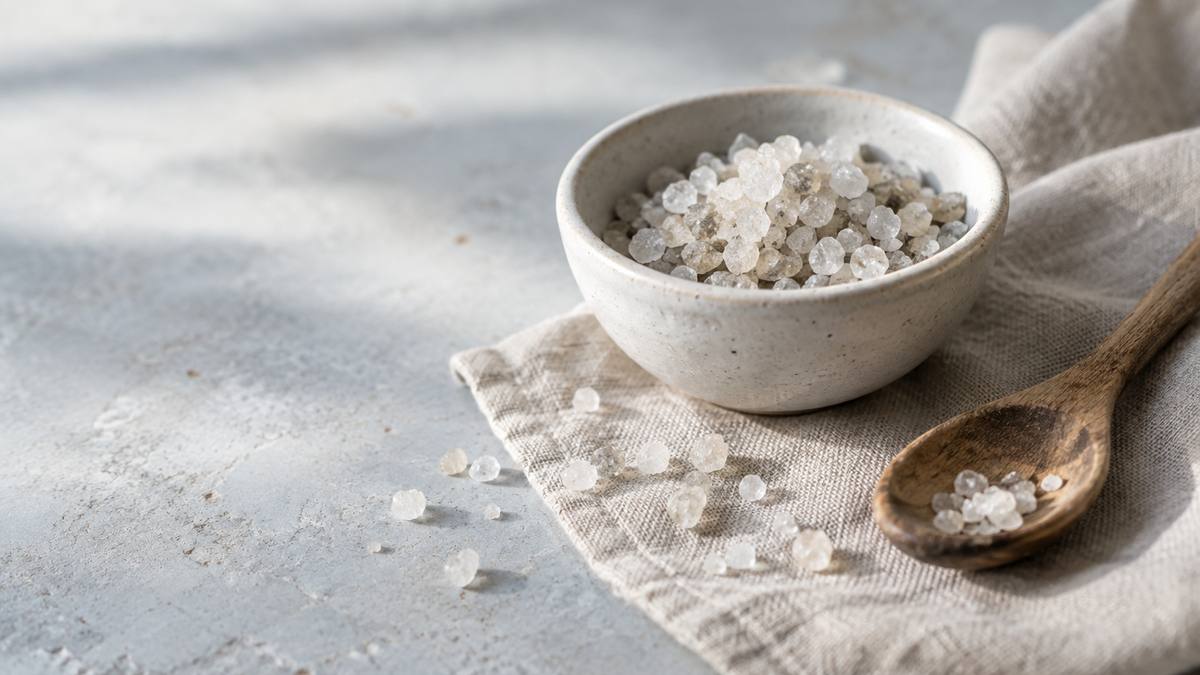
Unrefined sea salt and supermarket table salt are both, overwhelmingly, sodium chloride. The documentable differences are how each is made, what is added, whether it carries iodine, and how it behaves in a measuring spoon.
Some brands we cover are clients of our publisher. What we recommend is decided by our editors, and prices are read on the date noted in each article. Our standards.
Quick take. “High mineral” sea salt is unrefined salt that still holds the magnesium, potassium, calcium and trace elements left when seawater or geothermal brine evaporates. Those elements are real and very small: a quarter teaspoon is ~1.5 g, so a salt testing at 1% magnesium supplies roughly 15 mg against an adult magnesium RDA of 310–420 mg. What changes a kitchen or a label is iodine (most table salt is iodized, most unrefined sea salt is not), anti-caking additives, grain size and price per ounce. Prices and specs read 5 October 2026.
One canister says “iodized” and costs a few dollars; a pouch two shelves over says “hand-harvested, unrefined, high mineral” and costs several times as much. What is high mineral sea salt, and how does it differ from table salt on the label? This comparison uses producer documentation, federal data and live product pages read on 5 October 2026. No salts were tested for this article.
What is high mineral sea salt and how does it differ from table salt?
“High mineral sea salt” is not a regulated term. Brands use it for salt evaporated and harvested without being recrystallized, washed or chemically purified, so the non-sodium-chloride fraction of the original brine stays in the crystal. Refined table salt goes the other way: brine is purified and recrystallized until it is close to pure sodium chloride, then additives are blended in to keep it pouring and, usually, to supply iodine. Four things are worth checking:
- Processing: harvested and unrefined versus purified and recrystallized.
- Additives: usually none versus anti-caking agent, dextrose and potassium iodide.
- Iodine: declared on iodized labels, effectively absent in non-iodized sea salt.
- Physical form: crystal size, moisture and density — what decides how salty a spoonful tastes.
How sea salt, rock salt and refined table salt are produced
Most salt never reaches a kitchen. The U.S. Geological Survey’s 2025 salt commodity summary estimates 40 million tons of 2024 domestic production — salt in brine 42%, rock salt 40%, solar salt 9%, vacuum pan 9% — with deicing about 41% of consumption and food processing roughly 4%. Those types map onto what you buy:
Solar-evaporated sea salt
Seawater or brine is concentrated in shallow ponds by sun and wind until salt crystallizes, then harvested. Jacobsen Salt Co. describes its fine salt as coming from traditional salt ponds in Trapani, Italy and its flake salt from Netarts Bay on the Oregon coast; Maldon’s US site describes hand-harvested pyramid flakes. Crystal shape and moisture vary batch to batch, the trade-off for leaving the brine’s other minerals in place.
Rock and mined salt
Ancient buried seabeds are mined as rock salt or solution-mined as brine. Redmond’s Real Salt is mined in Utah, and the company posts certificates on a mineral analysis page — worth looking for in any unrefined salt.
Vacuum pan and Alberger salt
Purified brine is boiled under vacuum into uniform cubic crystals; the related Alberger process makes hollow flakes. Diamond Crystal says its kosher salt is made by the Alberger process in St. Clair, Michigan, is additive-free and is lower in sodium by volume than table salt — a density claim, not a chemistry one, and it matters when a recipe measures by the teaspoon.
How small the “mineral” part really is
Unrefined salts publish their non-sodium content in different ways, and the numbers reward a calculator. Modern Roots Life, a mineral-salt brand that is a client of this publication’s owner, states on its Salt of Life product page that the geothermal, hand-harvested salt tests between 0.705% and 1.44% magnesium by weight across its lab results, and lists typical approximate values per 1.5 g of 10.6–21.6 mg magnesium, 9.8 mg potassium, 11.2 mg calcium, 330 mg sodium and 842 mg chloride — figures the page says vary by harvest and are not a lot-specific assay.
Put that against reference intakes. The NIH Office of Dietary Supplements puts adult magnesium recommended intakes at 310 to 420 mg per day, so a quarter teaspoon at the top of that stated range covers about 5% of a 420 mg target and, at the bottom, closer to 3%. Trace minerals in salt are measurable and are not a meaningful dietary source. Salt is first a sodium chloride ingredient: the FDA’s consumer guidance on sodium sets the Daily Value at less than 2,300 mg a day and notes that over 70% of dietary sodium comes from packaged and prepared foods, not the salt cellar.
Sodium figures differ too, largely because water and other minerals take up room in the crystal: Morton’s 26 oz iodized table salt lists 590 mg sodium per 1.5 g, the Modern Roots Life page about 330 mg for the same weight — a difference in composition, not a licence to use more.
Iodine: the one nutritional difference that is not trivial
This is where the categories genuinely diverge. The ODS iodine fact sheet for health professionals states that US iodized salt contains about 45 mcg of iodine per gram by label, that iodization here has been voluntary since manufacturers began it in the 1920s, and that specialty salts — sea, kosher, Himalayan, fleur de sel — are not usually iodized; its food table lists non-iodized sea salt at 0 mcg per quarter teaspoon. The adult RDA is 150 mcg a day, higher in pregnancy and lactation.
The Morton iodized label declares 68 mcg of iodine per quarter teaspoon, 45% of the Daily Value; Morton’s plain 26 oz table salt without iodide declares none. If a household switches entirely to an unrefined salt, iodine has to come from other foods — dairy, eggs, seafood and seaweed lead the ODS tables. That is a question for a clinician or dietitian, particularly during pregnancy, not one a salt label can answer.
Anti-caking agents and what the ingredient line tells you
Refined salt is engineered to pour. Morton’s iodized canister lists salt, calcium silicate (an anti-caking agent), dextrose and potassium iodide, the dextrose stabilizing the iodide. Another permitted option is sodium ferrocyanide, which 21 CFR 172.490 allows in salt at no more than 13 parts per million. Unrefined salts skip all of it, which is why they clump — the harvest moisture is still there; Modern Roots Life says as much and suggests a jar rather than a shaker. That is a functional difference, not a safety story: free-flowing salt suits shakers and precise baking, damp crystals suit a pinch bowl.
Grain size, and why serious cooks weigh salt
A teaspoon measures volume, and salts differ in how much crystal fits in it: dense cubic crystals pack tightly, flakes and coarse crystals trap air. That is why Diamond Crystal’s foodservice page can call its kosher flake lower in sodium by volume than table salt while the chemistry is nearly identical, why Morton publishes a substitution table, and why swapping salts spoon-for-spoon can double or halve seasoning. Weigh salt in grams for brines, bread and anything structural, and taste-adjust otherwise. Grain is then texture: fine for baking and even dispersion, coarse or flake for finishing.
Microplastics in sea salt: what is documented
Studies have repeatedly found microplastics in commercial salts. A 2024 open-access study in Heliyon on microplastic contamination in Nepalese table salt reported particles in 100% of sampled packaged salts, from 80 to 1,040 per kilogram, averaging 381 ± 219, fibers most common. Those are samples from one market, not a verdict on any brand, and the authors point at manufacturing and packaging as well as source water.
The FDA’s page on microplastics and nanoplastics in foods states that current scientific evidence does not demonstrate that the levels detected in foods pose a risk to human health. Treat “no microplastics” marketing as unverifiable unless a brand publishes a method and a result.
Price per ounce, read today
Read on the brands’ own live pages on 5 October 2026; these move.
| Salt | Size and price | Approx. per ounce |
|---|---|---|
| Modern Roots Life Salt of Life | 4 oz, $7.77 | $1.94 |
| Modern Roots Life Salt of Life | 3 lb, $45.77 | $0.95 |
| Redmond Real Salt Fine | 26 oz pouch, $12.89 | $0.50 |
| Redmond Real Salt Fine | 10 lb bag, $54.49 | $0.34 |
| Jacobsen Pure Flake Sea Salt | 4 oz, $15.00 | $3.75 |
Redmond’s figures come from its Real Salt collection listing. Jacobsen’s Pure Fine canister is $10.00; its Pure Kosher Sea Salt is listed at $13.00 but showed as unavailable, so neither is in the table. Morton and Maldon publish no prices on their own US sites.
How to decide without overthinking it
Match the salt to the job rather than the claim. Keep an iodized salt if it has been a real contributor to a household’s iodine intake, or confirm with a clinician that other foods cover it. Buy an unrefined salt for flavour, texture and a short ingredient line, not as a mineral supply. Prefer brands that publish a lab analysis you can read, as Redmond and Modern Roots Life both do, and check net weight before comparing prices: per-ounce costs here run from about 34 cents to nearly four dollars.
Our sourcing and comparison method is set out in how we choose; anything inaccurate here can be flagged through the corrections policy.