
Ordering made-to-measure shades from a website comes down to five decisions: mount, measurements, shade type, fabric and lift system. Then read the return and warranty terms before paying.
Some brands we cover are clients of our publisher. What we recommend is decided by our editors, and prices are read on the date noted in each article. Our standards.
Quick take: Here is how to order custom window shades online: pick inside or outside mount, measure every window with a steel tape using the seller’s own instructions, narrow down shade type and opacity, order swatches, and choose a cordless or motorized lift if children are around. Read the returns policy before checkout. Most custom shades can’t be returned, so measuring mistakes usually fall on the buyer.
The catch with buying shades online is that you do the measuring. Sellers cut fabric to the numbers you enter, so a half-inch slip can leave a shade that won’t fit. We put this guide together from the measuring guides, warranty pages and safety material that sellers and safety bodies publish. Prices and specs read 7 October 2026. We didn’t test any shades. For how we pick sources, see how we choose.
How to order custom window shades online, step by step
1. Decide inside mount or outside mount
An inside-mount shade sits inside the window opening; an outside-mount shade fixes to the wall or trim and covers it. This decides where you measure.
For an inside mount, check how deep the opening is. Cityshade’s roller-shade measuring sheet asks for at least ¾ inch of depth. It also warns that an inside-mount shade comes out slightly narrower than the opening, so you get small light gaps at each side. Blinds.com tells buyers to measure depth at the left, center and right, use the smallest figure, and watch for latches or handles. If your opening is too shallow for the product’s minimum, go with an outside mount, which Blinds.com says can also make a window look larger.
2. Measure width and height the way the seller asks
Window openings are rarely perfectly square, so most guides have you measure in more than one place. The Blinds.com measuring guide sets out a three-point method for inside mounts. Measure the width at the top, middle and bottom, and submit the smallest. Measure the height at the left, center and right, and submit the largest. Round widths down to the nearest ⅛ inch and heights up. Blinds.com also says to enter exact inside-mount measurements without deductions, because the factory takes off whatever clearance it needs.
If you take off your own clearance and the factory takes it off again, the shade ends up too narrow. Sellers don’t all work the same way. Cityshade’s printable roller-shade sheet asks for the top width at the narrowest point, the height in the middle of the opening, and rounding down to the nearest ⅛ inch. The SelectBlinds guide to measuring windows says to measure every window on its own, even ones that look identical. Because the methods differ, use the measuring sheet from the company you’re buying from, not a general one.
For outside mounts, you add coverage instead of subtracting clearance. Cityshade’s sheet suggests adding 2 to 4 inches on each side for windows without trim, and 4 inches to the height. On trimmed windows, you measure to the outer edges of the trim. Blinds.com suggests at least 2½ inches of overlap on each side and starting the shade at least 3 inches above the frame. Label each window by room.
3. Choose the shade type
- Roller shades: a flat piece of fabric that winds onto a tube. Sellers commonly offer them in several opacities, from sheer to blackout.
- Solar shades: roller shades in a screen-style fabric, generally chosen to reduce glare.
- Cellular (honeycomb) shades: pleated fabric that forms air pockets. Sellers generally market them for insulation. If energy use matters to you, look for products certified by the Attachments Energy Rating Council, which rates window attachments including cellular and roller shades.
- Roman shades: fabric that folds up into soft or flat pleats as you raise it. The folded fabric stacks at the top when raised.
- Zebra, or dual-layer, shades: alternating sheer and solid bands that you line up or offset to control light.
4. Pick opacity, then order swatches
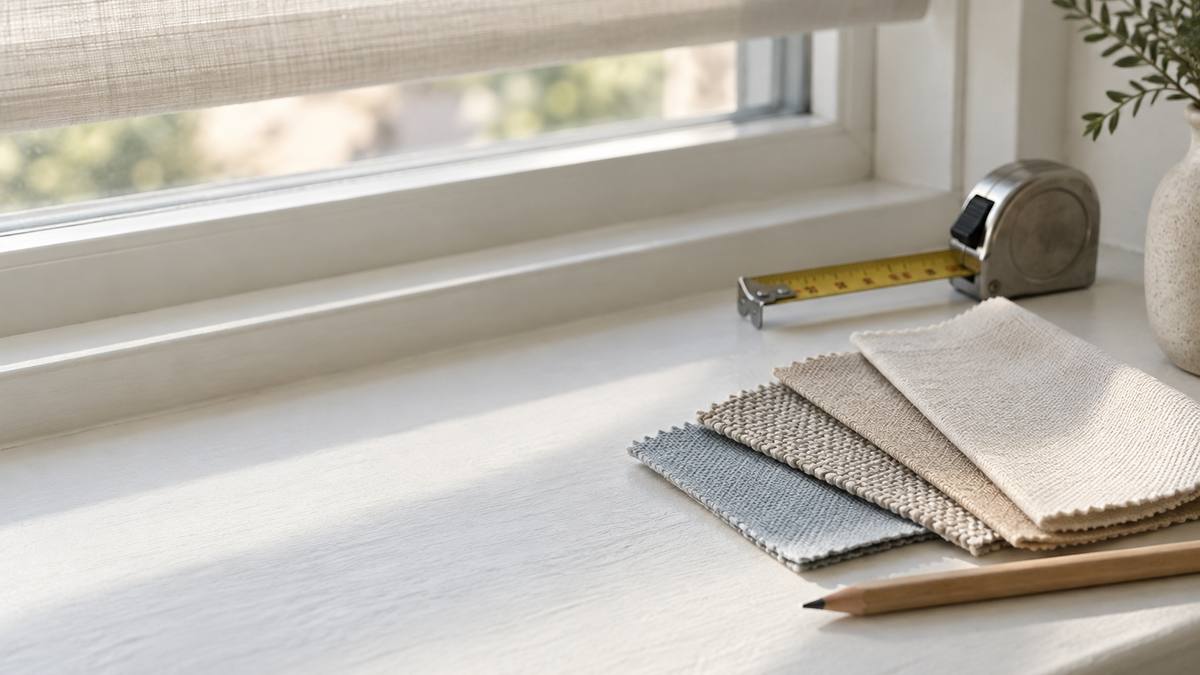
Sellers usually group fabrics by opacity: sheer, light filtering, solar or blackout. Some roller systems carry two fabrics on one bracket, so you can have a sheer by day and a blackout at night. Screen colors are unreliable, so order swatches and look at them in the room, at different times of day.
5. Choose a lift system with child safety in mind
Under the WCMA’s revised standard, ANSI/WCMA A100.1-2022, custom products made from 1 June 2024 can no longer have free-hanging operating cords, free-hanging tilt cords, or multiple cords running into one connector. The industry’s summary of the 2022 standard says it also bans continuous cord loops and bead chains on custom horizontal slatted products. Continuous-loop systems are still allowed on some other custom categories if they have improved tension devices. The U.S. Consumer Product Safety Commission is clear: its window covering cords page calls cordless coverings the only option that eliminates the strangulation hazard. It advises buyers shopping online to look for products described as cordless. The WCMA also runs a Best for Kids certification for products that pass third-party lab testing. If you’re childproofing a nursery, our guide to the dresser tip-over rule covers another hazard worth checking.
Your choices are usually cordless (lift the bottom rail by hand), a tensioned continuous loop, or motorized, which puts no cord within reach and helps on tall windows.
Lead times, returns and warranties: read these before you pay
Made-to-measure means made after you order. The FTC’s Mail, Internet, or Telephone Order Merchandise Rule requires sellers to have a reasonable basis for the shipping times they advertise. If they don’t state a time, the limit is 30 days. If an order is going to be late, the seller must get your consent to the delay or refund you for what hasn’t shipped.
Many sellers don’t take returns on made-to-measure goods. The policies we read:
| Seller | Returns on custom shades | Warranty terms published |
|---|---|---|
| Cityshade | Does not accept returns of custom-made window treatments as a general guideline; contact customer care on receipt for manufacturing errors, mix-ups or transit damage | Defects in materials and workmanship; cords and beaded chains 1 year; motors and motorization accessories 5 years |
| The Shade Store | No returns, because of the custom nature of its products | Limited lifetime; cords and chains 7 years; motorization 5 years |
| Blinds.com | No refunds; one free replacement of equal value within 30 days of delivery under its satisfaction guarantee, with exclusions | Warranty not reviewed for this article; measuring errors are excluded from the satisfaction guarantee and handled under a separate program |
The Shade Store’s guarantee and warranty page excludes fading from sun exposure and damage from installation by anyone other than its own professionals. Blinds.com’s replacement guarantee excludes draperies, certain cordless lines and commercial orders.
One example: how Cityshade handles the process
Cityshade is a family-run manufacturer in Boynton Beach, Florida. It sells roller, zebra, honeycomb and Roman shades, plus blinds and drapery, directly online. The company’s printable measuring and installation guides are split by product, with separate PDFs for roller, zebra, Roman and honeycomb shades, and it offers phone help with measuring. As of 7 October 2026, its roller shades came in cordless, corded and motorized versions in blackout, light filtering, solar, sheer and natural weave fabrics, plus a dual-roller Day & Night option. Its honeycomb shades came in blackout and light filtering.
The swatch page offers up to 10 free swatches for a $9.95 shipping charge, with a stated lead time of 5 to 7 days, and $2 for each swatch after the first 10. According to its FAQ, the company charges your card when you place the order, quotes a production lead time of one to four weeks depending on the product, and sells only in the 48 contiguous states. The FAQ calls the warranty “limited lifetime”, but the warranty page itself spells out shorter terms for cords and motors. If coverage length matters, ask the company to confirm it in writing.
A final checklist before checkout
- Mount type chosen and window depth checked against the product’s minimum.
- Every window measured separately, using that seller’s own instructions and rounding rules.
- No deductions of your own, unless the seller’s guide asks for them.
- Swatches viewed in the room, in daylight and in the evening.
- A cordless or motorized lift if young children live in or visit the home.
- Lead time, returns policy and warranty read and saved.
Policies change, so check them on the day you order. If something here has since changed, our corrections policy explains how to let us know.