

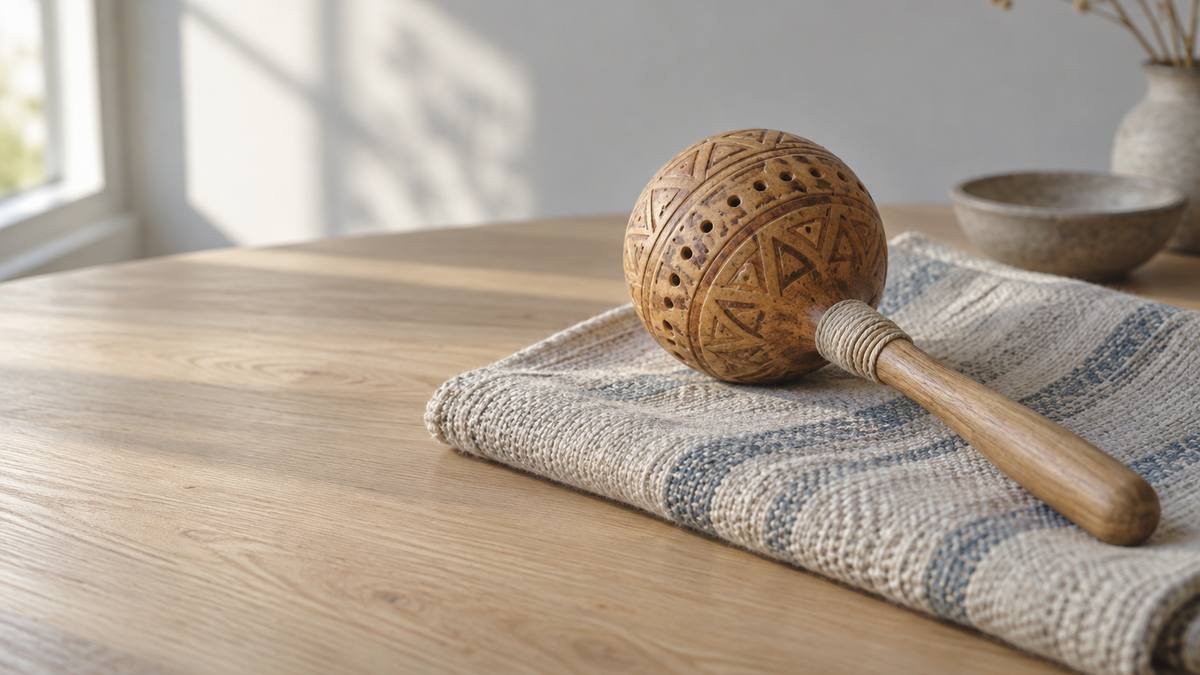
A handmade rattle, drum or beaded piece carries a story about who made it and where. Here is how to check that story before you buy, using the questions, directories and federal rules that are actually available to shoppers.
Some brands we cover are clients of our publisher. What we recommend is decided by our editors, and prices are read on the date noted in each article. Our standards.
Quick take: Researching the provenance of a ceremonial craft comes down to four checks. Ask for the maker or community by name and in writing. Look the seller up in an independent fair trade directory instead of relying on the phrase “fair trade.” Know which laws apply: in the U.S., “Indian-made” claims fall under the Indian Arts and Crafts Act, and feathers and some other animal materials are regulated by wildlife law. Finally, consider whether the object is something its community would want sold at all.
If you are wondering how to research the provenance of ceremonial crafts, you are really checking three claims a listing makes: who made the piece, how they were paid, and whether the materials and the sale itself are legal and appropriate. “Provenance” just means the documented history of an object, starting with where and by whom it was made. For a new rattle or textile that history is short, but it is often the hardest part to confirm. All facts, prices and specs below were read on 12 October 2026.
How to research the provenance of ceremonial crafts: start with the seller
Begin with what the seller will say in writing. The U.S. Department of the Interior’s Indian Arts and Crafts Board gives buyers a short list in its consumer tips for buying Native art. It advises asking for written verification of authenticity and a receipt that lists the price, the maker and the maker’s tribal affiliation. The guidance was written for American Indian and Alaska Native work, but the habits apply anywhere.
Questions to ask before you pay
- Who made it? A person’s name, or at least a named cooperative. “Made by artisans” tells you little.
- Which community? A region isn’t a community; a people, village or association is.
- How and when are makers paid? Per piece, a negotiated price, through a middleman, any advance before production?
- Who verified the seller? If the answer is “we’re fair trade,” ask which organization says so.
- What is it made of? Some plant and animal materials carry legal restrictions.
- Was it made for sale or used in ceremony? Those are different things.
Vague answers don’t prove anything is wrong. They just leave you with less to go on.
How to check “fair trade” claims
In everyday marketing, “fair trade” is a phrase any business can use about itself; membership organizations are where you can check it. The Fair Trade Federation runs a searchable directory of verified handmade brands. Listings show each brand’s source regions and product categories, including musical instruments. The federation’s published principles commit verified brands to being transparent about their supply chains and to pricing based on the true cost of labor, time, materials and skill.
The World Fair Trade Organization does the same job internationally. Its ten principles of fair trade describe fair payment as mutually negotiated, transparent and aimed at a local living wage. WFTO says it verifies and monitors members against them, and offers a member search by country and technique.
Some retailers publish the mechanics, too. Ten Thousand Villages, a fair trade retailer selling since 1946, says on its fair trade practices page that it pays artisan enterprises 50% of the purchase price before production begins. That is the kind of specific statement worth looking for. Buying directly from makers is another route: the Cultural Survival Bazaars, run by the Indigenous-led rights group Cultural Survival, let Indigenous artists and cooperatives sell their own work, with Boston and Providence events listed for December 2026.
The Indian Arts and Crafts Act: when “Indian-made” is a legal claim
In the United States, some origin claims are regulated. The Indian Arts and Crafts Act of 1990 is a truth-in-advertising law. It bars selling an art or craft product in a way that falsely suggests it is Indian-produced or the work of a particular tribe. It defines an Indian as a member of a federally or officially state-recognized tribe of the United States, or an artisan certified by a tribe. It covers Indian and Indian-style work produced after 1934. A first violation can bring penalties of up to $250,000 or five years in prison for an individual, and fines of up to $1,000,000 for a business.
Two details matter for shoppers. First, the IACB notes that work made by non-Indians can legally be sold with qualified labels such as “Native American style”. The same page explains how to report a suspected violation. Second, the act’s definitions are tied to U.S. tribes, so crafts from Amazonian, Andean or other communities abroad fall outside them. For those, the seller’s documentation is what you have to go on.
Materials: feathers and wildlife law
Material questions can turn a provenance check into a legal one. Under the Migratory Bird Treaty Act, it is illegal to kill, capture, sell, trade or transport protected migratory bird species without authorization from the U.S. Fish and Wildlife Service. Since a 2004 amendment it applies to species native to the U.S. and its territories. The Bald and Golden Eagle Protection Act bars selling, buying or possessing bald or golden eagles or their parts, explicitly including feathers, without a permit. A first offense can bring a fine of up to $100,000 ($200,000 for organizations), a year in prison, or both. Enrolled members of federally recognized tribes receive eagle feathers through the agency’s National Eagle Repository, so eagle feathers on a retail object are a serious red flag.
For materials that cross borders, CITES, the international wildlife trade treaty, requires a permit to import or export a listed species, whether it is a live specimen, a part or a product. That applies even to personal-use items. If a listing names an exotic animal material, ask for the species and import paperwork, or choose feather-free pieces.
Sacred objects and cultural respect
Some objects aren’t meant to be sold. The Native American Graves Protection and Repatriation Act covers sacred objects and objects of cultural patrimony, and its criminal provision makes it a federal offense to knowingly sell or buy Native American cultural items obtained in violation of the act, according to the National Park Service. An “antique” ceremonial object with no clear ownership history is the riskiest kind of purchase.
For new work, the practical test is whether the community makes the item for outside buyers, and whether you can buy from the artists or from a seller who names them. When a listing describes ceremonial use, treat that as the seller’s description, not an invitation to copy a practice you weren’t taught.
A worked example: reading one listing
Here is how the checklist applies to a real listing. Tribu Spirit, an online retailer that lists a Miami, Florida address, sells a small Shipibo carved gourd rattle for $80. On 12 October, the Jaguar, Hummingbird and Frog versions were all listed as available. The listing says it is hand-carved and made by the Shipibo, and names the materials: a natural gourd head 2½ inches tall, a Palo Sangre wood handle, clear quartz or tiger’s eye, Shipibo beadwork and silver accents. No feathers or animal parts are listed, so the wildlife questions above don’t come up.
What the listing doesn’t give is an individual maker or a named cooperative. On its About page, Tribu Spirit says it sources directly from Amazonian tribes through personal relationships, and that it practices fair trade by paying “above average prices.” Those are the company’s own claims; the page doesn’t name an outside verifying organization. A careful buyer would ask, in writing, for the artisan’s or community’s name and how makers are paid, as with any seller. Because the listing places the Shipibo in the Amazon rather than the United States, the Indian Arts and Crafts Act’s definitions don’t apply.
If sound objects interest you more broadly, our earlier explainer on what crystal singing bowl prices actually reflect covers a different kind of instrument.
The short version
Ask who made it and get the answer in writing. Check fair trade claims against the Fair Trade Federation or WFTO directories. Read “Native American” labels with the Indian Arts and Crafts Act in mind. Skip pieces with eagle or wild-bird feathers or undocumented animal materials. Treat old ceremonial objects with no clear history as off-limits. It takes a few questions and a seller willing to answer them.
Read more about how we choose what to cover. If you spot an error in this article, our corrections policy explains how to report it.