
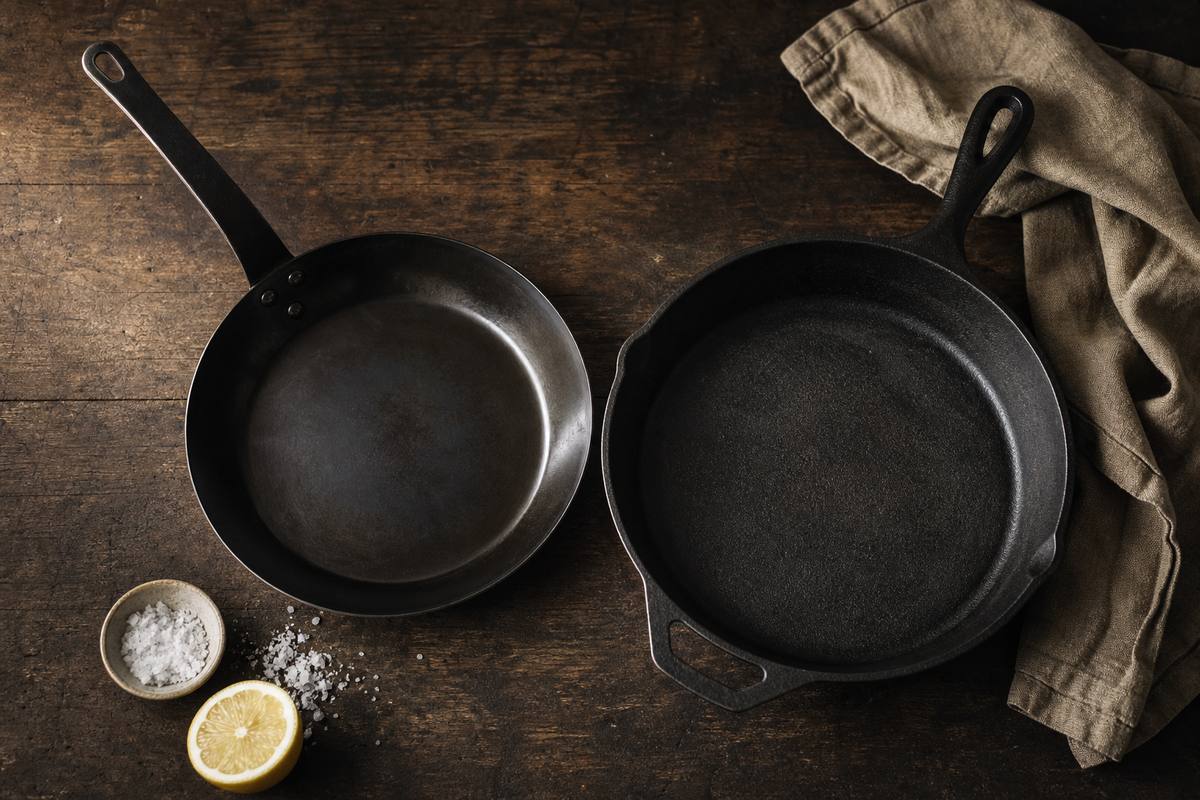
One pan heats fast and forgives nothing. The other holds heat forever and weighs like it. Here is how to tell which one you will actually cook with — and what the $12.95 pan does just as well as the $325 one.
Some brands we cover are clients of our publisher. What we recommend is decided by our editors, and prices are read on the date noted in each article. Our standards.
Quick take
If you want one pan that does the most things with the least thought, buy cast iron — and buy it cheap. A Lodge Classic 10.25-inch is $29.95 and cooks the same food as the $180 version. If you cook eggs, fish, crêpes or anything that needs the heat to change when you change the burner, buy carbon steel instead: the Matfer Bourgeat 10-inch at $73 is what professional kitchens use, and the Appalachian 10-inch at $169 is the one to buy if you want a pan made by a person rather than a press. Nonstick is not the third option here. Seasoning is.
Carbon steel and cast iron are the same material argument having two different conversations. Both are iron. Both rely on a polymerised oil layer — seasoning — rather than a synthetic coating. Both will outlive you if you do almost nothing right. And yet in a kitchen they behave differently enough that owning the wrong one is the most common reason people give up on iron cookware entirely and go back to a pan they will replace in three years.
The difference is not quality. It is thermal mass. Cast iron is poured thick, so it takes a long time to get hot and then refuses to cool down. Carbon steel is pressed or forged thin, so it heats in a couple of minutes and responds when you move the dial. That single physical fact decides everything else: what each pan is good at, how heavy it is, how much it costs to make, and which one belongs on your stove.
Every price in this guide was read off the brand’s own live product page on 3 September 2026. Cookware prices in this category are unusually stable, but variant pricing by size is not — check the size you actually want before you buy.
How we chose
We have not cooked a hundred steaks in these pans and we are not going to pretend otherwise. This is an editorial selection built from published specifications, stated materials, construction details, warranty terms and current price, read directly off each manufacturer’s own pages and cross-checked between them. Where a weight, a diameter or a warranty appears below, the brand publishes it. Where a brand does not publish it, we say so rather than fill the gap. Our approach is described in How We Choose.
Four things did the filtering:
- The pan is bare iron, seasoned, with no synthetic coating. That rules out every pan whose non-stick properties come from a factory-applied polymer, because those are consumables and these are not.
- Construction is documented. Cast or forged or pressed, riveted or welded, polished or as-cast. These are the details that determine how a pan cooks and how it ages, and brands that stay vague about them usually have a reason.
- Price is honest for what it is. A $30 pan and a $215 pan can cook identically; we will say when the premium buys finish and provenance rather than performance.
- Something stands behind it. A stated lifetime guarantee on a pan is close to free for the manufacturer — iron rarely fails — but it tells you the company expects to still exist.
The quick list
- Lodge Classic Cast Iron Skillet — Best First Pan ($12.95–$59.95)
- Matfer Bourgeat Black Carbon Steel Frying Pan — Best Carbon Steel, Full Stop ($63–$185)
- Appalachian Cast Iron 10-Inch Carbon Steel Standard Skillet — Best Made-By-Hand Carbon Steel ($169.00)
- de Buyer Mineral B Fry Pan — Best for High-Heat Searing ($75–$165)
- Lodge Carbon Steel Skillet — Cheapest Way Into Carbon Steel ($39.95–$49.95)
- Lodge Blacklock Lightweight Skillet — Best Light Cast Iron ($40–$80)
- Field Company No.10 Cast Iron Skillet — Best Smooth-Finish Cast Iron ($215.00)
- Smithey Ironware No. 10 Cast Iron Skillet — The One You Give As A Gift ($180.00)
Carbon steel or cast iron: pick by what you cook
Ignore the brand arguments for a moment. Answer this instead.
Buy cast iron if your cooking is mostly things that want steady, unwavering heat: a thick steak, cornbread, a shallow braise, roast chicken thighs, anything that starts on the stove and finishes in the oven. Cast iron’s thermal mass means a cold ribeye lands in the pan and the pan barely notices. It is also the more forgiving pan to own — thicker walls tolerate abuse, overheating, and years of indifferent maintenance.
Buy carbon steel if your cooking involves anything you need to control: eggs, fish fillets, crêpes, a quick pan sauce, vegetables you want browned and not stewed. A carbon steel pan is thin, so it gets to temperature in a fraction of the time and — crucially — cools when you pull it off the flame. Matfer Bourgeat publishes the numbers that make this concrete: its 10-inch pan is a single pressed piece of high-carbon steel, 2 inches deep, with a 7¼-inch cooking surface, and it weighs 3 pounds 11 ounces. Smithey’s cast iron No. 10, a smaller pan by cooking surface, weighs about 5½ pounds. The lighter pan is not the cheaper pan or the worse pan. It is a different tool.
There is also the handle question, which nobody mentions until they own the pan. Carbon steel pans usually have a long, steeply angled handle designed for tossing food, and it stays cooler than the pan because there is less metal feeding it heat. Cast iron handles are short, integral, and become exactly as hot as the pan. If you like to move food by flicking a pan rather than stirring it, that alone may settle this.
What both share is the part people fear and shouldn’t. Seasoning is not a ritual, it is a habit: cook with fat, avoid boiling acidic liquids in it for an hour, dry it after washing. Neither pan needs to be babied and neither needs to be stripped and re-seasoned on a schedule. Every carbon steel maker we looked at — Appalachian, de Buyer, Matfer, Smithey — describes the same mechanism in the same terms, because it is the same mechanism.
The recommendations
Best First Pan
Lodge Classic Cast Iron Skillet
This is the pan almost everyone should own first, and the fact that it is the cheapest thing here is not a compromise. Lodge sells the Classic in nine sizes, from a 3.5-inch novelty at $12.95 to a 15-inch at $59.95, with the two most useful sizes — 10.25-inch and 12-inch — at $29.95 and $36.95. It arrives pre-seasoned from the foundry, made without PFAS, and it will cook a steak indistinguishably from a pan costing six times as much.
What you do not get is finish. The cooking surface is as-cast and slightly pebbled rather than machined smooth, which matters less than the internet insists — a few months of cooking fills it in. Buy the 10.25-inch, use it for a season, and only then decide whether you have opinions worth spending $180 on.
- Good: Costs less than a decent lunch, pre-seasoned, nine sizes, effectively unkillable
- Less good: Rough as-cast surface, heavy, plain looking
Best Carbon Steel, Full Stop
Matfer Bourgeat Black Carbon Steel Frying Pan
If you want to know what carbon steel is for, buy this pan. Matfer’s black steel range is the default in a great many professional kitchens, and the reason is a construction detail: the pan is stamped from a single piece of high-carbon steel and the handle is welded rather than riveted. No rivets means nothing on the interior for food to catch on and nothing to work loose in twenty years. The company states a limited lifetime warranty, and it publishes a full weight-and-dimension table by SKU — the 10-inch is 3 pounds 11 ounces with a 7¼-inch cooking surface.
Pricing runs from $63 for the 8½-inch to $185 for a 17¾-inch pan you probably cannot lift when full; $73 buys the 10-inch, which is the one to get. It arrives unseasoned and needs a first seasoning before use, which takes twenty minutes and puts some people off. It shouldn’t.
- Good: Rivet-free welded handle, stated limited lifetime warranty, published specs, professional-standard pricing
- Less good: Ships unseasoned, plain finish, long handle needs drawer space
Best Made-By-Hand Carbon Steel
Appalachian Cast Iron 10-Inch Carbon Steel Standard Skillet
Appalachian Cast Iron is a small, veteran-owned shop in Johnson City, Tennessee, and its carbon steel skillets are the closest thing in this guide to a pan made rather than manufactured. The 10-inch has a 7-inch cooking surface, steel rivets instead of the brass ones a lot of boutique makers use, and — the detail that gives away who made it — a deliberately mild ground surface texture, left rough enough for seasoning to key into instead of polished to a mirror.
At $169 it sits between the professional-standard pans and the American boutique cast iron, and what the premium buys is provenance and the option to have the thing personalised with a maker’s mark. The 8-inch at $129 is the better buy if eggs are the reason you are here; its 5-inch cooking surface is exactly one omelette wide. One honest note: Appalachian does not publish gauge, weight or warranty terms on its product pages, so we are not going to quote any. If those matter to your decision, ask before you order.
- Good: Made by hand in Tennessee, steel rivets, seasoning-friendly ground surface, personalisation available
- Less good: No published thickness, weight or warranty; considerably more than a functionally equivalent Matfer
Best for High-Heat Searing
de Buyer MINERAL B Classic Carbon Steel Fry Pan
The French answer to the same question, and the pan most home cooks meet first because it is the one kitchen shops stock. de Buyer describes the material precisely — 99 percent iron, one percent carbon, no synthetic coating — and builds Mineral B with noticeably flared walls and a heavy iron handle that is happier in an oven than on a wrist. The brand’s own positioning is searing: fast, hard heat and a proper Maillard crust.
Sizes run $75 for the 8-inch to $165 for the 14-inch, with the 10.25-inch at $105. That is $30 more than the equivalent Matfer for a pan that cooks the same, so buy it because you prefer the shape and the handle, not because it is better. de Buyer does not publish thickness or weight on this page either.
- Good: Precise material disclosure, excellent for searing, widely stocked so you can hold one first
- Less good: Pricier than the professional benchmark, heavy handle, no published thickness or weight
Cheapest Way Into Carbon Steel
Lodge Carbon Steel Skillet
Lodge makes a carbon steel line as well, and almost nobody knows it. The 8-inch is $39.95, the 10-inch $44.95 and the 12-inch $49.95, and unlike most carbon steel it arrives pre-seasoned and ready to use. Lodge’s own copy leans on “thin, lightweight design,” which is the whole point of the material.
If you are carbon-steel-curious but unwilling to spend three figures to find out whether you like a thin iron pan, this is the entry ticket. It is not the pan you will still be using in 2060 — the finish and the handle are not at Matfer’s level — but $44.95 is a cheap way to learn which camp you are in.
- Good: Pre-seasoned, genuinely inexpensive, easy to find
- Less good: Basic handle and finish, less refined than pans costing $30 more
Best Light Cast Iron
Lodge Blacklock Lightweight Skillet
The most useful pan in this guide for anyone who wants cast iron but finds cast iron too heavy. Blacklock is Lodge’s thinner, lighter cast line — $40 for the 7-inch, $60 for the 10.25-inch, $80 for the 12-inch — and it splits the difference between the two materials more honestly than any hybrid marketing claim.
You give up some thermal mass, which means it will not hold a sear quite as ferociously as the Classic. You gain a pan you will lift out of the cupboard without thinking about it, which is the only performance metric that matters over ten years.
- Good: Meaningfully lighter cast iron, nicer finish than Classic, still under $100
- Less good: Less heat retention than thick cast iron, twice the price of the Classic
Best Smooth-Finish Cast Iron
Field Company No.10 Cast Iron Skillet
Field’s pitch is that modern cast iron got too thick and too rough, and that vintage American pans were better because they were neither. The No.10 — 11⅝ inches — is cast with thinner sidewalls than the mass-market standard and arrives with a polished, pre-seasoned cooking surface, no PFOA, PTFE or synthetic coatings, made in the USA and, in the company’s words, guaranteed for life.
It is a genuinely lovely object and it costs $215, which is seven Lodge Classics. Buy it if the smooth surface and the lighter pour matter to you enough to pay for them; do not buy it expecting food to taste different. Field does not publish a weight for this size.
- Good: Polished surface, thinner walls, US-made, lifetime guarantee
- Less good: Very expensive for cast iron, no published weight, cooks like a $30 pan
The One You Give As A Gift
Smithey Ironware No. 10 Cast Iron Skillet
Smithey publishes the numbers most premium makers leave out, which we appreciate: 10-inch diameter, 1.9 inches deep, 16.5 inches handle to handle, a 9-inch cooking surface and roughly 5½ pounds. It is polished inside, has pour spouts on both sides and a helper handle, and it is made in Charleston, South Carolina. As a wedding present it is close to unbeatable.
Smithey also makes the most expensive pan in this guide, a hand-forged carbon steel Deep Farmhouse Skillet at $325 — 12 inches across with 2-inch sidewalls, about 6 pounds. It is beautiful and it is a lot of money for a pan whose functional twin costs $73. Worth noting from Smithey’s own specs: the bigger carbon steel pan weighs only half a pound more than the smaller cast iron one, which is the clearest illustration of the density difference you will find anywhere.
- Good: Fully published specs, polished interior, two pour spouts, US-made, superb gift
- Less good: $180 for cast-iron performance you can buy for $30; carbon steel line is dearer still
What we would actually buy
Two pans cover almost every home kitchen, and together they cost about $75. A Lodge Classic 10.25-inch at $29.95 for anything that wants heavy, patient heat, and a Matfer Bourgeat 10-inch at $73 for everything that wants control. Nothing above those two prices buys better cooking; it buys finish, weight, provenance and, in the case of the small American makers, the fact that a person you could email made your pan. Those are legitimate reasons to spend more. “It cooks better” is not one of them.
If you are buying a single pan and you do not want to think about it again, make it cast iron. If you already own cast iron and something still isn’t working — eggs stick, fish tears, sauces break — the problem is not your technique. It is that you are asking a thick pan to be a responsive one, and no amount of seasoning will fix that. Buy the thin one.