
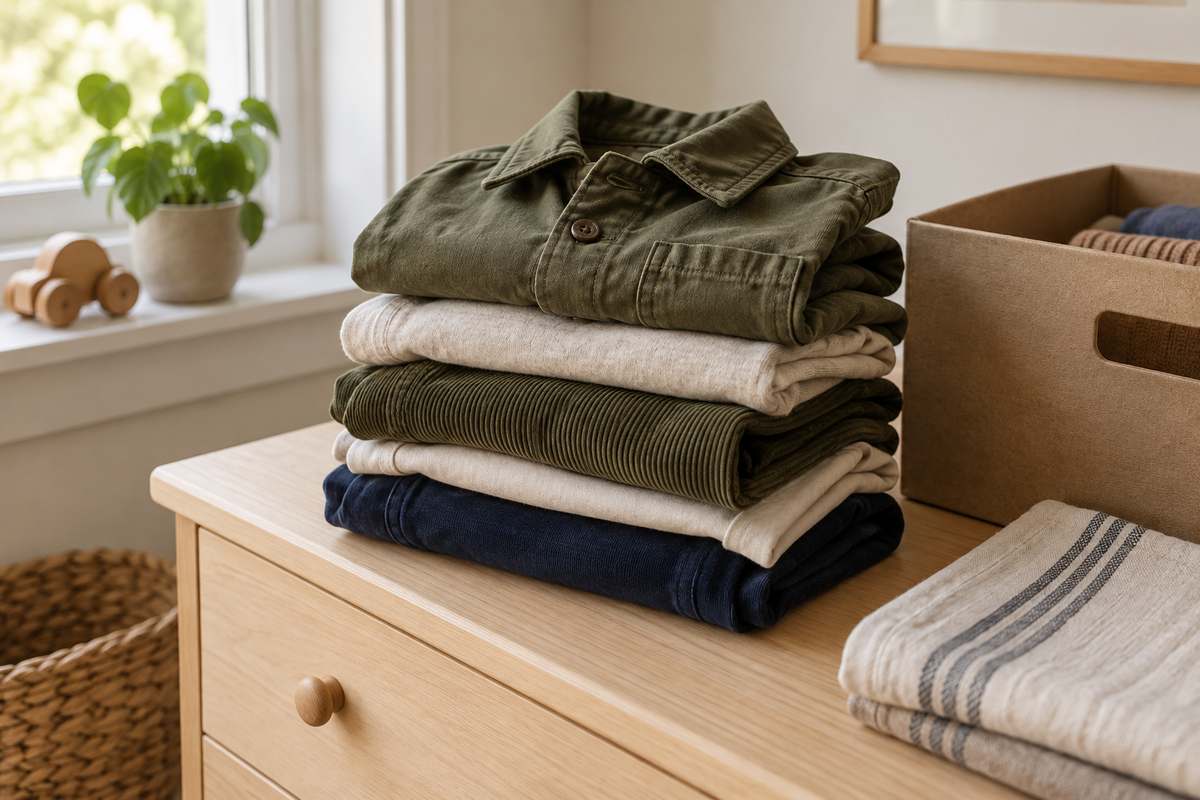
Hand-me-downs are the cheapest sustainability strategy in parenting, and most children’s clothes are not built for the trip. Here are nine pieces that hold their shape through a second child — with every price and fabric detail read off the brand’s own live page on 17 September 2026.
Some brands we cover are clients of our publisher. What we recommend is decided by our editors, and prices are read on the date noted in each article. Our standards.
The quick take
- Fibre content decides the handoff. Woven cotton twill, corduroy and heavy rib knits move to a second child intact. Fine bamboo-viscose jersey is lovely on a newborn and rarely survives two toddlers.
- Buy the boring colour in the bigger size. Solid olive, navy and oatmeal work on any sibling; a name-embroidered jacket works on exactly one.
- Reinforced knees are the single best value feature in this category, and almost nobody prices them as a premium.
- Resale is part of the maths now. Boutique labels with a secondhand market cost more up front and less per wear — the preloved shelf at New York children’s shop CouCou was carrying 73 listings when we looked today, most of them $36–$40.
- Cheapest per wear on this list: a five-piece bodysuit-and-pant set at $34.95. Most expensive: a $59.99 embroidered overall that will photograph well on two children.
Why most children’s clothes fail the second child
Nothing about a hand-me-down is complicated. A garment gets worn for nine months, washed maybe sixty times, outgrown, folded into a bin, and pulled out two years later for the next kid. The failures are predictable, and they are almost always the same three: the knees go, the neckline stretches, or the print cracks.
Knees go because most children’s bottoms are a single layer of jersey. Necklines stretch because a thin rib collar with no stabilising tape has nothing holding it in shape after the fiftieth over-the-head pull. Prints crack because plastisol sits on top of the fabric rather than in it, and every wash cycle flexes it a little more. None of that is a manufacturing defect; it is what the price point buys, and it is why a bin of two-year-old clothes so often turns out to be a bin of pyjamas and one good coat.
The pieces that do survive share a short list of traits: a woven or heavyweight knit fabric, a little elastane for recovery rather than a lot for stretch, mechanical closures that can be replaced, and colours that are not tied to one child’s particular year. Everything below was chosen against that list.
Editors’ note: We did not put these garments through a wash-test lab, and we are not going to pretend otherwise. What follows is a read of published fibre content, construction details and current pricing, plus the failure patterns any parent recognises from a hand-me-down bin. Where a fabric is a poor bet for a second child we say so — including in one pick we still recommend. Sizes sell through quickly in this category, so stock noted today may not hold.
How we chose
We started with fibre content and construction rather than brand reputation. Anything whose product page would not disclose fabric composition was dropped. We prioritised woven twill, corduroy, french terry and heavy rib over lightweight single jersey; reinforced knees and functional drawstrings over decorative details; and solids or small repeating prints over placement graphics. We also checked today that each piece was in stock in more than one size, because a recommendation you cannot buy is not a recommendation. Prices are US dollars from each brand’s own storefront; two boutique European labels we considered were dropped because their direct sites price in euros and the conversion would have made the comparison dishonest. More on how we choose and how we test.
- Best boutique pant: Misha & Puff Baby Gus Pant at CouCou — $58
- Best plain tee: Primary kids long sleeve hedgehog tee — $24.50
- Best everyday pant: Colored Organics Grover Twill Pant — $45
- Best reinforced knees: Tea Collection Playwear Jeggings — $45
- Best layer: Colored Organics Denver Twill Chore Jacket — $58
- Best photograph-twice piece: Jamie Kay Blair Overall — $59.99
- Best value multipack: Burt’s Bees Baby Limestone five-piece set — $34.95
- Best corduroy: Nature Baby Teddy Cord Pants — $42
- Softest, with a caveat: Kyte Baby Toddler Basic Tee — $22
The picks
1. Misha & Puff Baby Gus Pant at CouCou — $58
Boutique labels are where the hand-me-down maths gets interesting, because they hold resale value in a way mass-market basics do not. This is a roomy pull-on pant in organic Pima cotton with a gathered elastic waistband and cuffed hems, listed at $58 in the Onsen Circus print at CouCou, the New York children’s boutique that also carries Emile et Ida, Konges Sløjd, Hello Simone and Soor Ploom. Sizes 0–3m through 12–18m were all in stock today.
Two things make it a handoff piece. A gathered waist and cuffed leg stretch across a wider size range than a fitted pant, so the same pair carries a smaller sibling for a season longer; and the brand’s own sizing note suggests going up a size for longer wear, which is the correct instinct here. Pima cotton is a long-staple fibre, so it pills less than the short-staple cotton in cheaper knits — the practical reason a $58 pant can be worth more than three $20 ones.
2. Primary kids long sleeve hedgehog tee — $24.50
Primary built its whole catalogue on a refusal to print slogans, which happens to be the most handoff-friendly design decision on this list: a tee with no words on it fits whichever child comes next. This one is cotton slub, and the small hedgehog motif is the sort of quiet graphic that does not date. Slub cotton has a slightly irregular surface, so the wear it picks up reads as texture rather than damage.
The catch is that single-layer cotton tees are consumables no matter who makes them; buy two, expect the second child to get one. At $24.50 that is a reasonable trade.
3. Colored Organics Grover Twill Pant — $45
This is the pattern you want in a pant that gets handed down: organic cotton twill with a small percentage of elastane, an elastic waistband and real pockets. Twill is a woven fabric, so it abrades rather than pills, and the touch of elastane is there for recovery — enough that the knees do not bag out permanently, not so much that the fabric goes slack after a year.
The size logic helps a second child too: infant sizes use a faux tie and toddler sizes a functional drawstring, so the same pant can be cinched onto a narrower kid than the one it was bought for. Olive was $45 with every size from 3–6m upward available today.
4. Tea Collection Playwear Jeggings — $45
Reinforced knees are the cheat code of this category, and Tea Collection’s Playwear line is one of the few places the feature is stated outright on the product page. The jeggings are a cotton-rich stretch knit with a pull-on elastic waist, built as the stretchier sibling of the brand’s Playwear Pants, and all eleven listed sizes were in stock today at $45.
Knees are where roughly every toddler bottom fails first, so a second layer of fabric there is the difference between a pant that gets handed down and a pant that becomes a shorts conversion.
5. Colored Organics Denver Twill Chore Jacket — $58
Chore jackets are unstructured, unlined and boxy, which is exactly why they survive a handoff: there is no tailoring to outgrow and no lining to shred. This one uses the same organic cotton twill as the Grover pant, with a classic collar, roomy patch pockets and snap closures. Unlined construction keeps it light enough to layer in autumn and easy to wash without reshaping.
Snaps are also repairable in a way that a broken separating zip on a $58 jacket is not. Olive was $58 today, in sizes 6–12m through the toddler range.
6. Jamie Kay Blair Overall — $59.99
Every family has one of these: the outfit that shows up in the photographs. Jamie Kay’s Blair Overall is cotton with all-over floral embroidery on a denim-look base, and overalls are structurally forgiving — adjustable straps mean one pair fits a broad height range, and the bib takes the abuse that would otherwise land on a shirt. It was $59.99 today with sizes 6–12m through 5Y available.
Embroidery is also a better long-run bet than a printed graphic: thread does not crack the way plastisol does.
7. Burt’s Bees Baby Limestone bodysuit & pant five-piece set — $34.95
For the first year the correct strategy is volume in neutral colours, and this is the cheapest honest way to get it: five mix-and-match pieces in organic cotton, in a neutral limestone palette, for $34.95. The lap-shoulder neckline matters more than it sounds — that envelope opening is why a bodysuit can be pulled down rather than over a head, which is what saves the collar.
Rib knit in a neutral also hides the staining that ends most baby clothes’ careers before a seam ever fails. Expect the pants to outlive the bodysuits.
8. Nature Baby Teddy Cord Pants — $42
Corduroy is underrated for handoffs. It is a woven cotton with a cut pile, so it wears at the ridges rather than thinning all at once, and it hides scuffing that would show on flat twill. These are GOTS certified organic cotton corduroy with a soft elastic back waistband, a decorative front tie, front pockets, a straight leg and folded cuffs at the hem — and those folded cuffs are a full extra size of growth if you let them down.
Pinecone and navy were both $42 today, in sizes 6–12m through 5Y. The one caution with cord is the wash: turn it inside out and skip high heat, or the pile flattens and the fabric loses the depth that makes it look good on a second child.
9. Kyte Baby Toddler Basic Tee — $22
Included with a caveat, because it is the clearest example of the trade-off in this whole category. The tee is rayon made from bamboo with a little spandex, crew neck, short sleeve, $22 in most sizes and $24 at 5T — genuinely the softest, most breathable thing on this list, and the one a child with sensitive skin will actually keep on.
But bamboo-derived rayon is a regenerated cellulose fibre with a relatively short staple length. It pills, it thins at friction points, and it loses opacity faster than cotton does. Buy it for the child who needs it now; do not plan the second kid’s wardrobe around it. Sleep bags and pyjamas from the same brand, which see far less abrasion, are the better handoff bet.
Making the handoff actually work
Storage does as much damage as wear. Clothes packed away damp or still carrying body oils develop the brown oxidation spots that show up two years later on a white bodysuit, and nothing takes those out reliably. Wash before storing, dry completely, and skip the fabric softener, which leaves a residue that traps odour in synthetics and coats cotton fibres.
Label bins by size rather than by child, and photograph the contents before the lid goes on. The most common failure in the hand-me-down system is not a garment wearing out; it is a family buying a size they already own because nobody could remember what was in the attic.
Buy for the second child at the point of purchase, not later. That means the larger of two sizes when a piece is cut generously, cuffs and drawstrings over fixed hems, and colours that are not attached to one kid’s identity. It also means resisting the monogram, however good it looks in the photograph.
And be honest about the exit point. Everything eventually stops being handed down, and the question is whether it is worth reselling, worth donating, or worth cutting into rags. Woven twill, corduroy and boutique knits tend to clear the first bar; five-packs of bodysuits almost never do, and that is fine — that is what they were for.
Prices in this article were read on 17 September 2026 and change often, particularly on seasonal colourways. If we have got something wrong, our corrections policy explains how we fix it, and our affiliate disclosure covers how this publication makes money.