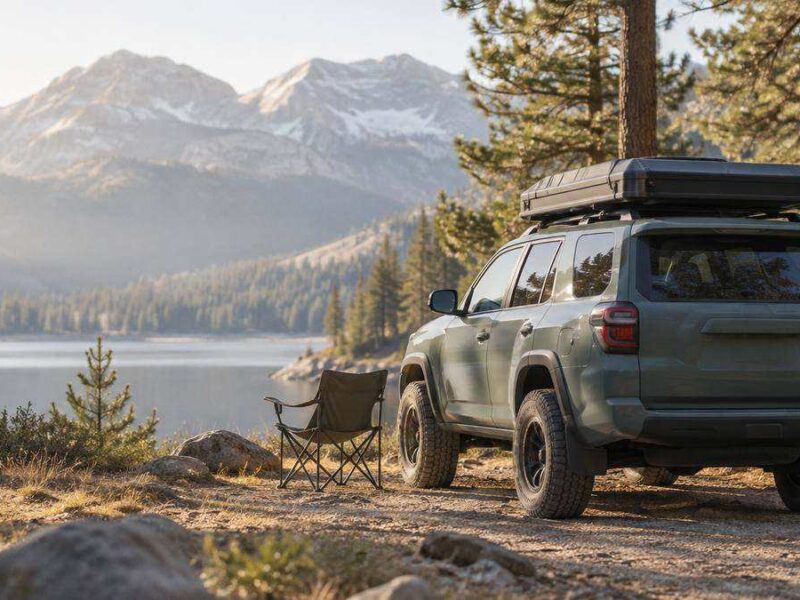

Every rooftop tent shopping guide leads with sleeping capacity. The number that actually decides what you can buy is weight — yours, your rack’s, and your roof’s. We read the published specs for nine tents on September 21, 2026, sorted them lightest to heaviest, and flagged every place a brand and its retailer disagree.
Some brands we cover are clients of our publisher. What we recommend is decided by our editors, and prices are read on the date noted in each article. Our standards.
The quick take: A tent’s dry weight is the spec that eliminates options, because your vehicle’s dynamic roof load — the limit while you’re driving — is usually the smallest number in the whole system. Plenty of crossovers and unibody SUVs are rated near 150 lbs. That rules out most hardshells before you get to color choices. Lightest published weight in this round-up: 90 lbs. Heaviest: 184 lbs. And in three cases the manufacturer and the retailer publish different weights for the same tent, which is exactly why you should read both pages before you order.
Why weight, not sleeping capacity, is the first spec
A rooftop tent lives in a stack of limits: the tent’s dry weight, the rack’s dynamic load rating, and the vehicle roof’s own rating in the owner’s manual. Whichever is lowest is your real budget, and it is almost never the tent.
Dynamic versus static is the distinction that trips people up. Dynamic load is what roof and rack carry while moving, and it’s the number the tent must fit under; static load, while parked, is far higher, which is why a 90-lb tent holds two adults once open. Roofnest says so plainly: compare your rack’s dynamic capacity to the tent’s weight, and don’t count the people inside.
Two more numbers matter. Ladder weight is sometimes separate — iKamper lists the Skycamp 4.0 ladder at 13 lbs on top of the tent — and shipping weight is not tent weight: Overland Vehicle Systems publishes both, and the gap runs 25 to 45 lbs of crate.
Editors’ note: Every weight, price, capacity and dimension below was read off the brand’s own live product page (or, where noted, the retailer’s listing) on September 21, 2026. We have not mounted, slept in, or crash-tested any of these tents, and nothing here is a fit confirmation for your specific vehicle — that comes from your owner’s manual and your rack maker’s fit guide. Prices exclude tax, shipping and freight, and rooftop tents frequently ship freight. Where a brand page and a retailer page disagree on weight, we say so instead of picking the friendlier number.
How we chose
We started from a specialist retailer’s live rooftop tent catalog — Overland Junction’s rooftop tent collection listed 31 items on the morning of the run — and then went to each manufacturer’s own product page to confirm price, weight and availability. Rules we held to:
- A published weight, or it’s out. If we couldn’t find a weight in the brand’s or retailer’s page text, we didn’t estimate one.
- In stock today. Anything showing sold out was dropped, including one hardshell whose only variant was unavailable.
- No scratch-and-dent or open-box units, since those are one-off listings that vanish.
- Spread across the weight range, from tents a single person can pull off the roof for winter to full-family hardshells that stay mounted.
- Lightest published weight: Roofnest Meadowlark — 90 lbs, $1,695
- Most tent per dollar: Overland Vehicle Systems TMBK 3 — 108 lbs dry, $1,149.99
- Lightest hardshell claim: Freespirit Recreation Aspen Lite — 100 lbs, $2,250
- Clearest load guidance: iKamper Skycamp 4.0 DUO — 119 lbs, $4,250
- Most sizes at one weight class: OVS XD Sherpa — 120–180 lbs, from $1,699.99
- Middleweight hardshell: Roofnest Condor 2 Air — 140 lbs, $3,795
- Missing spec, decent price: Tuff Stuff Alpha II — ~141 lbs, $3,245
- Heaviest two-person: iKamper BDV Duo — 175 lbs, $2,995
- Heaviest in this round-up: Freespirit Evolution XL — 184 lbs, $3,595
The nine, lightest to heaviest
1. Roofnest Meadowlark — 90 lbs
Price: $1,695 · Sleeps: 2 · Type: soft shell, fold-out
Ninety pounds is the reason this one leads. It is the only tent here that a reasonably fit pair can lift off a roof at the end of a season without renting equipment, and Roofnest says as much: at 90 lbs it’s the model in their line you can realistically remove for a weekend. The closed profile is 47″ long by 44″ wide and 12″ tall, opening to 80″ by 43″ with 36″ of headroom, with a 190GSM coated poly-cotton body rated 2000mm waterproof. Setup is a three-step fold-out rather than a gas-strut pop, and installation needs crossbars no more than 35″ apart.
The trade-off is footprint when open and folding it out in bad weather. Need more room? The Meadowlark 2 XL is $2,095, and the brand’s spec table puts the step-ups at 120 and 130 lbs. Meadowlark at Roofnest.
2. Overland Vehicle Systems TMBK 3 — 108 lbs dry
Price: $1,149.99 tent only; $1,324.07 with annex room · Sleeps: 3 · Type: soft shell, fold-out
The cheapest tent here and, on paper, the best weight-to-space ratio: a three-person soft shell with a 750-lb stated weight capacity, a 5″ high-density foam mattress, an anodized aluminum base and an 81″ telescoping ladder, closing to 57″ by 49″. With the annex room it still costs less than half of what the hardshells here do.
Read both pages on this one. Overland Vehicle Systems’ listing publishes a 108-lb dry weight and a 134-lb packaged weight, with body copy saying it “only weighs about 100 lbs”; the retail listing states 100 lbs, or 110 with the ladder. Irrelevant on a truck rack, decisive if your crossbars are rated 110 — ask for the figure in writing. Shop it at Overland Junction or read the spec sheet on the manufacturer’s site.
3. Freespirit Recreation Aspen Lite Standard — 100 lbs (spec) / 110 lbs (copy)
Price: $2,250 · Sleeps: 2 · Type: hardshell
A hardshell at around 100 lbs is unusual, and that is the whole pitch: interior dimensions of 45½” wide by 76″ long with 59″ of headroom, a tri-layer tent body, and a stated 750-lb weight capacity. If you want the pop-up-in-seconds experience on a vehicle with a modest roof rating, this is the shortest path to it in this group.
One honest wrinkle: the page’s marketing line says the Aspen Lite “practically floats at only 110 lbs,” while the spec block on the same page lists 100 lbs. We don’t know which figure includes the ladder, and we won’t guess — if your rack is anywhere near that number, get the answer from Freespirit before ordering. The XL version is $2,495. Aspen Lite Standard at Freespirit Recreation.
4. iKamper Skycamp 4.0 DUO — 119 lbs plus a 13-lb ladder
Price: $4,250 · Sleeps: 1–2 · Type: hardshell, fold-out
The most expensive tent here, and also the one with the most usable load guidance. iKamper publishes the tent-plus-mounting-brackets weight at 119 lbs, the ladder at 13 lbs, an “at a glance” range of 119–130 lbs depending on configuration, and — crucially — the minimum dynamic roof load it wants: 140 lbs for the DUO, 155 lbs for the TRIO, and 185 lbs for the QUAD. That is the sentence every brand should print. It turns “will this fit my car?” into arithmetic.
The shell is dual-layer fiber-reinforced polymer, the fabric 300gsm poly-cotton, sleeping area 60¼” by 82⅝”, setup quoted at 60 seconds. The premium buys a compact closed profile and the lowest load requirement in the range; TRIO $4,500, QUAD $4,700. Skycamp 4.0 DUO at iKamper.
5. Overland Vehicle Systems XD Sherpa — 120 to 180 lbs
Price: from $1,699.99 (Solo, tent only) to $2,099.99 (Sherpa 4, tent only) · Sleeps: 1–4 · Type: hybrid soft shell
The Sherpa is the useful case study here: one design in four sizes with a published weight for each — Solo 120 lbs, Sherpa 2 140, Sherpa 3 160, Sherpa 4 180, with packaged weights of 178, 187, 209 and 226 lbs. Closed height is a flat 10″ across the range, open height 52″. You can buy exactly as much tent as your roof rating allows, which single-size hardshells don’t let you do.
Two details from the spec sheet worth knowing: the built-in storage rack is rated 45 lbs while the tent is open and 100 lbs closed, and the annex and awning attachments are separately priced add-ons that push a Sherpa 2 from $1,799.99 to $2,429.98 fully loaded. Prices above are read from the tent-only variants. XD Sherpa at Overland Vehicle Systems.
6. Roofnest Condor 2 Air — 140 lbs
Price: $3,795 · Sleeps: 2+ · Type: hardshell, pop-up
The Condor 2 Air is the middleweight default: 140 lbs per Roofnest’s spec table, 8″ tall closed, 40″ of headroom open, a 280GSM poly-cotton canvas body, and compatibility with the brand’s six-channel crossbars rated to 150 lbs of gear on the lid. Sizing up is where the weight goes: the XL is $4,095 and the XXL $4,595, and the retail listing for the range puts the XXL at 205 lbs and recommends a rack rated at least 200 lbs dynamic.
Mind the discrepancy here too: the retailer describes the Condor 2 Air as 145 lbs where Roofnest says 140 — proof these numbers get retyped by hand. Accessories add up: wall kit $299, awning $299, awning bundle $747. Condor 2 Air at Roofnest.
7. Tuff Stuff Alpha II — about 141 lbs, and that’s the problem
Price: $3,245 · Sleeps: 2 · Type: ABS hardshell, side-open
A fair price for a side-opening ABS clamshell, in stock, and a clean example of the missing-spec trap: on the day we checked, the manufacturer’s product page published no weight anywhere in its description text. The 141-lb figure comes from a retailer’s listing for the same tent, which also puts the larger Alpha at 176 lbs. We include it because that number is published somewhere credible — and we’re labeling where it came from.
If you’re shopping at the edge of your rack’s rating, treat an unpublished weight the same way you’d treat an unpublished price: ask, get it in writing, then decide. Note also that the annex room for this shell is a $622 add-on, and a replacement rainfly for the Alpha family is $252. Alpha II at Tuff Stuff Overland.
8. iKamper BDV Duo — 175 lbs
Price: $2,995 · Sleeps: 1–2 · Type: hardshell, under-30-second setup
The BDV Duo is the interesting outlier: it costs $1,255 less than the Skycamp DUO but weighs 56 lbs more, at 175 lbs with a 75D ripstop rainfly and an 83¾” by 53¾” sleeping area. iKamper again publishes the requirement instead of making you infer it — the BDV Duo wants a rack rated at 175 lbs dynamic or better, the BDV Solo 150 lbs — and states that the shell itself will carry 110 lbs of gear on top.
Here, too, the retail listing and the brand page disagree: the retailer describes the Duo at 165 lbs and the Solo at 125. Take the higher number when you’re sizing a rack. The accessory list is where this one gets expensive — annex plus $995, solar panel $415, accessory rack $250. BDV Duo at iKamper.
9. Freespirit Recreation Evolution XL — 184 lbs
Price: $3,595 · Sleeps: 2–3 · Type: hardshell
The heaviest tent we kept, and a fair illustration of what weight buys: 55″ of interior width by 81½” long with 38″ of headroom, a tri-layer body and the same stated 750-lb capacity as the lighter Aspen Lite. It’s a stay-mounted tent for a truck or body-on-frame SUV with a rack rated north of 200 lbs, not a crossover project.
The older Evolution V2 showed sold out in the retail channel on the day of the run, which is why we list the current XL from the brand’s own catalog. The telescoping ladder for the Evolution series is a separate $175. Evolution XL at Freespirit Recreation.
What we dropped, and why
A 163-lb, $2,998 two-person hardshell sold under a house brand published a weight and sensible rack guidance — 175 lbs dynamic, 600-plus static — but we couldn’t reach a manufacturer site to verify it, so it failed our brand-page rule. A Freespirit Evolution V2 at $2,762.50 had its only variant unavailable. Scratch-and-dent and open-box hardshells from $2,995 to $3,645 were excluded by policy: the listing disappears when the unit sells.
Buying notes that apply to all of them
Ladder, bedding and awning are payload too. A 13-lb ladder, a 3-lb topper and a 10-lb awning turn a 140-lb tent into a 165-lb roof load — add them before you compare against your rating. And watch closed height: these tents close between 8″ and 13″, which is the difference between clearing a parking structure and not.
Accessories are half the category’s real pricing. Annex rooms ran $451 to $995 across these brands on the day we looked, awnings $155 to $349, covers $149 to $250, and bundles well past $4,000. A “cheaper” tent with a required annex can land above a pricier one.
Freight is not shipping. Packaged weights run 25 to 45 lbs over dry weight and often exceed parcel limits, so many of these ship freight to a business address or terminal. Confirm the delivery method before planning an install weekend.
For more on how we put lists like this together, see how we choose and how we test. Spot a number that’s changed? Our corrections policy explains how we fix it.