
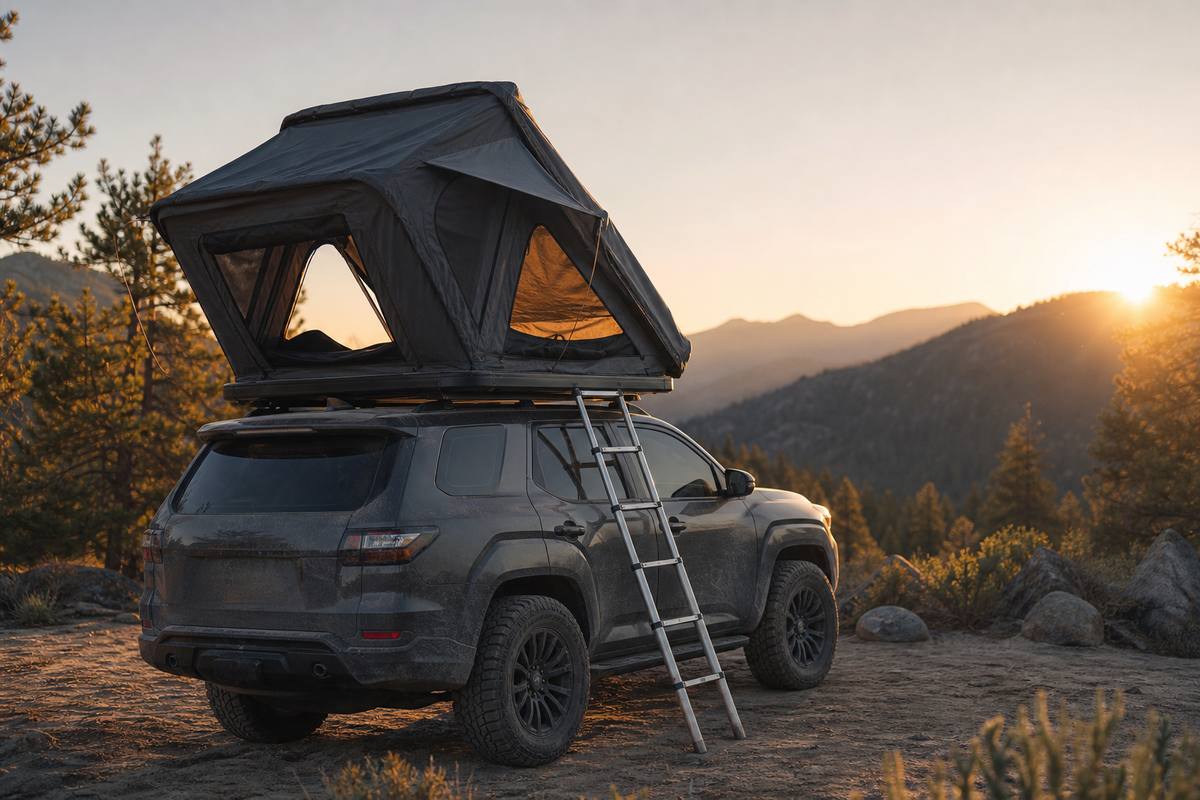
Hard shell or soft shell, $1,100 or $4,000 — the tent is the easy part. The real question is what your roof can carry and how many nights a year you will actually climb up there.
Some brands we cover are clients of our publisher. What we recommend is decided by our editors, and prices are read on the date noted in each article. Our standards.
Quick take
If you camp a handful of weekends a year, a soft-shell fold-out is the honest answer — the OVS Nomadic 2 Extended at $1,599 gives you more usable space than any hard shell at the price, annex included. If you camp most months, the thirty-second setup of a hard shell stops being a luxury and the Roofnest Condor 2 Air is the one we would buy. And before you fall for any of them, look up your vehicle’s dynamic roof load rating. It is the number that decides this, not the reviews.
Rooftop tents have quietly matured. Five years ago the category was a handful of imports and a lot of guesswork; today there are credible options at $1,100 and at $4,000, and the difference between them is no longer quality so much as how much convenience you are buying.
That has made choosing harder, not easier. Nearly every tent on the market is competently built. The spec sheets converge. What separates them is a set of practical questions the marketing does not address: whether your roof is legally allowed to carry the thing, whether you will still be enthusiastic about a four-minute setup in your third season, and whether the mattress that came with it is one you can sleep on without a topper.
Prices in this guide were verified against current listings on 2 September 2026 and move often in this category — hard shells in particular are discounted heavily off season. Check the live price before you commit.
How we chose
A word on what this guide is and is not. We have not put these eight tents on a roof and driven them through a winter — we will say so plainly rather than imply otherwise. This is an editorial selection built from published specifications, materials, included kit, warranty terms and price, cross-checked against what each manufacturer documents about its own product. Where a number appears below, it comes from the brand or the retailer, not from us. Our approach is described in How We Choose.
Four criteria did the filtering:
- Weight is stated, and it is realistic for a normal vehicle. A tent that only works on a truck with an aftermarket bed rack is a fine product and a bad recommendation for most readers.
- The setup mechanism matches the price. Paying hard-shell money for hard-shell branding without gas struts and a rigid lid is the most common way to overspend in this category.
- The included kit is documented. Ladder length, mattress thickness, travel cover, mounting hardware. Tents that leave these vague tend to leave them out.
- The brand supports the product after the sale. Replacement parts and a real warranty matter more on something bolted to a moving vehicle than on almost anything else you buy for camping.
The quick list
- Overland Vehicle Systems Nomadic 2 Extended — Best Overall for Weekend Use ($1,599.00)
- Overland Vehicle Systems TMBK 3 — Best Value ($1,099.99)
- Overland Vehicle Systems XD Sherpa Hybrid — Best Hybrid ($1,649.99)
- OVS Bushveld Hard Shell — Best Fast-Setup Hard Shell ($2,399.99)
- Freespirit Recreation Evolution V2 Hardshell — Most Living Space ($2,762.50)
- Roofnest Condor 2 Air — Best All-Rounder Hard Shell ($3,036.00)
- Tuff Stuff Alpha II — Best for Small SUVs ($3,245.00)
- iKamper Skycamp 4.0 DUO — Best for Couples ($3,612.50)
The recommendations
Best Overall for Weekend Use
Overland Vehicle Systems Nomadic 2 Extended
The Nomadic 2 Extended is the tent we would point most weekend campers toward, and it is a soft shell — which will annoy anyone who has been told hard shells are simply better. They are not simply better. They are faster. A soft-shell fold-out like this one gives you a bigger footprint than any hard shell at the price, ships with an annex that turns the space under the tent into a changing room or a dog room, and packs down to a profile your roof rack will not complain about.
What you pay for that is about four minutes of setup instead of thirty seconds, and a cover you have to zip back on in the rain. If you camp eight weekends a year, that trade is fine. If you camp forty, it will wear on you.
- Good: Annex included, largest usable space per dollar, low packed weight
- Less good: Slowest setup here, fabric cover needs care in wet weather
Best Value
Overland Vehicle Systems TMBK 3
The least expensive tent on this list and the one we would recommend to somebody who is not yet sure they like sleeping on a roof. OVS lists it at 100 pounds and sleeps three, which for a sub-$1,100 tent is a genuinely unusual combination — most three-person tents at this weight cost half again as much.
It is a straightforward fold-out with a telescoping ladder, a 2.5-inch foam mattress and a heavy PVC travel cover. Nothing about it is clever. That is the appeal: there is very little to break, and if rooftop camping turns out not to be your thing, you have not spent Skycamp money to find out.
- Good: Hard to beat at the price, light enough for a modest rack, sleeps three
- Less good: Thin mattress by current standards, no hard shell convenience
Best Hybrid
Overland Vehicle Systems XD Sherpa Hybrid
Hybrids try to split the difference: a rigid lid for weather and speed, a fabric section for space. The XD Sherpa is the most affordable credible version of that idea we found, and it makes sense for the camper who wants faster setup than a fold-out without moving into the $3,000 bracket.
Understand what you are buying, though. A hybrid is heavier than the soft shell it resembles and smaller than the soft shell it costs the same as. It is a compromise, and compromises are only good if you have correctly identified which thing you actually care about.
- Good: Faster than a fold-out, cheaper than a true hard shell
- Less good: Heavier than a soft shell and tighter than one at the same price
Best Fast-Setup Hard Shell
OVS Bushveld Hard Shell
This is the cheapest tent here that delivers the actual hard-shell experience: unclip, let the gas struts do the work, climb up. OVS quotes a thirty-second setup and sells it in two- and four-person sizes, and the kit list is more complete than most — quilted mattress, a 96-inch telescoping ladder, mounting hardware, storage pouches, a removable LED strip.
Note that ladder length. Ninety-six inches is aimed at trucks and taller SUVs; on a lifted rig you want to confirm the reach before you are standing in a dark campsite discovering it.
- Good: Real hard-shell speed for well under $2,500, generous included kit
- Less good: Heavier than the soft shells; check the ladder against your ride height
Most Living Space
Freespirit Recreation Evolution V2 Hardshell
Freespirit is the brand people bring up when the conversation turns to interior volume, and the Evolution hard shell is where their reputation comes from. If you are tall, or you sleep with a partner who resents being touched at night, the extra headroom and floor area matter more than any feature on a spec sheet.
It is also the brand least likely to be in stock at any given moment, which is worth knowing before you build a trip around it.
- Good: Standout interior volume and headroom for the money
- Less good: Availability is inconsistent; confirm stock before planning around it
Best All-Rounder Hard Shell
Roofnest Condor 2 Air
The Condor 2 Air is the tent we would buy with our own money if the budget stretched. It comes in Regular, XL and XXL — sleeping two to three, up to four, and a genuine family respectively — so you can size to your household rather than to the marketing. The Air designation brings a self-inflating mattress, which sounds like a small thing until you have spent a week on a folded foam pad.
Roofnest also sells an awning that clips into the tent base and adds around eighty square feet of covered space, plus a wall kit that encloses it. That system is the strongest argument for the brand: the tent is a good tent, and it is the front door to a setup you can extend for years.
- Good: Three sizes, self-inflating mattress, best accessory ecosystem here
- Less good: Awning and wall kit are extra, and they add up fast
Best for Small SUVs
Tuff Stuff Alpha II
Most hard shells are designed around trucks. The Alpha II is Tuff Stuff’s answer for everyone driving a RAV4 or a Forester: a compact, side-opening clamshell in an ABS shell and poly-cotton canvas, sleeping two, with roughly a thirty-second deployment.
The side-opening layout is the detail worth understanding. It buys you interior width in a small footprint and lets you leave bedding inside when the tent is closed, which is the single biggest quality-of-life feature in this entire category. It also means you climb in from the side of the vehicle, so think about where you park.
- Good: Fits smaller vehicles, bedding stays inside, fast clamshell setup
- Less good: Two-person only; side entry dictates how you park
Best for Couples
iKamper Skycamp 4.0 DUO
iKamper is the expensive one, and it is expensive for reasons you can point at. The Skycamp 4.0 DUO uses the same dual-layer fiber-reinforced polymer shell as the larger models, with air insulation between the layers, a nine-zone foam mattress and 300gsm blackout poly-cotton canvas that cuts light and manages condensation better than the thinner fabrics further down this page.
The DUO is the compact member of the family — a full queen platform, aimed at couples and at solo travellers who would rather mount a lower-profile tent on a mid-size truck or a Bronco Sport. If you need more room, the TRIO and the four-person QUAD run to $3,825 and $3,995 respectively. None of them are impulse purchases, and none of them are the wrong answer if you camp most months of the year.
- Good: Best materials and mattress here; blackout canvas is a real upgrade
- Less good: The most expensive way to sleep two people on a roof
Check your roof before you check the reviews
This is the part most buying guides skip, and it is the part that decides whether any of the above is available to you.
Your vehicle has two roof load ratings. The static rating is what the roof can hold when parked — it is large, and it is the number that covers you and your sleeping companion once the tent is up. The dynamic rating is what it can carry while moving, and on crossovers and unibody SUVs it is frequently well under 200 pounds including the rack itself. That is the constraint. A 140-pound hard shell plus a 40-pound crossbar set has already spent the budget on a lot of vehicles.
Two practical consequences. First, weigh the whole system, not the tent: rack, crossbars, tent, and anything you leave mounted. Second, if your rating is tight, a soft shell is not a downgrade, it is the only correct answer — and the fold-out designs are where the space-per-pound is best anyway. Your owner’s manual has the figure. If it does not, the rack manufacturer publishes ratings for its own hardware; Thule is the usual reference point.
The rest is smaller but worth thinking through. Expect a real fuel economy penalty, worse on hard shells at highway speed. Expect wind noise, and expect it to be louder on a fold-out with a fabric cover. Measure your garage. And if you are mounting to a truck bed rack, confirm the ladder still reaches the ground at that height — the taller your platform, the more likely the standard ladder becomes an accessory purchase.
Where these are actually stocked
Rooftop tents are a specialist purchase and the general outdoor retailers carry a thin slice of the market. Every brand here sells direct, which is the simplest route if you know exactly what you want. If you would rather compare across brands in one place — and in a category where the right answer depends on your specific vehicle, that is usually the better way to shop — specialist retailers stock most of these lines side by side; this rooftop tent selection is a reasonable place to see the price bands next to each other.
Whatever you buy, buy it from somewhere that will answer the phone about a broken strut in year three. In this category, that is worth more than fifty dollars off.
Have we missed a tent you rate? Our editorial standards explain how we handle reader suggestions and corrections.