
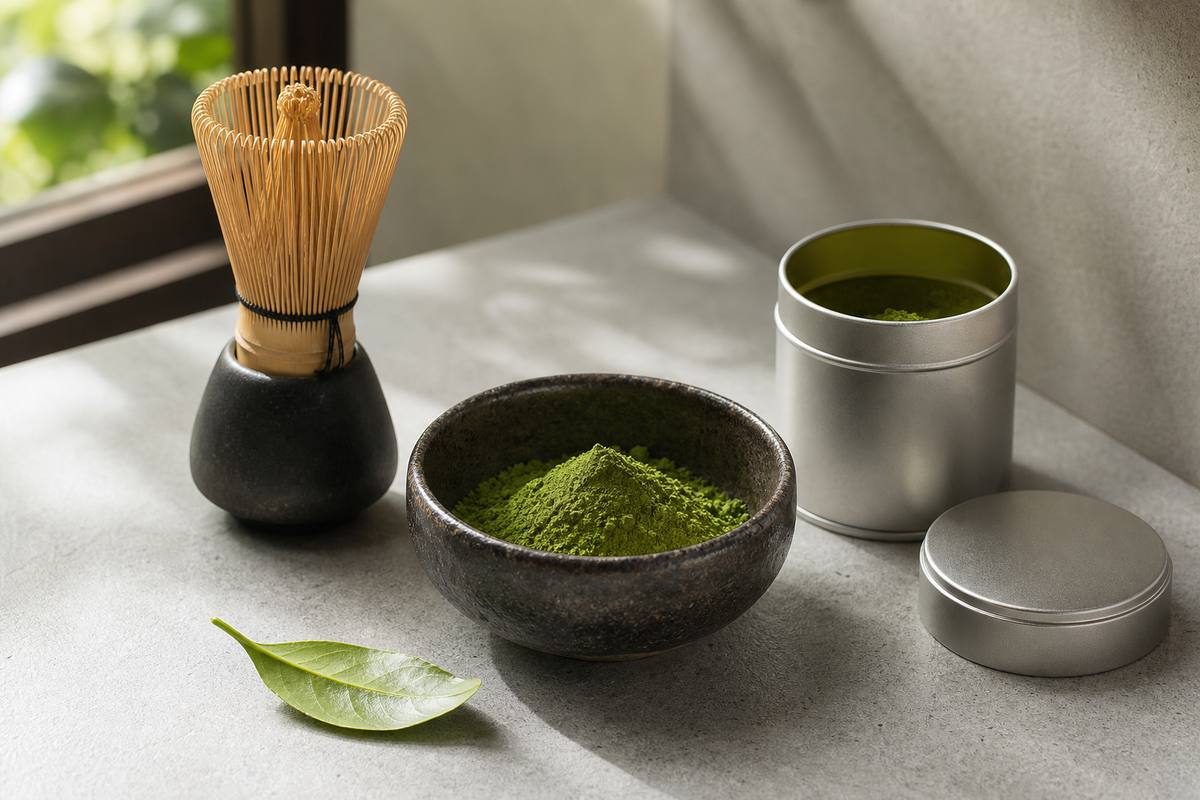
No government, trade body or tea guild certifies “ceremonial grade.” It is a marketing term each brand grants itself. Here is what to read on the tin instead — and eight matchas from $0.50 to $3.50 a gram that show how wide the honesty gap gets.
Some brands we cover are clients of our publisher. What we recommend is decided by our editors, and prices are read on the date noted in each article. Our standards.
Quick take
“Ceremonial grade” has no certifying body behind it. What actually predicts a good tin is disclosure: named region, first harvest, named cultivar, stone-milled, and a stated net weight so you can work out price per gram. Jade Leaf’s Teahouse Edition discloses the most for the money. More Than Matcha is the easiest place to start if you own no equipment, and its refill economics are the best in this set at $0.73 a gram. And note what Ippodo — arguably the most respected matcha house in Kyoto — does with the phrase: nothing. It never uses it.
Walk into the matcha aisle and roughly everything says “ceremonial grade.” A $19.99 tin says it. A $45 tin says it. A tin priced per gram at seven times either of those does not say it at all, because the houses at the very top of the market sell named products, not grades.
That is the whole story of the term. There is no Japanese Agricultural Standard for ceremonial grade, no international registry, no independent body issuing the designation. JAS organic certification is real, and USDA Organic is real, but both certify farming practice, not tea quality or intended use. When a brand calls its matcha ceremonial grade, the brand is the only authority involved. Some earn it. Some are describing a price point.
None of which makes the tea worse. It means the label carries no information, so you have to read past it — and the good news is that the things which do predict quality are all printed on the same page, if the seller chose to print them.
Prices and product details here were read off each brand’s own live listings on 3 September 2026. Ippodo prices are in yen as shown on its global storefront; we have not converted them at a live exchange rate, so treat any dollar comparison as rough. Matcha is seasonal and stock rotates — check the tin you are buying.
How we chose
We have not held a tasting panel and we are not going to describe umami we did not taste. This is an editorial survey of what these brands publish about their own products: origin, harvest, cultivar, milling method, certification, net weight and price, read off their live pages and compared line by line. The interesting findings here are about disclosure, and disclosure is something you can check without a whisk. Our approach is described in How We Choose.
The five disclosures we looked for, in the order they are worth caring about:
- Net weight, stated plainly. Without it you cannot compute price per gram, and matcha’s price range is so wide — roughly $0.50 to $3.50 a gram in this survey — that a headline price tells you almost nothing. Two products below list no weight at all.
- Region. Uji, Nishio, Kagoshima, Miyazaki, Shizuoka. Naming the region is the minimum credible sourcing claim.
- First harvest (ichibancha). The spring picking, and the real dividing line between drinking matcha and latte matcha.
- Cultivar. Okumidori, Saemidori, Samidori, Yabukita, Uji Hikari, Gokou. A brand that names cultivars knows its supply chain well enough to be held to it.
- Milling. Stone mills are slow — traditionally something like 40 grams an hour — and gentle on the leaf. Ball or roller milling is faster and warmer. Very few brands state which they use, which is itself a finding.
One thing we went looking for and did not find anywhere: a published lab result. Several brands make testing claims. Not one of the brands surveyed shows an actual heavy-metal or pesticide certificate on the pages we read.
The quick list
- Jade Leaf Organic Ceremonial Matcha, Teahouse Edition — Best Disclosure for the Money ($22.99–$189.99)
- More Than Matcha Ceremonial Matcha Powder — Best Place to Start ($45.00)
- Encha Ceremonial Grade Matcha — Best Everyday Value ($19.99–$189.99)
- Naoki Ujitawara Special — Best for Drinking Straight ($42.99)
- Encha Okumidori Limited Edition Reserve — Best Single-Cultivar Under $40 ($39.99)
- Jade Leaf Barista Edition — Best for Lattes ($22.99–$139.99)
- Naoki Nishio Bloom — Best Regional Alternative to Uji ($39.99)
- Ippodo Ummon-no-mukashi — Best Traditional Kyoto House (¥4,000)
The recommendations
Best Disclosure for the Money
Jade Leaf Organic Ceremonial Matcha, Teahouse Edition
Jade Leaf publishes more about this tea than anyone else here and charges middle-of-the-road money for it: five named cultivars — Okumidori, Kanayamidori, Sayamakaori, Samidori and Yabukita — origin given as Uji and Kagoshima, first harvest, USDA Organic. A 30-gram tin is $26.99, a 30-gram pouch $22.99, 100 grams $59.99 in either format, and a 454-gram bag $189.99. That works out at $0.90 a gram for the small tin and $0.60 for the 100-gram.
The honest wrinkle is on Jade Leaf’s own page. A customer asks in the Q&A for the heavy-metal certificate of analysis, and the brand’s reply is that it does not share test results publicly. That is a legitimate position, and it is also exactly why “tested for purity” is not a claim you can verify from the outside — even from the most transparent brand in this survey.
- Good: Five cultivars named, region and harvest stated, wide size range, strong price per gram at 100g
- Less good: Declines to share lab results, does not state milling method
Best Place to Start
More Than Matcha Ceremonial Matcha Powder
The most beginner-friendly tin in this guide, and the one we would hand to somebody who has decided to take matcha seriously but owns no equipment. It is 40 grams — 20 to 25 servings — organic, shade-grown, first harvest, freshly ground, from Kagoshima, and it ships in a tin with a teaspoon, which sounds trivial until you have tried to portion matcha with a kitchen spoon.
At $45 for 40 grams it is $1.13 a gram, which is upper-mid for a first tin. The move is to buy it once and then buy refills: the Refill Trio is $88 for 120 grams, or $0.73 a gram — the best per-gram price on organic first-harvest single-region matcha anywhere in this set. Two disclosures we would like to see added: the cultivar, and whether the grinding is stone-milled. Both would put this tin’s paperwork on a level with its packaging.
- Good: Tin and spoon included, single region, organic and first harvest, outstanding refill pricing
- Less good: No cultivar or milling method stated, first tin costs more per gram than the refills
Best Everyday Value
Encha Ceremonial Grade Matcha
Encha is the only brand here that states plainly that its matcha is stone-ground, and it does so on every page we read. Add shade-grown, USDA Certified Organic, first harvest, hand-picked within 24 hours, and grown without synthetic pesticides, and the paperwork is good. 30 grams is $19.99, 60 grams $34.99, a 30-pack of single-serve sticks $39.99, and a 500-gram catering bag $189.99 — which at $0.38 a gram is the cheapest tea in this survey by a wide margin.
The thing to understand before buying: Encha’s sourcing graphic names four regions — Kagoshima, Uji, Miyazaki and Shizuoka — so the flagship is a multi-region blend, not a single origin. That is not a flaw. It is how you keep a flavour profile consistent at this price. It just means a tin is not traceable to one farm.
- Good: States stone-grinding, organic, first harvest, unbeatable bulk price per gram
- Less good: Multi-region blend rather than single origin, “third-party tested” with no visible report
Best for Drinking Straight
Naoki Matcha Ujitawara Special
Naoki sits one rung up in specificity: this is a 1.4-ounce (roughly 40-gram) tin, about $1.07 a gram, made by a producer in Uji city from Kyoto-region leaf, and it names the cultivars in the blend — notably Uji Hikari and Gokou, two of the more prized ones. Uji is the historic centre of Japanese matcha; the shading practice that defines the whole category was refined there.
This is a tin to drink as usucha with hot water and nothing else. Putting it in a latte is not a crime but it is a waste — the milk flattens exactly the qualities you paid the premium for. If you want a matcha to make you understand what people mean by sweetness in tea, start here.
- Good: Named cultivars, named production city, genuine top-tier Uji sourcing
- Less good: No stated milling method or harvest, wasted in milk drinks
Best Single-Cultivar Under $40
Encha Okumidori Limited Edition Reserve
A single cultivar, Okumidori, from a single region — Kagoshima’s volcanic soil — shade-grown by the traditional honzu method, hand-picked, stone-ground, harvested once a year. On disclosure of the things that actually matter, this is the most specific product in the guide. There is a companion Saemidori Reserve at the same $39.99, sourced from the Miyazaki coast.
And then the one thing they forgot. Neither Reserve page states a net weight anywhere. That means you cannot calculate price per gram on the two most carefully documented teas here, which is a strange place for a brand this precise to leave a gap. Worth an email before you order.
- Good: Single cultivar, single region, honzu shading, stone-ground, hand-picked, all stated
- Less good: No net weight published, so price per gram is unknowable; limited availability
Best for Lattes
Jade Leaf Organic Ceremonial Matcha, Barista Edition
Same cultivars, same Uji and Kagoshima sourcing, same first-harvest and organic claims as the Teahouse Edition, positioned a step down and priced accordingly: 30-gram tin $22.99, 50-gram pouch $30.99, 100-gram tin $49.99, and a pound at $139.99. The 100-gram tin at $0.50 a gram is the cheapest credible tin in this survey.
If your matcha habit is a daily iced latte, this is the correct purchase and the Teahouse Edition is not. Milk and sugar hide the difference the extra money buys, and a tea you drink every day at $0.50 a gram beats a better tea you ration.
- Good: Excellent price per gram, built for milk, same disclosed sourcing as the pricier edition
- Less good: Less nuance drunk straight, no milling method stated
Best Regional Alternative to Uji
Naoki Matcha Nishio Bloom
Nishio, in Aichi prefecture, is the region most matcha drinkers have never heard of and most Japanese tea ceremonies have. Naoki’s Nishio Bloom is a 1.4-ounce tin at $39.99 — about $1.00 a gram — made with a tea company with long roots in the region, shade-grown, with the harvest claim stated but the cultivar not named.
Buy it as a second tin rather than a first. Tasting a Nishio matcha against a Uji one is the single most useful thing you can do to work out whether you actually have preferences or are just paying for a place name.
- Good: Genuinely different regional profile, respected producer, fair per-gram price
- Less good: Cultivar not named, no milling method, less familiar so harder to compare
Best Traditional Kyoto House
Ippodo Ummon-no-mukashi
Ippodo has been selling tea in Kyoto since 1717, and the most instructive thing about its matcha pages is what is missing from them: the phrase “ceremonial grade” does not appear. Ippodo sells named teas — Ummon-no-mukashi, Kanza — and lets the name carry the reputation. Ummon-no-mukashi is ¥4,000 for a 20-gram box, ¥200 a gram. The Kanza, from the premium select series, is ¥10,000 for 20 grams, or ¥500 a gram — several times the price of anything else here.
Two practical notes. The global storefront prices in yen and does not switch to dollars, so you are buying at whatever your card’s rate is that day. And a Shopify weight field on the Kanza listing reads 30 grams; that includes the box. The tea is 20.
- Good: Three centuries of provenance, sells by named tea rather than invented grade, unmatched pedigree
- Less good: Yen-only pricing, small 20g boxes, by far the most expensive per gram
What to do with this
Stop reading the front of the tin and read the back of the page. If a listing gives you region, harvest, cultivar, milling and net weight, you are dealing with someone who knows where their tea came from. If it gives you a grade and an adjective, you are dealing with a marketing department — which may still be selling perfectly good tea, just not tea you can verify.
And treat “tested” as a claim rather than a fact until you see the document. Across eight products from five brands, several testing claims, and one direct customer request for a certificate, we found no published lab result anywhere. The first brand in this category to put an actual heavy-metal report on the product page will deserve every bit of the advantage it gets.