
The short answer: the right commercial playground for ages 2 to 5 is one built and certified for that age group, sized to the space you actually have once the safety use zone is included, and matched to how many children will play at once. For a preschool or childcare center planning a mid-size area, Playground Boss’s Simon Says is a useful benchmark: it is designed for ages 2 to 5, lists capacity for up to 30 children, needs a 30 ft x 26 ft safety use zone and includes an ADA transfer station.
Preschool playgrounds are not scaled-down school playgrounds. Platform heights, climber spacing and slide length are set for smaller bodies, and the US Consumer Product Safety Commission recommends separating play areas for different age groups. The decisions below will narrow a long catalog to a short list.
How to choose a 2 to 5 playground
1. Confirm the age rating and the standards behind it
Look for an explicit 2 to 5 age designation and for references to CPSC’s Public Playground Safety Handbook (Publication 325) and ASTM F1487, the standard for public playground equipment. IPEMA certification indicates third-party validation of equipment to ASTM requirements. These references describe the equipment; your installation, surfacing and maintenance still determine how safe the finished site is.
2. Measure the safety use zone, not just the footprint
The use zone is the structure plus the cushioned clearance around it. A unit that “fits” by footprint can fail once you add the zone. Mark the listed dimensions on your site plan before you compare prices, and leave room for paths, fencing and staff sightlines.
3. Match capacity to your largest group
Listed child capacity tells you how many children the structure is designed to serve at once. Compare it with your biggest outdoor group, not your average enrollment, so classes are not waiting in line for one slide.
4. Plan for inclusion from the start
An ADA transfer station lets a child move from a wheelchair onto the structure. It is a useful feature, but one transfer station does not by itself make a whole play area compliant. The US Access Board’s guide to play areas covers accessible routes, ground-level components and surfacing that also matter.
5. Budget for surfacing, freight and installation
The structure price is only one line item. Impact-attenuating surfacing, delivery and installation can change the total significantly, so request a quote that breaks them out separately.
Three Playground Boss options at different scales
Playground Boss’s Ages 2 to 5 collection listed 26 structures on November 15, 2026, from $4,868 to $67,290. Three in-stock models show how capacity and space scale. Prices below are sale prices shown on that date.
| Model | Ages | Child capacity | Safety use zone | Listed price |
|---|---|---|---|---|
| Mini Monkey (PGB-20211) | 2 to 5 | 16 | 20 ft x 24 ft | $7,895 |
| Simon Says (PGB-20210) | 2 to 5 | 30 | 30 ft x 26 ft | $15,858 |
| Shady Days (PGB-20212) | 2 to 5 | 36 | 28 ft x 27 ft | $22,611 |
Mini Monkey suits small daycares or a corner of a larger site. The brand describes a low deck, short slide, a small climber and activity panels, with five play activities listed.
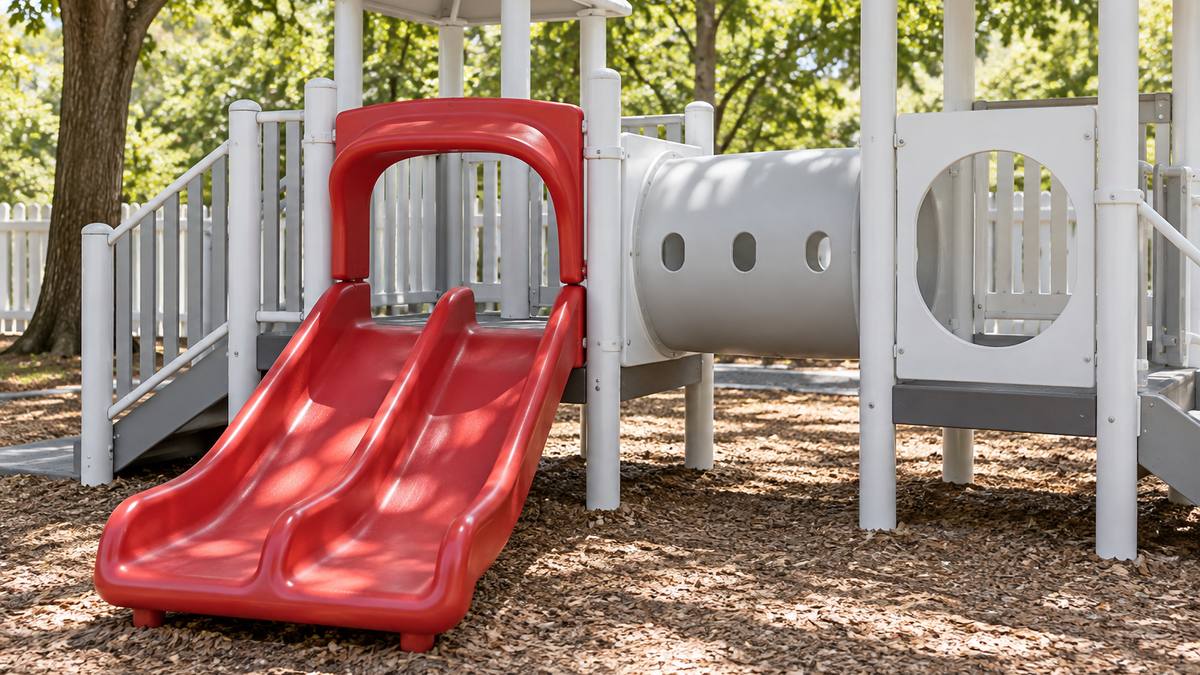
Simon Says is the middle option for a typical preschool class. Children can enter by the ADA transfer station, a Sea Creatures Climber or a Wing Climber. A crawl tunnel links two raised decks, one with a right turn slide and one with a double slide, and a racing game panel and rain wheel add ground-level play. The listing shows eight play activities.
Shady Days adds a large integrated shade, which matters for sites without tree cover, and lists capacity for 36 children across ten play activities.
All three listings cite ASTM F1487-17, CPSC Guidelines #325 and IPEMA certification, 3.5 inch galvanized powder-coated steel posts, a 15-year limited warranty on rotomolded plastic components and a 100-year limited warranty on posts, steel hardware, aluminum decks, clamps and caps. Playground Boss states it offers turnkey installation across the continental United States.
Limitations to plan around
- Surfacing is separate. Listed prices are for the structure. Choose surfacing rated for the fall height of the equipment.
- Freight is curbside. The shipping policy says most large items ship by LTL freight with curbside delivery, typically 3 to 7 business days in transit, delivery dates are not promised, and there is no shipping to PO boxes. Plan for unloading if you are not using installation.
- Returns are limited to unopened items. Most new, unopened items can be returned within 30 days of delivery.
- Accessibility is site-wide. Confirm accessible routes and surfacing with your designer, not only the structure.
Next step
Measure your available area, note your largest group size and decide whether you need shade. Then use the Playground Boss quote request to ask for a written scope that separates equipment, surfacing, freight and installation.
FAQ
Can 2 to 5 year olds share a 5 to 12 playground?
CPSC recommends separate areas for different age groups, because equipment heights and spacing are designed for specific ages. A dedicated 2 to 5 structure is the safer plan.
How much space does a preschool playground need?
It depends on the model. In the examples above, safety use zones range from 20 ft x 24 ft to 30 ft x 26 ft before paths and fencing.
Some of the brands mentioned in this article may have a prior working engagement with this publication.