
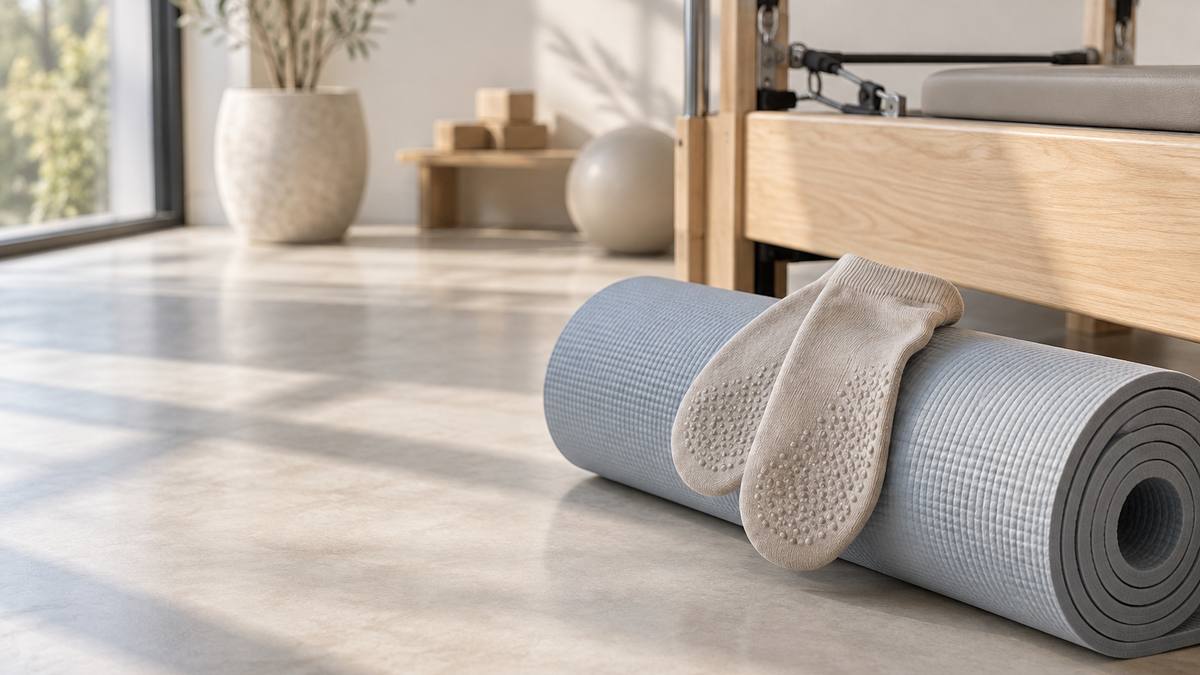
Grip pattern, toe style, height, fit, fabric and care: the six checks that matter when you’re choosing a pair for reformer or mat class, and what brands actually publish about each.
Some brands we cover are clients of our publisher. What we recommend is decided by our editors, and prices are read on the date noted in each article. Our standards.
Quick take: If you’re working out how to choose grip socks for Pilates, check six things in this order. Does your studio require them? How much of the sole does the grip cover? Do you want closed, toeless or five-toe? Which height suits you? Does the size chart actually match your shoe size? Can you live with the care instructions? Most pairs we looked at cost $16 to $20. Price matters less than whether the listing gives you a size chart and care instructions you can check before you buy.
Grip socks vary more than they first appear to. Some put grip dots across the whole sole and some only at the ball and heel. Some leave the toes open, some split them into five, some cover them completely. Size charts don’t agree either, so a 7.5 shoe can be an S/M at one brand and an M at another. This guide goes through each decision using what the brands themselves publish. All prices and specs were read on 9 October 2026 and can change.
If you want product picks rather than a buying framework, see our earlier roundup of grip socks that stay put through a reformer class. For fiber content and price per pair, see our grip sock fiber and fit breakdown.
Why studios ask for grip socks in the first place
Start by checking your studio’s own rules, since that often settles whether you need a pair at all. The Club Pilates FAQ answers “Do I need grip socks?” with a yes. It says you can bring your own or buy a pair at the studio, and that every class participant needs them. Pure Barre’s new-to-barre page asks for “sticky socks (grip socks)”. It gives two reasons, keeping feet from sliding and studio hygiene, and says to put them on before you enter the class. It also notes that reasonable accommodations are available.
Studio rules vary by brand and sometimes by location, so check your studio’s page or ask at the front desk before your first class.
How to choose grip socks for Pilates: the six checks
1. Grip pattern and coverage
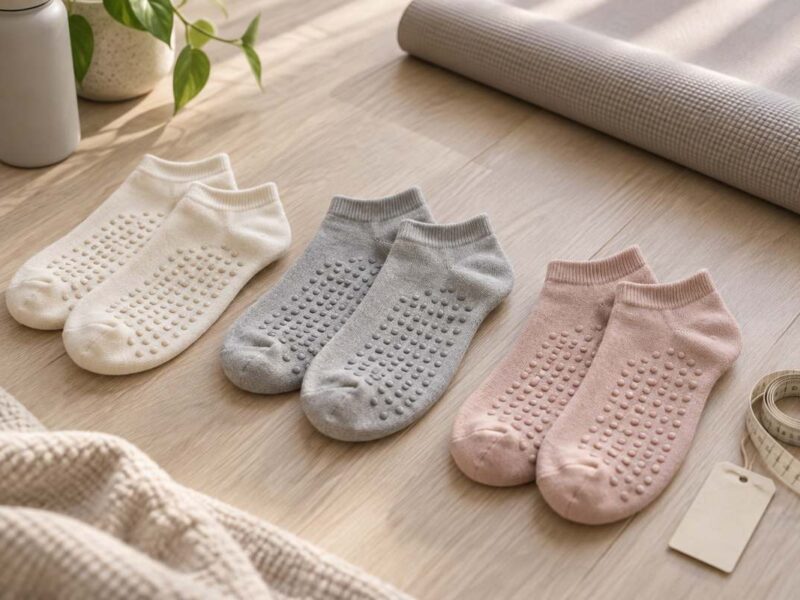
Brands describe their soles in different ways, and it’s worth reading the wording closely. Pointe Studio’s Basal Toeless Full Foot Grip Sock ($16) lists “an all-over PVC grip on the foot.” TAVI’s Base33 Crew ($18) names a “non-slip hex grip.” Souls describes its Body & Soul style as having “full-coverage silicone grips.” These are brand descriptions, not test results, but they tell you what to look for in the sole photo.
No coverage pattern is right for everyone. Some people want grip under the whole foot for class. Others also wear their socks around the house and prefer a lighter pattern. Look at the sole photo and choose the layout that fits how you’ll use them.
2. Toe style: closed, toeless or five-toe
Toe style is mostly personal preference, and several brands sell the same sock in more than one version, which makes comparing easy:
- Closed toe. A standard sock shape. Arebesk sells its Muse Closed Toe Grip Sock at $18.
- Open or toeless. The toes are exposed. Arebesk makes the Muse Open Toe at the same $18. Pointe Studio’s Basal toeless style is described as letting toes “spread, breathe, and grip.”
- Five-toe, full or half. ToeSox separates each toe. It sells the Full Toe Ultra Fine Knit Low Rise and a Half Toe version with open toe tips, both at $20.
If you’ve never worn five-toe socks, try a single pair before buying several, since putting on a toe sock is a different routine. Toeless and half-toe designs leave skin on the equipment, so check whether your studio says anything about that.
3. Height: no-show, low rise, ankle or crew
Height mostly affects comfort and looks. TAVI’s Savvy Grip Sock ($16) is a below-ankle style with a heel tab at the back. The Base33 is described as “classic crew height.” Souls divides its catalog into short and crew styles. Its crew grip sock collection includes styles such as Cream Cloud, which the brand says has “a slightly longer scrunch style.” Crew and scrunch styles cover more of the ankle. Low-rise styles barely show above leggings. If socks that slide down under the heel bother you, look for a heel tab or a cuffed top.
4. Fit and size charts
Brands don’t share a sizing standard, so compare your shoe size with each brand’s chart rather than assuming the letters mean the same thing. Here’s what the listings showed on 9 October 2026:
| Brand and style | Price | Published size ranges (US women’s shoe) |
|---|---|---|
| Souls Body & Soul / Cream Cloud | $20 | S/M 5.5–7, M/L 7.5–9 |
| Pointe Studio Basal Toeless | $16 | S/M 5–7, M/L 8–10, L/XL 11–13 (chart) |
| ToeSox Ultra Fine Knit Low Rise | $20 | S 6–8, M 8.5–10.5, L 11–13 (L in one colorway) |
| Arebesk Muse (open or closed toe) | $18 | S 6–8, M 8.5–10.5, L 11–12 |
| TAVI Savvy | $16 | S, M (see brand size guide) |
Two details stand out. Pointe Studio’s chart skips 7.5, and the brand’s own advice is to size up if you’re between sizes. Souls doesn’t print one M/L range across its whole catalog. Some listings say 7.5–9 and others say 7.5–10, so read the range on the exact style you’re buying.
5. Fabric: read the listing, not the photo
Fabric detail varies a lot from brand to brand. TAVI’s Savvy page lists 73% organic cotton, 14% nylon, 7% elastane and 6% polyester, and says the cotton is GOTS certified. ToeSox’s Half Toe Low Rise lists 68% organic cotton, 20% polyester, 7% elastane and 5% nylon. Pointe Studio’s Basal toeless lists 83% cotton, 15% nylon and 2% spandex. Arebesk’s Muse pages list 75% cotton, 15% spandex and 10% elastane. Souls describes Body & Soul as a “soft, breathable cotton blend.”
A fiber list helps you compare like with like, but it won’t tell you how a sock feels on your foot. If you have a fabric preference, go by the listing text rather than the product photo.
6. Washing and care
The grip layer is the part to look after. The published care instructions overlap a lot:
- TAVI: turn inside out, gentle cold wash, skip fabric softener, air dry.
- ToeSox: machine washable, inside out on a gentle cycle, line dry or low heat, no bleach, no iron.
- Pointe Studio: machine wash inside out on warm, delicate cycle, no bleach or iron, line dry or low heat.
- Souls (Body & Soul): machine wash, air dry.
- Arebesk: includes a wash bag with each pair, which the brand says helps protect the silicone in the laundry and can double as a carrying bag.
Keep the packaging or hang tag. Under the FTC’s guidance on the Care Labeling Rule, hosiery doesn’t need a permanent sewn-in care label. Care instructions have to appear on a hang tag, the package or somewhere else conspicuous instead. With socks, that means the instructions often leave with the packaging. The rule’s definition of textile wearing apparel, which includes hosiery, is in 16 CFR Part 423.
Where Souls fits
Souls’ catalog is mostly grip socks, plus a smaller range of totes, claw clips and grip mat towels. Most pairs were $20 on 9 October 2026, with some marked down to $15, and the site was running a buy-three-get-the-fourth-free offer. Souls makes sense if you want a graphic or slogan design in crew or short height and the published size ranges fit your shoe size. If you want five-toe construction or a women’s size above the top of its ranges, the brands above list those options for specific styles.
A short checklist before you buy
- Read your studio’s grip sock policy.
- Look at the sole photo to see how much grip coverage there is.
- Choose closed, toeless or five-toe based on comfort, then check your studio’s rules.
- Pick a height: no-show, low rise, ankle or crew.
- Check your shoe size against that style’s chart, especially if you’re between sizes.
- Read the fabric and care details on the listing, and keep the hang tag.
The bottom line
No grip sock is right for every foot or every studio. The best pair is the one that meets your studio’s rules, fits your shoe size on that brand’s chart, and comes with care instructions you’ll actually follow. How we pick the brands we cover is explained in how we choose. If a price or spec here has changed since 9 October 2026, our corrections policy explains how to tell us.