
In a Florida house that takes direct sun for hours, the useful question is not whether motors are nicer. It is whether a shade will actually be closed when the heat and glare arrive, and what that is worth on each window.
Some brands we cover are clients of our publisher. What we recommend is decided by our editors, and prices are read on the date noted in each article. Our standards.
Quick take: Motorized shades make the most sense on large, hard-to-reach or strongly sun-facing glass where a schedule can lower the shade before afternoon sun hits, on windows in homes with young children, and in second homes that sit empty for weeks. Manual cordless shades are usually enough for small windows, rooms people use all day and anyone who would rather not maintain batteries, hubs or wiring. Neither type is storm protection.
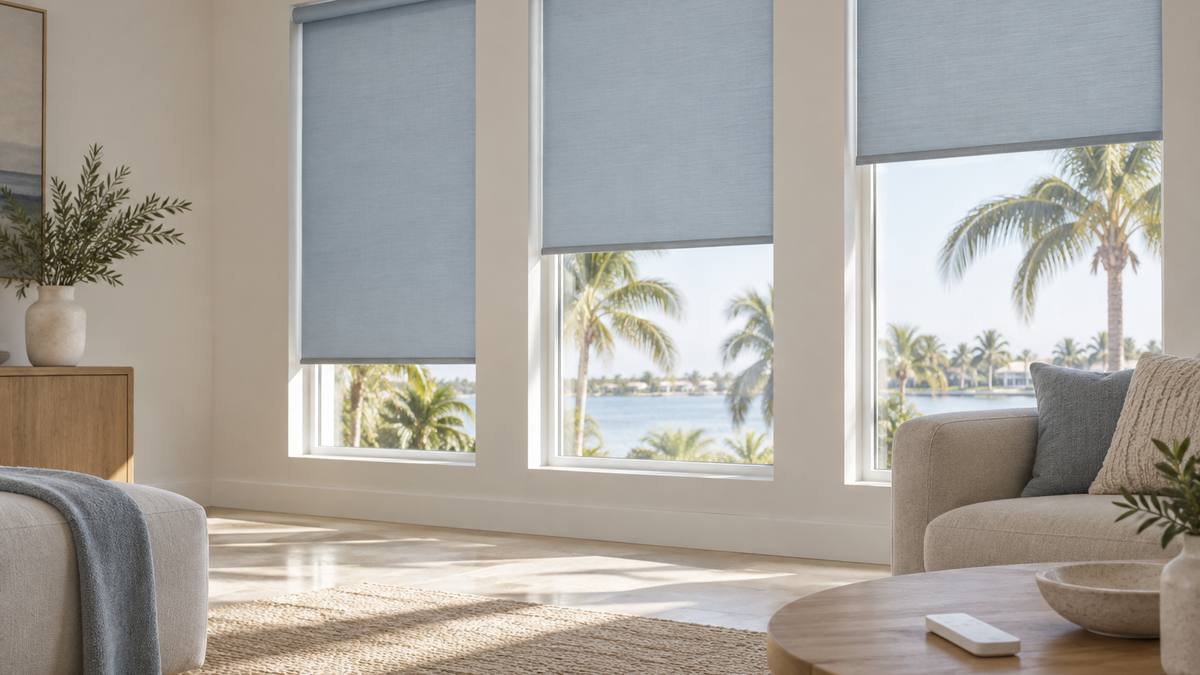
Choosing motorized shades vs manual shades for a sunny Florida home comes down to behavior more than hardware. A shade only reduces heat gain while it is down, and the hours when Florida sun is strongest are often the hours when nobody is home to pull a cord or lift a bar. That is the case for motors. The case against is cost, complexity and the fact that a manual shade on a window people pass every day does the same job.
Specs and claims below come from manufacturers’ and agencies’ live pages; prices and specs read 7 October 2026. No products were tested for this article; see how we choose for how sources are selected.
Why window heat and glare matter so much in Florida
The Attachments Energy Rating Council (AERC), which rates blinds, shades and other window attachments, cites Department of Energy figures that in cooling seasons about 76% of the sunlight that falls on standard double-pane windows enters to become heat. AERC’s guidance for warm climates is plain: closing window attachments during the day helps keep the sun’s heat out and reduces air-conditioning use.
That makes timing the core issue. AERC’s page on automated window attachments says scheduled opening and closing can increase savings and comfort, and it specifically lists out-of-home absences, hard-to-reach windows, homes with small children and hot climates as situations where automation is recommended.
Some caution is fair. A Department of Energy fact sheet on interior cellular shades reports that window attachments can save 15% of a household’s annual HVAC energy use compared with vinyl blinds, and that Lawrence Berkeley National Laboratory simulations found cellular shades achieved higher energy savings than other shading devices. But the fact sheet also says the underlying experiments focused on the heating season and that more research is needed on cooling-season control. In Florida, treat those numbers as direction, not a promise.
Motorized shades vs manual shades for a sunny Florida home: a window-by-window test
Rather than picking one system for the house, sort each window with a few questions.
- Which way does it face? Windows that take long stretches of direct afternoon sun gain the most from a shade that closes on schedule.
- Can someone reach it easily? Tall living-room glass, transoms and windows behind furniture are where manual shades tend to stay in one position all day.
- Is anyone home at peak sun? An occupied home office can be managed by hand; a house empty all day, or a seasonal residence, cannot.
- Are there young children? Cordless operation matters here either way (see below).
Many homes end up mixed: motors on big sun-facing and hard-to-reach glass, cordless manual shades on bedrooms, bathrooms and small windows.
Fabric choice matters as much as the motor
A motor does not change what the fabric does once it is down.
Openness factor and visible transmittance
Solar shade fabrics are woven with a percentage of open space, called the openness factor. Mermet, a shade-fabric manufacturer, explains in its fabric selection guide that openness is the part of visible light that passes straight through the fabric without being diffused. Mermet says fabrics with visible transmittance below 8% are considered effective for glare control, that dark colors in low openness are the best glare options, and that light colors optimize heat management.
Solar shades vs blackout fabric
Solar or screen fabrics cut glare while keeping the view; blackout fabrics suit bedrooms and media rooms. Mermet notes that its blackout levels are tested against 100,000 lux to simulate direct sunlight. Lutron’s Palladiom shade line, for example, is offered in light-filtering, privacy and blackout fabrics on the same hardware.
For energy comparisons across products, AERC’s guide to reading its residential label points to the Warm Climate rating and to solar heat gain coefficient (SHGC), where lower values may reduce cooling costs.
Cords and child safety
The U.S. Consumer Product Safety Commission’s window covering cords page states that cordless window coverings are the only option that eliminates the strangulation hazard, and that the safest option when young children are present is to go cordless. CPSC also lists a newer federal safety standard for custom window coverings. The Window Covering Safety Council urges caregivers to use only cordless coverings or coverings with inaccessible cords in homes with young children.
Note that manual cordless shades meet this goal too; motors add the option of never reaching for the shade at all. Similar reasoning about everyday hazards appears in WVB’s guide to buying a dresser under the tip-over rule.
How motorized shades are powered
Power choice shapes installation cost and upkeep. Somfy’s power options FAQ describes four routes:
- Battery (WireFree): a battery tube behind or above the headrail. Somfy describes its version as 12V with 8 AA lithium batteries and says no electrician is needed.
- Plug-in: the motor plugs into a nearby standard outlet.
- In-wall wired: tied into the home’s electrical system, usually by an electrician, with no batteries to maintain.
- Solar pack: a small panel that charges a compatible WireFree battery motor.
Battery life claims vary by brand. Somfy says its rechargeable lithium-ion WireFree motors need recharging once or twice a year, or can run on solar charging. Lutron says Palladiom shades have a three-to-five-year battery life. Hunter Douglas’s PowerView battery-care guide says batteries typically need recharging or replacing about once a year, depending on shade size and how often the shades move. Wired motors suit renovations with open walls; battery and solar options suit retrofits.
Smart-home control and scheduling
Scheduling is where motorization earns its keep on a hot facade. Hunter Douglas says its PowerView system can run saved scenes on a schedule, including at sunrise or sunset, and uses a gateway for remote access and integration with other smart-home systems. AERC notes that shades can link to platforms such as Amazon Alexa, Google Assistant, IFTTT, Nest and Control4 to respond to weather, temperature and sunrise or sunset.
Before buying, check which ecosystem the house already uses; a shade that needs its own hub and app is one more thing to maintain. A wall keypad also keeps guests from depending on a phone.
Hurricane season: shades are not storm protection
No interior shade, motorized or manual, protects a window in a hurricane. FLASH (the Federal Alliance for Safe Homes) says on its window protection page that openings should be protected with tested and approved hurricane shutters, panels or, as an emergency measure, 5/8-inch plywood, and that reinforced screens or fabric protection may not prevent deflection that breaks glass. Motorized exterior roll-down shutters are a separate category; FLASH advises owners to learn how to open motor-driven shutters manually during a power outage.
The same question applies indoors: ask how hardwired shades behave when power drops.
Cost and maintenance, in general terms
No live price list for comparable custom shades was available to verify, so this guide does not quote figures. In general, motorized shades cost more than manual ones because of the motor, controls and possible electrical work, and they add upkeep such as charging and app updates. Itemized quotes that separate fabric, motor, power and programming make it easier to motorize only the windows that need it.
Where a local installer fits
Larger projects often go through a local dealer that handles measuring, power and programming. Shading Source, a custom drapery, shade and blind company with a showroom in Boynton Beach, says it serves South Florida from Fort Lauderdale to Jupiter and lists Lutron, Crestron and Somfy certifications on its site. Its Lutron motorized shade page describes Triathlon, Sivoia QS and Palladiom systems and presents the company as a Lutron-certified dealer offering design and installation in Palm Beach and Broward counties. With any installer, confirm the service area, which motor brands they support and who handles warranty service.
When manual makes more sense
Manual cordless shades suit small or shaded windows, rooms occupied at peak sun, rentals, tight budgets and households that want no extra app. Motors are easier to justify on large sun-facing glass, hard-to-reach windows and homes that sit empty through the hottest hours. Spotted something out of date? See our corrections policy.