
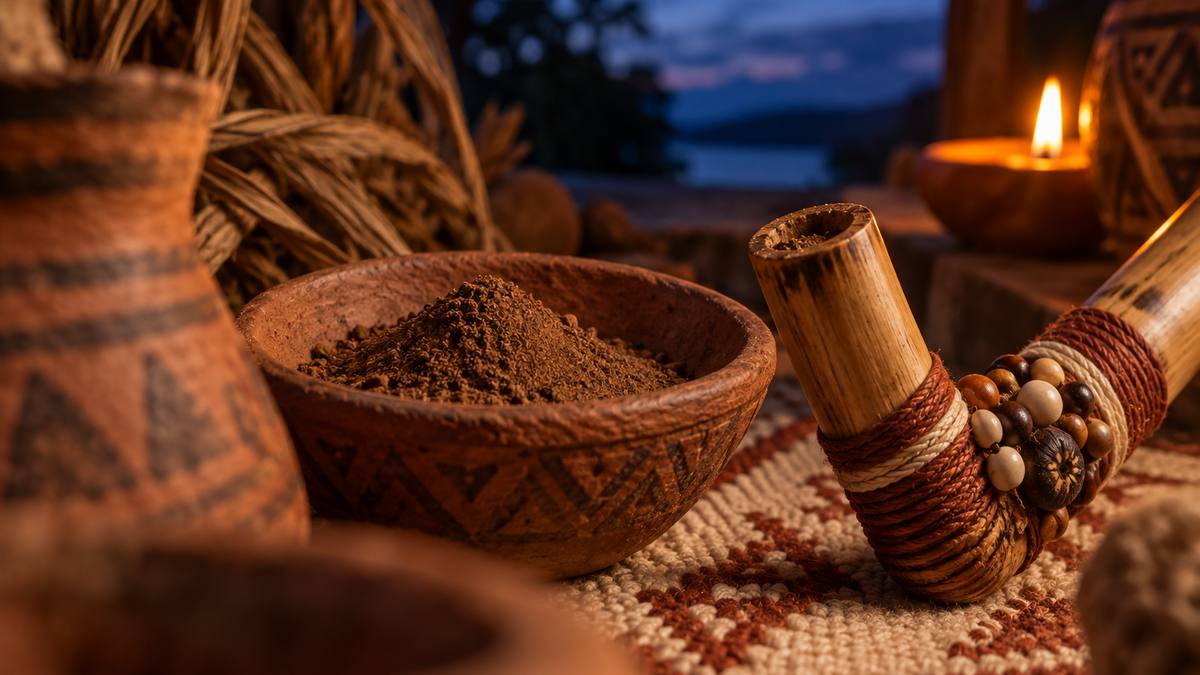
Hapé is a finely ground Amazonian tobacco snuff, made by hand by Indigenous communities in Brazil and applied through a small pipe. This guide covers what it is made of, which communities make it, how the tools work, and how to read a Hapé listing before you buy.
Quick answer: Hapé (also written hape, or rapé in Portuguese, pronounced roughly “ha-PEH”) is a powdered snuff whose main ingredient is tobacco, blended with plant ash and sometimes other plants. Specific Amazonian communities prepare it by hand, and it is applied with a tepi (blown by another person) or a kuripe (self applied). Because it contains tobacco and nicotine, it is for adults only. For a first purchase, the Tribu Spirit Hapé Starter Set ($60) puts a kuripe, a Medium blend and a carry bag together.
What is Hapé made of?
At its core, Hapé is tobacco. Traditional blends typically use a strong tobacco often called mapacho (Nicotiana rustica), dried and ground into a very fine powder. That powder is mixed with ash from the bark of specific trees, and many blends add other plants for aroma and character.
You can see this in real listings. Tribu Spirit’s Jungle Mint Hapé from the Yawanawa names peppermint leaves and Tsunu ash. Its Kuntanawa Jarina Hapé is made with Jarina flowers. A limited edition blend is named for its cacao, anise and sage. Each recipe belongs to the community that makes it, which is why the same word covers so many different blends.
Is Hapé the same as snuff?
It is a type of snuff, but it differs from the commercial snuff sold in tins. Hapé is hand prepared in small batches, the ash and plant additions vary by community, and it is applied by blowing the powder through a pipe rather than sniffing a pinch from the fingers.
Where does Hapé come from?
Hapé comes from Indigenous traditions in the Amazon basin, and a good seller tells you exactly which community made each blend. Tribu Spirit’s current listings name several communities in the Amazon rainforest of Brazil:
- Huni Kuin (Kaxinawa): makers of blends such as Warrior Heart and Sananga Hapé.
- Yawanawa: makers of Jungle Mint and Crown Consciousness.
- Nukini: makers of Mint Hapé and Nukini Clarity.
- Arara: the listing explains that Arara is the community’s word for the macaw.
- Kuntanawa: makers of Jarina Hapé.
- Shanenawa: makers of Crystal Waterfall Hapé.
Naming the community is more than a label. It tells you who prepared the blend and lets you judge whether the seller works with the people behind it. Our guide on researching the provenance of ceremonial crafts walks through the questions to ask.
How is Hapé traditionally applied?
Hapé is never smoked. A small amount of powder is placed in a pipe and blown into each nostril. There are two kinds of applicator.
Tepi: applied by another person
A tepi is a longer, straight pipe. One person loads it and blows the powder into the other person’s nostril. In traditional settings this is often done by an experienced practitioner, and it is the more ceremonial of the two methods.
Kuripe: self applied
A kuripe is a short, V shaped pipe that runs from your mouth to your nostril, so you can apply Hapé yourself. Most beginners start with a kuripe because it does not need a second person. Tribu Spirit’s Hapé Starter Set includes one, and our kuripe and tepi guide compares the options in more depth.
How to read a Hapé listing
Once you know the basics, a product page becomes much easier to judge. Look for these details:
- The making community. A specific name, such as Nukini or Yawanawa, rather than a vague “Amazonian blend”.
- A strength rating. Tribu Spirit rates each blend, for example Medium for Arara, Kuntanawa Jarina and Mint Hapé Nukini, and Strong for Warrior Heart, Nukini Clarity and Jungle Mint.
- Named additions. Ash type, herbs or flowers, where the seller lists them.
- Clear sizes and prices. Tribu Spirit sells most traditional blends in 5 gram, 15 gram and 42 gram pots. Smaller pots started at $18.99 and 15 gram pots ran from $34 to $47 when we checked on November 5, 2026.
- Adult only language. A responsible seller presents Hapé as the tobacco product it is.
Many seller pages, including some of Tribu Spirit’s, describe blends in spiritual or energetic terms. Read those as the seller’s cultural framing. We report only origin, contents, strength and price, and we make no wellness claims about any blend.
Where to start if you are new
The simplest first purchase is a matched set, so you do not have to pair a pipe with a pot yourself. The Tribu Spirit Hapé Starter Set includes three pieces for $60:
- A handmade bamboo kuripe
- A 15 gram pot of Arara Hapé, rated Medium and described as handmade by the Arara community in the Amazon rainforest of Brazil
- A Tribu Spirit medicine bag to carry them
The set was listed as in stock on November 5, 2026, after selling out earlier in the season. If you would rather choose your own pieces, the bamboo kuripe is $33 on its own and the Medium Kuntanawa Jarina Hapé is $34 for 15 grams. Tribu Spirit also sells a $22 beginner’s video and 15 page e-book that covers the tools and how to set up a quiet space for your practice.
Other places sell Hapé too, from small importers to general marketplaces. What sets a specialty seller apart is the detail: named communities, strength ratings and clear sizes. For a deeper look at specific blends, see our guides to traditional Hapé for ceremonial use and limited edition Hapé blends.
Frequently asked questions
What does Hapé mean?
Hapé is the commonly used English spelling of rapé, the Portuguese word used in Brazil for this kind of snuff. You will see hape, hapé, rapé and rape used for the same thing.
Does Hapé contain nicotine?
Yes. Hapé is made mainly from tobacco, so it contains nicotine. It is for adults only and should be kept away from children.
What is the difference between a kuripe and a tepi?
A kuripe is a short V shaped pipe for applying Hapé to yourself. A tepi is a longer straight pipe used by one person to apply Hapé to another.
How much Hapé comes in a pot?
At Tribu Spirit, most traditional blends come in 5 gram, 15 gram and 42 gram pots. Some specialty and limited edition blends use a 3 gram smallest size.
Is Hapé legal?
Rules for tobacco products vary by country and state, including age limits and shipping rules. Check your local laws before ordering.
Editor’s note: We have not used these products. Makers, ingredients, strength ratings, prices and stock come from Tribu Spirit’s product listings, read on November 5, 2026. See how we choose for more on our process.
The bottom line
Hapé is a hand prepared Amazonian tobacco snuff, made by named communities such as the Huni Kuin, Yawanawa and Nukini, and applied with a tepi or a kuripe. Learn who made a blend, check its strength, and handle it as an adult tobacco product. If you are starting out, the Tribu Spirit Hapé Starter Set is the most straightforward way to begin.
Some of the brands mentioned in this article may have a prior working engagement with this publication.