

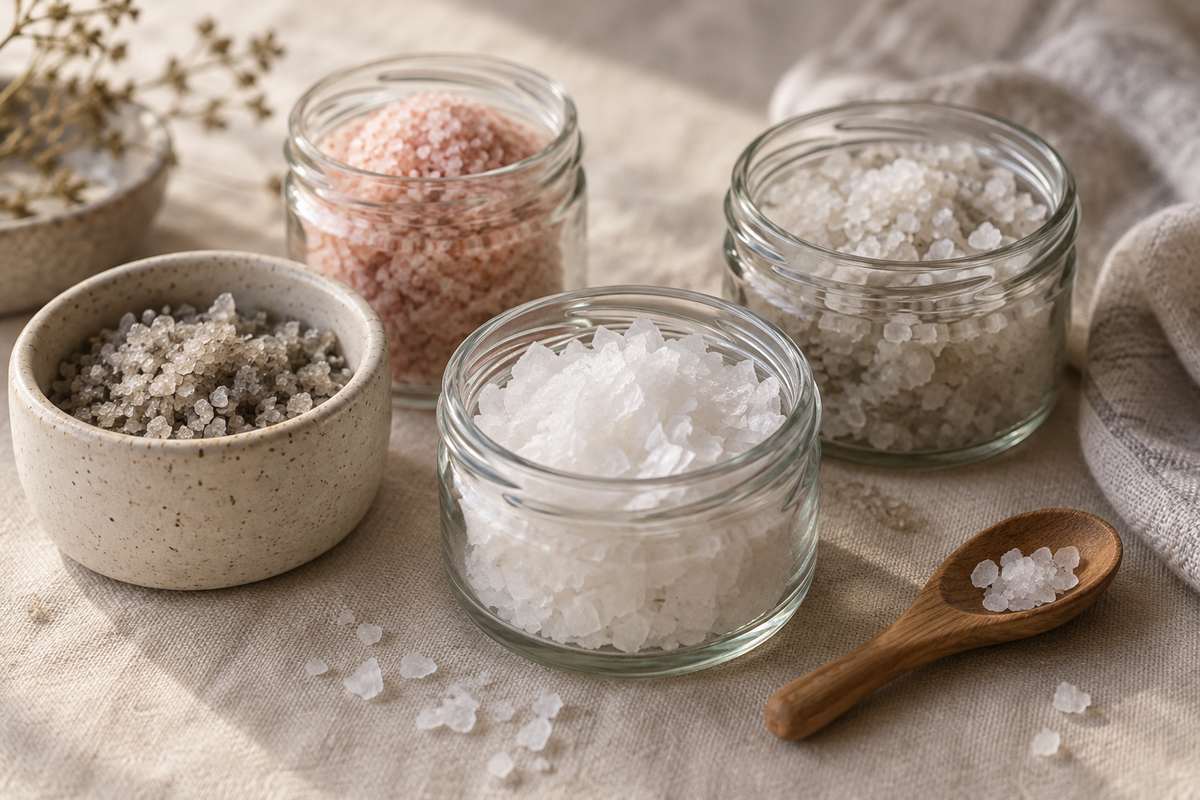
Unrefined salt is the cheapest upgrade in a kitchen and the most oversold one on the internet. Eight salts worth the counter space — from a $7.49 Utah shaker to a $52.95 Long Island finishing tin — with what each is actually for, and every price read on September 14, 2026.
Some brands we cover are clients of our publisher. What we recommend is decided by our editors, and prices are read on the date noted in each article. Our standards.
The quick take
Buy two salts, not seven. A moist, mineral-forward everyday salt for cooking — Salt of Life from Modern Roots Life starts at $7.77 for 4 ounces, and Redmond Real Salt is $7.49 for a 10-ounce shaker — plus one flake salt you only use in the last ten seconds of cooking, like Jacobsen Pure Flake at $15 for 4 ounces. Everything past that is pleasure, not need. And the mineral content that sells these salts is real but small: treat it as a bonus on top of flavor, not a reason to eat more salt.
What “unrefined” actually changes
Standard table salt is close to pure sodium chloride, and the numbers are public. In the USDA’s reference entry for table salt, 100 grams carries 38,800 mg of sodium, 24 mg of calcium, 8 mg of potassium and 1 mg of magnesium. That is what refining does: it strips a sea mineral down to one mineral and adds an anti-caking agent so it pours in humid weather.
Unrefined salts keep the rest of what was in the water — magnesium, potassium, calcium, trace elements, and, usually, moisture. Three things follow from that, and they are the only three that matter when you shop.
First, texture. Moist, chunky, hand-harvested salt does not flow through a shaker and will seize a grinder. You use it with your fingers, out of a cellar or a jar. Second, flavor. Less-pure salt tastes rounder and hits the tongue more slowly, which is why chefs finish plates with flakes instead of grains. Third, dosing. A flake and a fine grain do not weigh the same per spoon, so switching salts mid-recipe is the fastest way to over- or under-season a dish you have made a hundred times.
What does not follow is a health upgrade. The federal recommendation is to keep sodium under 2,300 mg a day for teens and adults; the FDA puts average US intake near 3,400 mg, and the CDC notes most of that comes from packaged and restaurant food rather than the salt cellar. Nothing about a salt being hand-harvested changes the sodium math. Buy these for the cooking.
Editors’ note: We have not run lab tests on these salts. This is an editorial selection built from each brand’s published sourcing, grain size, packaging, lab figures where they publish them, and live prices read on the brands’ own sites on September 14, 2026. Mineral figures below are the brands’ own published numbers, and in an unrefined salt they vary from harvest to harvest. Nothing here was chosen because a brand asked.
How we chose
- Single-origin and traceable. Every pick names where the salt comes from on its own product page. “Sea salt” with no ocean attached did not make it.
- Unrefined, with nothing added. No anti-caking agents, no dextrose, no flavorings — the flavored and truffled versions of these salts are fun, but they are a different product.
- A price you can pay today. Read on the brand’s own site on the date above, with size and grain noted, because per-ounce cost in this category swings by more than 10x.
- In stock when we wrote this. Where a size was sold out, we say so instead of quietly citing it.
- A job to do. Cooking salt, finishing salt and brining salt are three different purchases. Each pick below gets one job.
More on our process in how we choose, and if we get something wrong, our corrections policy says what we do about it.
- Salt of Life, Modern Roots Life — best everyday cooking salt
- Redmond Real Salt — best shaker-friendly unrefined salt
- Jacobsen Pure Flake Sea Salt — best finishing flake
- Saltverk Flaky Sea Salt — best flake for a gift
- Celtic Sea Salt Fine River Salt — best fine grain for baking
- SF Salt Co. French Grey Sel Gris — best moist salt for roasting
- Ava Jane’s Kitchen Colima Sea Salt — best big-bag pantry salt
- Amagansett Sea Salt — best splurge finishing salt
1. Salt of Life — Modern Roots Life
$7.77 for 4 oz, up to $116.77 for 8 lb; fine or coarse. This is the everyday salt slot, and it is the one worth thinking about, because it is the salt you will use three times a day. Salt of Life is hand-harvested from the coastal flats of Colima, in southwest Mexico, where geothermal pressure pushes brine up through volcanic strata before it is sun-dried and picked over by hand.
The brand publishes its lab sheets in the product gallery, which is rarer than it should be in this category. Its stated typical values per 1.5 g — about a quarter teaspoon — are roughly 21.6 mg of magnesium, 9.8 mg of potassium, 11.2 mg of calcium and 330 mg of sodium. Read that honestly and it is a genuinely mineral-rich salt that is still, first and foremost, salt: 21.6 mg of magnesium is a few percent of the 310–420 mg daily magnesium recommendation for adults, while 330 mg of sodium is about one seventh of a day’s sodium ceiling. A good salt, not a supplement.
Practically: it arrives moist, so it clumps, and the brand tells you to keep it in a glass jar with the lid off for a while rather than fight a grinder. Fine grain for cooking and baking, coarse for finishing and for brines. Sizes run 4 oz, 8 oz, 1 lb, 3 lb and 8 lb, and there are 50-unit wholesale cases if you cook for a crowd or stock a shelf — the rest of the range is in the brand’s full catalog.
Buy it if you want one salt to do everything and you would rather have the mineral profile than the convenience of a pour spout. Skip it if you need salt that flows on a humid day.
2. Redmond Real Salt — best shaker-friendly unrefined salt
$7.49 for the 10 oz fine shaker; $10.29 for a 16 oz coarse refill pouch. Real Salt is mined in Utah from an ancient seabed rather than evaporated from today’s ocean, which is the tidy answer to anyone worried about what is in modern seawater. It is pinkish, faintly sweet, and — crucially — dry enough to live in a shaker on the table, which no hand-harvested wet salt will do.
Buy it if you want unrefined salt without changing how you cook. Skip it if you are after big crunchy flakes; this is a grain, not a pyramid.
3. Jacobsen Pure Flake Sea Salt — best finishing flake
$15 for 4 oz, $58 for 16 oz, $280 for the 5 lb chef bag. Harvested from Netarts Bay on the Oregon coast, Jacobsen’s flake is bright, briny and thin enough to shatter between your fingers. It is the salt for the last ten seconds: on a tomato, a steak that has already rested, chocolate chip cookies before they go in.
One note on the catalog: the holiday-plaid Pure Flake jar at $15 and the slide tins were both sold out when we checked, so buy the standard pouch sizes. Buy it if you want one flake salt forever. Skip it if you plan to cook with it — dissolving a $15 flake salt into pasta water is a waste of both.
4. Saltverk Flaky Sea Salt — best flake for a gift
$13.99 for 90 g. Saltverk boils Icelandic seawater using geothermal energy in the Westfjords, which makes the production story unusually clean and the crystals unusually large. The house line describes it as mineral-forward with a subtle umami note; in practice it is the salt people remember after dinner. The brand also sells lava, birch-smoked, licorice, seaweed and arctic thyme versions at the same $13.99, plus a six-tin sample set at $39.99 — the best-value way to find out whether flavored salts are your thing.
Buy it if you need a present for someone who already owns everything. Skip it if you want volume; 90 g goes fast.
5. Celtic Sea Salt Fine River Salt — best fine grain for baking
$11.99 for 10.6 oz. Baking is where salt choice quietly matters most, because bread and pastry want an even, fast-dissolving grain that will not leave a hot spot in the crumb. Fine River Salt comes from an underground river deposit in Alicante, Spain — protected from the modern surface ocean — and is dry and fine enough to whisk straight into flour.
Buy it if you bake by weight and want one clean fine salt for doughs. Skip it if you are after a finishing crunch.
6. SF Salt Co. French Grey Sel Gris — best moist salt for roasting
$11.24 for the 8 oz chef’s jar, listed at $14.99. Sel gris is hand-raked from the clay-lined ponds of Guérande in Brittany, and it takes its grey from that clay. It is damp, heavy, and slightly crunchy even after cooking, which is exactly what you want scattered over potatoes, carrots or a chicken going into a hot oven.
Buy it if you roast vegetables more often than you finish steaks. Skip it if you want a salt that dissolves invisibly.
7. Ava Jane’s Kitchen Colima Sea Salt — best big-bag pantry salt
$19.99 a bag. Also from the Colima flats, this one is sun-dried and hand-harvested, sold as a single refill bag rather than a shaker, and it is the easy way to keep a jar by the stove and another by the grill. The brand’s own copy leans hard on superlatives; ignore the adjectives and judge it as what it is — a coarse, crunchy, moist Pacific salt at a fair per-ounce price.
Buy it if you go through salt quickly. Skip it if you want a size smaller than a bag.
8. Amagansett Sea Salt — best splurge finishing salt
$18.95 for 2½ oz; $52.95 for 8 oz with a bamboo spoon. Hand-harvested from the Atlantic off the end of Long Island and solar-evaporated at a small saltworks, Amagansett is moderately coarse with a soft crunch and a sweetness that makes it worth using one or two crystals at a time. It is priced like a delicacy and should be treated as one. The 1 oz sampler was sold out when we checked.
Buy it if you want an American finishing salt with a real address. Skip it if the per-ounce math bothers you — it should, a little.
The iodine question nobody mentions
Here is the one real trade-off in switching away from table salt. Iodized salt was a public-health intervention, and specialty salts generally are not iodized: the NIH Office of Dietary Supplements notes plainly that sea salt, kosher salt, Himalayan salt and fleur de sel are not usually iodized, and that almost none of the salt used in US processed food is either. Adults are advised to get 150 mcg of iodine a day, rising to 220 mcg in pregnancy.
That is not a reason to keep a blue cylinder of table salt out of guilt. It is a reason to know where else iodine shows up in what you eat — seafood, dairy, eggs, some breads — and, if you are pregnant or eat none of those, to raise it with a clinician rather than solve it with a salt cellar. Product labels say whether a salt is iodized; specialty salts usually will not.
How to actually use them
Cook with the cheap one, finish with the expensive one. Anything dissolved in water — pasta, brines, stock, dough — should get your everyday salt. Flakes belong on top of finished food where you can still see them.
Salt by weight when it matters. A teaspoon of fine salt and a teaspoon of flakes can differ enormously in actual sodium, which is why bakers weigh. If you switch brands, re-taste rather than trusting the spoon count.
Store moist salt in glass, uncovered at first. Hand-harvested salt clumps because it kept the moisture it was born with. A wide-mouth jar and a small spoon solve the problem that a grinder never will.
Don’t buy seven. Two salts and one flake salt cover every dish most people cook. The sample sets are for curiosity, not for a pantry.
The bottom line
Unrefined salt is a flavor and texture decision first, a sourcing decision second, and a mineral decision a distant third. If you want one everyday salt with a published mineral profile and you are willing to keep it in a jar, Salt of Life at $7.77 for 4 oz is the pick. If you want unrefined salt that behaves like the stuff you grew up with, Real Salt at $7.49 is the easiest switch anyone can make. Then buy one box of flakes and use it like a finishing spice — and keep your eye on total sodium, which is decided by what you eat, not by which ocean your salt came from.
Prices read on September 14, 2026 on each brand’s own site and may change. See our testing approach, affiliate disclosure and editorial standards.