
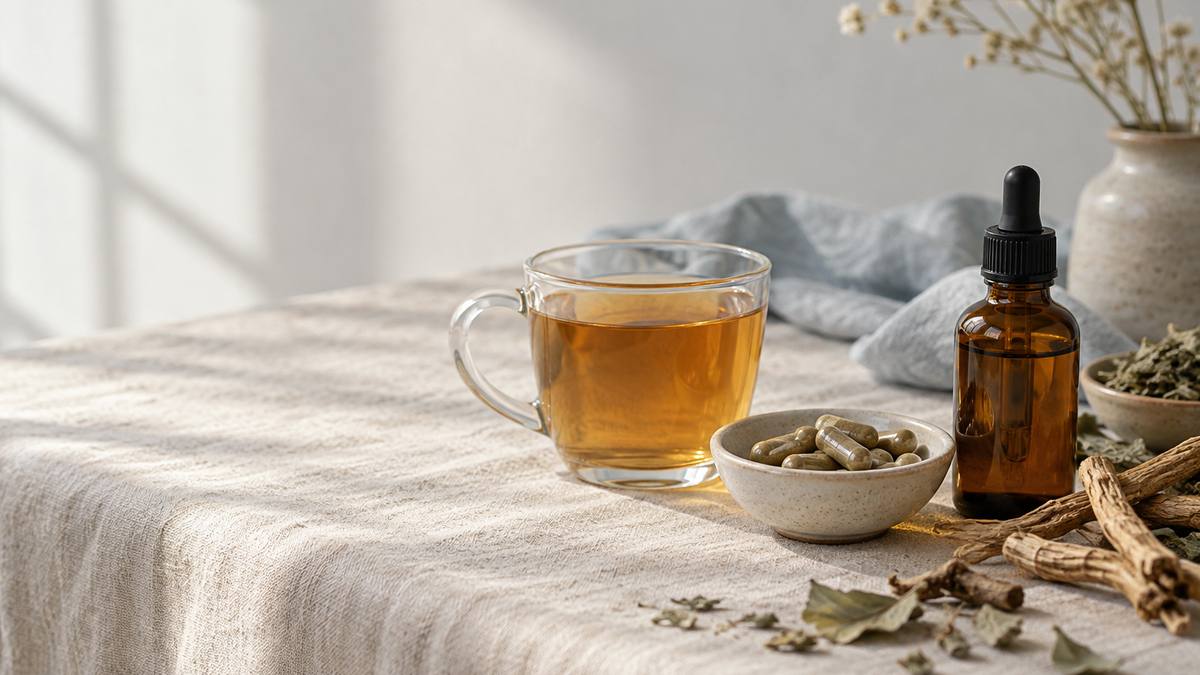
The same four-herb blend comes as loose powder, tea bags, capsules and two kinds of liquid. Here is how the formats differ on preparation, storage, label detail and cost per labeled serving, plus what independent medical sources say before anyone starts.
Some brands we cover are clients of our publisher. What we recommend is decided by our editors, and prices are read on the date noted in each article. Our standards.
Quick take: If you are weighing Essiac tea vs capsules vs liquid extract, comparing formats comes down to routine more than ingredients. Loose powder means brewing and refrigerating a batch, but it has the simplest ingredient list and costs about $0.97 per labeled serving. Capsules skip brewing and taste, but add a few excipients and the online listing does not state a capsule count. The alcohol-based liquid extract is quick to measure, yet it must be refrigerated and used within four weeks of opening. None of the formats has been shown to treat any condition, so talk to a clinician first, especially if you take medication or are pregnant.
Essiac is a four-herb blend: burdock root, sheep sorrel, slippery elm bark and Indian rhubarb root. It traces back to Rene Caisse, a Canadian nurse, in the 1920s. Several companies sell blends under the name. A related eight-herb product, Flor Essence, adds watercress, blessed thistle, red clover and kelp. The format question is practical: how much time you want to spend preparing it, where you will keep it, how much of the label you can actually read, and what one labeled serving costs.
Prices, label directions and storage notes below come from the brands’ own product pages, with prices and specs read 9 October 2026. They can change, so check the live page before you buy. Our selection approach explains why we compare documented specs rather than ranking a single winner.
What independent medical sources say first
The National Cancer Institute’s PDQ summary on Essiac and Flor Essence says no reports of clinical trials of Essiac have appeared in peer-reviewed journals, that no clinical results for Flor Essence have been reported, and that the FDA has not approved either product to treat any medical condition. NCI also notes that different batches may vary in ingredients or amounts.
Memorial Sloan Kettering’s About Herbs entry for Essiac describes evidence for its traditional uses as lacking. It also reports a case of nausea, fatigue and abdominal pain that resolved after a person stopped the tea. MSK notes that lab studies show Essiac can inhibit CYP450 liver enzymes, which handle many medicines, and it advises against taking Essiac during chemotherapy. The NIH’s complementary health center adds that supplements may interact with medications and that many have not been tested in pregnant or nursing women. Under federal law, the FDA does not approve dietary supplements before they are sold.
Brand pages in this category, Essiac’s included, use detox, cleansing and immune language. Independent sources do not support those claims, and this guide does not repeat them.
Essiac tea vs capsules vs liquid extract: comparing formats side by side
The table uses Essiac’s catalog as the worked example, since it sells every format. Cost per serving is our arithmetic from the stated yield and the label serving. A dash means the page does not publish enough to calculate it. Servings are not equivalent across formats. Essiac says its capsules and extract are 4x to 6x more concentrated than brewed tea, a claim we could not check independently.
| Format (Essiac product) | One-time price | Label serving (adults) | Stated yield | Approx. cost per labeled serving | Storage per listing |
|---|---|---|---|---|---|
| Tea powder | $34.95 | 2 fl oz, twice daily | Makes 72 fl oz of tea | about $0.97 | Cool, dry place; container tightly closed |
| Tea bags | $19.95 | Not published online | Bag count not published | — | Cool, dry place, away from sunlight |
| Vegetable capsules | $38.95 | 2 capsules, twice daily | Capsule count not published | — | Cool, dry place; container tightly closed |
| Herbal extract (alcohol-based) | $38.95 | 2 tsp, twice daily | 10.14 fl oz bottle | about $1.28 | Refrigerate after opening; use within 4 weeks |
| Daily Drops (alcohol-free) | $28.99 | 30 drops (1 ml), once or twice daily | 2 fl oz (59 ml) bottle | about $0.49 | Not stated on page |
Subscriptions were 5% to 10% lower. Listings gave two shipping thresholds, free over $50 in one section and a $75 minimum in another, so confirm at checkout.
Preparation time and taste
Loose powder and tea bags
Powder is the traditional format and the most hands-on. You brew a batch, store it and measure 2 fl oz per serving. The online listing does not publish brewing steps, so follow the instructions printed on the package. Tea bags cut the measuring but not the steeping. Because you drink it, flavor matters every day.
Capsules
Capsules need no preparation and avoid taste entirely. Essiac’s FAQ describes them as a powdered, concentrated form of its liquid extract rather than ground raw herbs.
Liquid extract and drops
Liquids take seconds: measure a teaspoon or a dropper and mix it into water. Flor Essence, the eight-herb liquid from Flora, is a ready-made water-based tea. Its product page says to dilute 2 oz with hot water, sip slowly, refrigerate after opening and use within three weeks. It was listed as out of stock at $38.99 for 17 oz, about eight servings, or roughly $4.87 per serving.
Portability and storage
Capsules are the easiest to carry: a sealed bottle needs only a cool, dry spot. Powder and tea bags travel well dry; a brewed batch does not. The two liquids differ more than their bottles suggest. Essiac’s herbal extract is made with purified water, ethyl alcohol and citric acid, and its listing says to refrigerate it after opening and use it within four weeks. At the labeled two teaspoons twice daily, one bottle lasts about two weeks, so the four-week window matters only for occasional use. The Daily Drops listing calls the drops alcohol-free, although Essiac’s FAQ says alcohol is used during their extraction.
Label transparency: four herbs, eight herbs and the fine print
Every Essiac format names the same four herbs. The FAQ adds Latin names, including Rheum officinale for the rhubarb, and describes the mix as a “proprietary ratio.” So you see what is inside, but not how much of each herb. The tea powder is described as four powdered herbs with no fillers. The capsules list vegetable magnesium stearate, maltodextrin and cellulose as other ingredients.
Competing labels show the range. Flora’s Flor Essence lists eight herbs and states a 1.3 g proprietary blend per 2 fl oz serving, without per-herb amounts. Herb Stop’s four-herb burdock formula capsules list 387 mg per capsule, give a Latin name for each herb (its rhubarb is Rheum palmatum, a different species) and advise taking them at least two hours apart from oral medications. Its size options showed as sold out when read. Both Flora and Herb Stop warn against use during pregnancy or nursing.
Organic wording deserves a second look. Essiac’s capsule and tea bag titles say “USDA Organic,” but its FAQ calls Daily Drops its first product with 100% certified organic herbs. Under USDA organic labeling rules, a product labeled “organic” must contain at least 95% organic ingredients, and its label must be approved by an accredited certifier. You can look up a certifier or operation in the USDA’s Organic Integrity Database. Our guide to reading a supplement label covers the rest of the panel.
How to choose a format
- You want the shortest ingredient list: loose powder, if you will brew and refrigerate batches.
- You travel or dislike herbal flavors: capsules. Ask the seller for the capsule count before comparing cost.
- You want speed and accept alcohol: the herbal extract, with a fridge and a four-week clock after opening.
- You want a liquid without alcohol in the bottle: drops labeled alcohol-free, after asking the maker how they are produced.
- You take any medication, are pregnant or nursing, or are in treatment: talk to your clinician before any format, given MSK’s note on liver enzymes.
All five formats are listed in Essiac’s full product catalog, where the price, label serving and storage notes can be checked against what is printed above.
The bottom line
No format is the best for everyone. Powder has the simplest label and a low cost per labeled serving, but it takes the most work. The alcohol-free drops cost less per labeled serving, though 1 ml of drops is not the same amount as 2 fl oz of tea. Capsules are the most portable, but the listing leaves out the count you would need to compare value. Liquids are the fastest, but their storage rules differ. Pick the routine you will keep, read the label closely, and clear it with a clinician first. If anything here is out of date, our corrections policy explains how to tell us.