
A counted plan for a school week, the layers that handle a 45-degree morning and a 70-degree afternoon, and the label, safety and sizing checks worth doing before anything goes in the cart.
Some brands we cover are clients of our publisher. What we recommend is decided by our editors, and prices are read on the date noted in each article. Our standards.
Quick take: If you want to know how to build a practical fall capsule wardrobe for kids, start with the school week rather than the store. Count roughly five to seven tops, three or four bottoms, two warm mid-layers, one light jacket, one heavier coat and two pairs of shoes, then fill gaps from what already fits. Pick a few colors that all match each other, buy one size up only where the cut allows it, read the care label before buying, skip hood and neck drawstrings on outerwear for kids up to size 12, and never buckle a puffy coat under a car-seat harness.
A capsule wardrobe is a small set of clothes where any top goes with any bottom. For kids, fall is when it pays off: cold mornings, warm afternoons, muddy recess, and a growth spurt somewhere before the holidays.
The numbers below are a starting point, not a rule. Prices, size runs and stock were read on each brand’s own product pages, and prices and specs were read 12 October 2026, so check the page before you buy. Our selection approach explains how we pick examples.
How to build a practical fall capsule wardrobe for kids: the count
Plan for one school week plus one weekend day, and assume laundry runs once or twice a week. That gives a simple framework:
- Tops: 5 to 7. Mostly long-sleeve tees or thin knits, enough to cover a messy day without washing midweek.
- Bottoms: 3 to 4. Pants usually get worn more than once before washing. Mix one sturdy woven pair with knit joggers or leggings.
- Mid-layers: 2. A cardigan, sweatshirt or zip sweater that goes on and comes off without a fight.
- Outerwear: 2. A light jacket for 50s and 60s mornings, and a warmer coat once the forecast drops further.
- Shoes: 2 pairs. One everyday pair and one that can handle wet grass or rain.
Before buying anything, sort what your child already owns into those groups and see what still fits. Adjust the numbers for uniforms, daycare spare-clothes rules or a child who goes through three outfits before lunch.
Pick a palette before you pick pieces
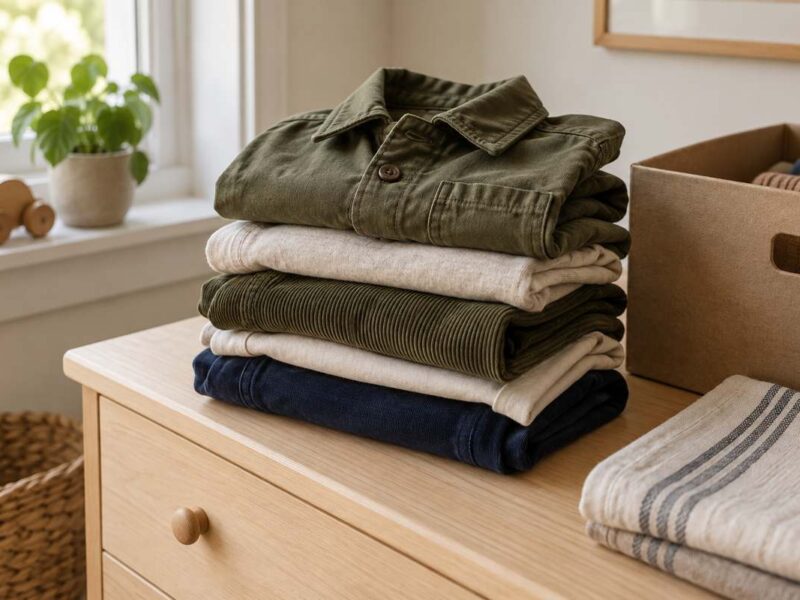
Mixing works best when the bottoms are neutral (navy, gray, olive, tan, denim) and the color or print goes on the tops. If every bottom matches every top, five tops and three bottoms give fifteen outfits. Letting a child choose the printed piece cuts down on morning arguments.
Layering for fall temperature swings
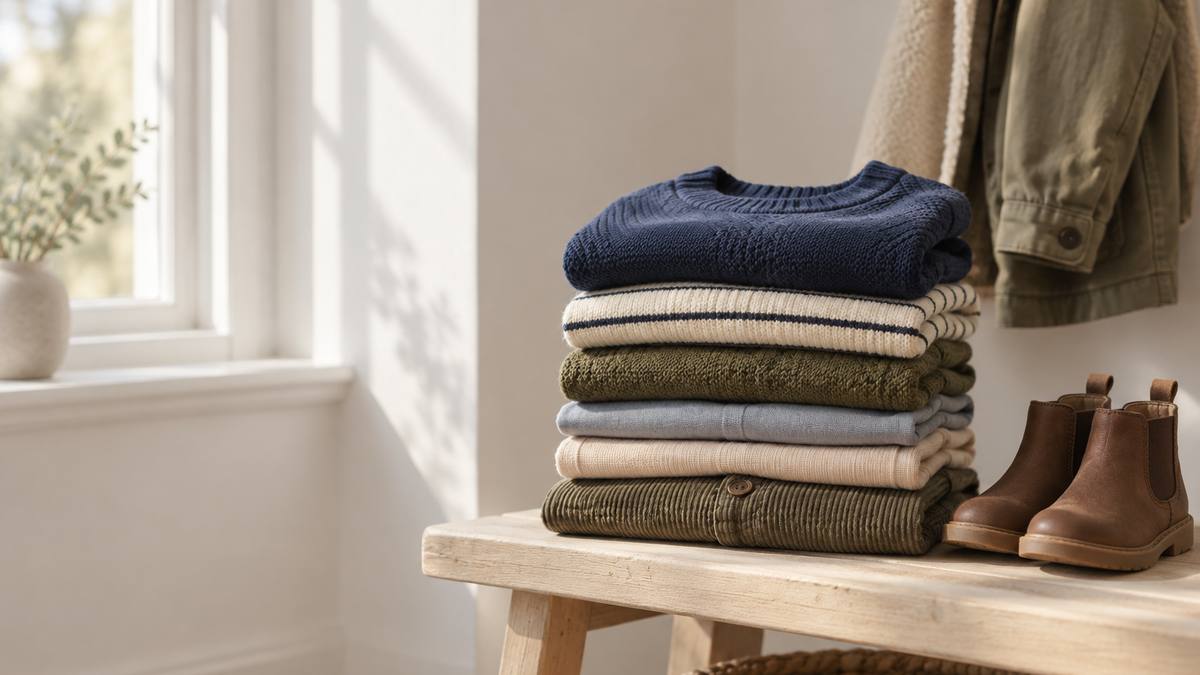
The practical fall formula is thin base, warm middle, outer shell, so each layer can come off as the day warms up. Some examples, read from the product pages:
- Base layer: Kyte Baby’s long-sleeve toddler crew neck tee in Cypress lists 97% rayon made from bamboo and 3% spandex. It was $26 in sizes 12–18 months through 4T, $28 for 5T through 7 and $30 for 8 and 10, and all ten sizes showed as available.
- Bottoms: Colored Organics’ Atlas lightweight toddler jogger in heather grey was $30, made of 100% organic cotton rib with an adjustable waistband, sized 2T through 5T/6, with all four sizes available.
- Mid-layer: Jamie Kay’s Shelby cardigan in Eclipse is 100% cotton with a tie front. It was $44.99 USD from 6–12 months to 9 years and $54.99 for 10 to 14 years, with all thirteen sizes listed as available.
- Light jacket: Burt’s Bees Baby’s organic cotton utility jacket is a hooded, lined French terry zip jacket listed as 100% GOTS certified organic cotton. It was $36.95 for 0–3 months through 24 months and $38.95 for 2T through 5T, with every size available.
- Warmer coat: Primary’s weatherproof parka puffer was $82.50, marked down from a listed $118, in sizes 2 through 14. Primary lists a waterproof 100% recycled polyester shell and says it is machine washable with the zipper closed.
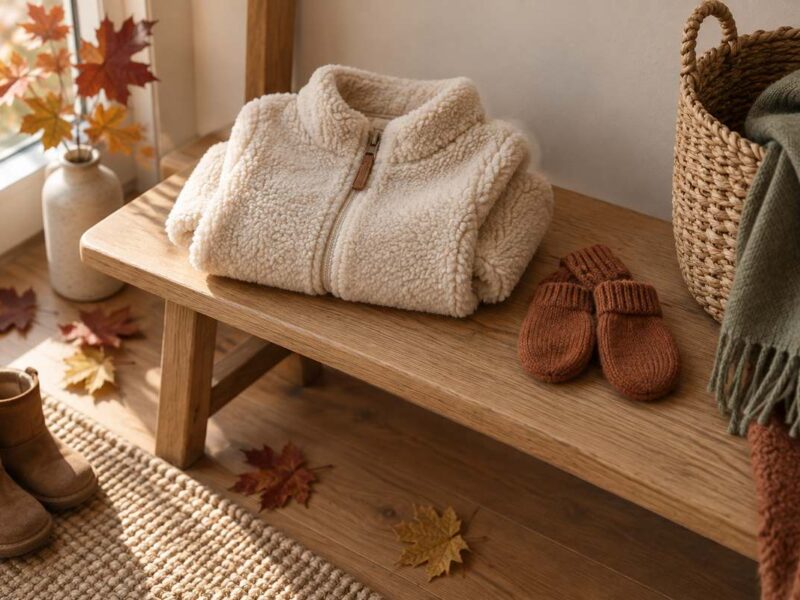
For teddy and sherpa jackets, we compared seven on fiber, size runs and returns in our teddy fleece jacket guide.
The coat and the car seat
The American Academy of Pediatrics’ winter car seat guidance on HealthyChildren.org says that, as a general rule, bulky clothing, including winter coats and snowsuits, should not be worn under a car-seat harness. In a crash the padding flattens, leaving the harness loose. The AAP suggests thin layers, such as a thin fleece jacket, and a coat or blanket laid over the buckled straps, or a coat put on backwards after buckling. If you can pinch the harness strap at the chest, it needs tightening.
For a capsule, that means a child who rides in a car seat needs a thin, warm mid-layer to wear under the harness, with the coat on top.
Drawstrings on hoods and necks
Federal rules treat noncompliant drawstrings on children’s outerwear as a hazard. Under 16 CFR Part 1120, children’s upper outerwear in sizes 2T to 16 with drawstrings that don’t conform to the voluntary standard ASTM F1816-97 is deemed a substantial product hazard. The regulation says that standard bans hood and neck drawstrings up to size 12 and sets requirements for waist and bottom drawstrings through size 16.
On hoodies and jackets up to size 12, look for snaps, elastic or a plain hood instead of a cord. On older hand-me-downs and thrifted outerwear, remove any hood or neck cord before your child wears it.
Sizing up without buying clothes that swamp them
Buying one size up can stretch a fall wardrobe into spring. Cardigans, elastic-waist joggers and jackets with rollable cuffs are forgiving; fitted knits and sleeves that hang past the hands are not. Brand notes help. On one listing at Shop CouCou Kids, a multi-brand children’s boutique, the retailer says Cozmo “generally fits true to size with relaxed designs.” On an Emile et Ida listing it says the brand “tends to run snug” and suggests sizing up.
One basic-tee example at Shop CouCou Kids is the Cozmo long-sleeve basic T-shirt in navy, made in Spain. It was $52 and listed in 3y through 12y. When we checked, 4y, 5y, 6y, 8y and 10y were available and 3y and 12y were not, and the page warned “Only 1 left!” for the size it showed first. The listing also shows why it’s worth reading the whole page: the description says “100% slub cotton,” but the composition line reads 96% cotton and 4% elastane. When the two disagree, check the sewn-in label when the piece arrives.
Care labels and how often to wash
A capsule gets worn more often, so care matters more. The FTC’s Care Labeling Rule, 16 CFR Part 423, requires care labels on apparel to “state what regular care is needed for the ordinary use of the product,” and labels must be easy to see or find at the point of sale. Online, read the product description for it. The examples above vary. Colored Organics says to machine wash cold and tumble dry low. Burt’s Bees Baby says to machine wash cold on a gentle cycle and tumble dry low, except for sweaters, which should dry flat. Jamie Kay recommends a delicate wash in a laundry bag on cold, with no tumble drying.
If you do laundry once or twice a week, make the cold-wash, tumble-dry pieces the everyday ones and keep hang-dry knits to one or two. Tops usually need washing after a school day; joggers and mid-layers can often take a second wear if they aren’t visibly dirty.
Buying preloved
Secondhand clothes suit a capsule because kids often outgrow things before wearing them out. Shop CouCou Kids, for example, runs a PreLoved section, and on the day we checked its first page listed items from $20 to $55, each shown next to a higher original price. Every listing on that page was marked final sale, and the store’s refund policy says final-sale items can’t be returned or exchanged. Check the size in the listing title against a garment that fits now before you buy.
Wherever you buy preloved, check for pilling at the underarms and knees, stretched cuffs, working zippers and snaps, and drawstrings on hoods or necks. For family hand-me-downs, see our sibling hand-off list.
Putting it together
A practical fall capsule is about fifteen pieces that match each other, suit how your household does laundry, and layer down to something thin enough for a car seat. Count what you have, fill only the gaps, check size and stock on the day you buy, and check hoods for cords. If you find a price or detail here that has changed, our corrections policy explains how to flag it.