
Humidity, hard afternoon sun, sand and narrow condo hallways change what a good sofa looks like. Here is how to choose a sofa for a Florida living room.
Some brands we cover are clients of our publisher. What we recommend is decided by our editors, and prices are read on the date noted in each article. Our standards.
Quick take: Start with the room, not the showroom. Measure the wall, the walkway and every door on the delivery path. Pick a solution-dyed or performance fabric if the sofa sits in sun from a slider, and a cleaning code that suits kids, pets or beach sand. Ask how the frame is joined and what the foam density is, and check for the federal flammability label.
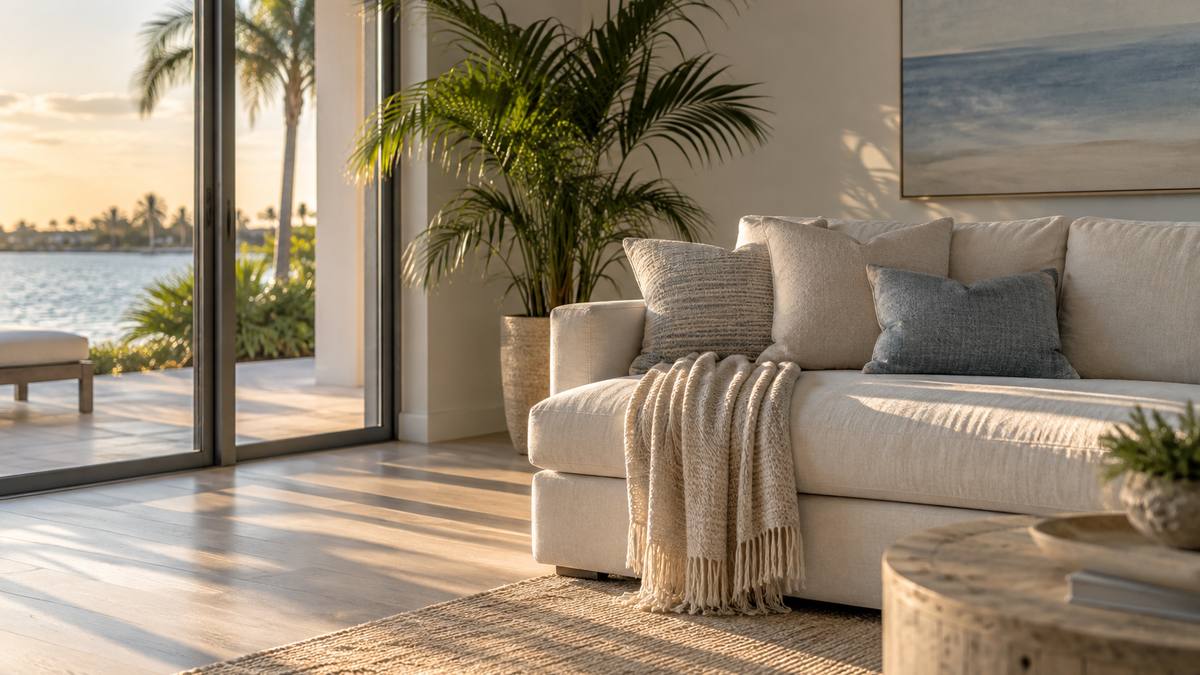
A Florida room has its own problems: indoor air that turns humid when the air conditioning cycles off, sliding doors that pour light onto upholstery for hours, and a steady supply of sand, pool water and wet dogs. None of that rules out a style, but it changes which specifications matter.
Facts, specs and store details in this guide were read on the brands’ and agencies’ own pages on 7 October 2026. Nothing here was tested by us; it is a reading of published specifications, in line with how we choose what to cover.
How to choose a sofa for a Florida living room: start with the air
Upholstery is fabric, foam, fiber and wood, all of which hold moisture. The EPA’s guide to mold, moisture and your home recommends keeping indoor relative humidity below 60 percent, ideally between 30 and 50 percent, and notes that an inexpensive humidity meter from a hardware store will tell you where you stand. The Florida Department of Health’s mold guidance for residents makes the same under-60-percent point and adds that dust settled on furniture can be a food source for mold, and that spills should be cleaned and dried up quickly.
For a sofa buyer that translates into three practical choices:
- Placement. Keep the sofa back a few inches off exterior walls and away from AC vents that drip or sweat.
- Cover fibers. Some performance fabrics are marketed on mildew resistance; linen and cotton work but lean harder on your humidity control.
- Removable covers. Zippered covers and loose cushions let you air out or clean a cushion after a spill.
Sun and fading near sliding doors
The sliding glass door is the defining feature of many Florida living rooms, and it is also the main threat to upholstery color. Rowe Furniture’s upholstery care guidance says plainly that direct sunlight can cause fabrics to fade and that direct sun on any piece of furniture should be limited.
The fabric chemistry matters here. Sunbrella says its performance fabrics are 100% solution-dyed acrylic, meaning the fiber is saturated with color and UV-stabilized pigments before it is spun into yarn, rather than dyed on the surface afterward. The company describes those fabrics as fade resistant, mold and mildew resistant and bleach cleanable. Those are the brand’s own claims.
For a sofa in strong afternoon light, a solution-dyed fabric is the lower-maintenance option. For a conventional fabric in a deep color, plan on blinds, UV window film or a layout that keeps cushions out of the direct beam.
Leather versus fabric in the heat
Leather wipes clean and does not hold sand or pet hair; the trade-offs are heat after hours in the sun and how the finish ages. Rowe’s leather glossary distinguishes protected (pigmented) leather, which it says is easier to clean because surface pigments repel water and stains, from pure aniline leather, which it describes as delicate, soft and supple. For a sunny room with kids or pets, a protected leather is the more forgiving choice; aniline leather suits people who like a patina and accept marks as part of the look.
Performance fabrics, pets and sand
“Performance fabric” is a marketing category, not a standard, so read what each maker actually claims. Crypton describes its home fabric as stain-resistant, odor-resistant and PFAS-free, and its cleaning instructions recommend weekly vacuuming with the upholstery attachment so dirt does not embed in the fibers, blotting spills and misting stains with plain water before using soap. For a beach household, weekly vacuuming matters because sand works into the weave.
For pets, a tight, flat weave is easier to live with than loops that claws can catch.
Read the cleaning code before you buy
Upholstery fabrics carry a cleaning code, usually printed on the law tag attached to the furniture. Rowe’s cleaning-code reference summarizes the industry codes this way:
| Code | What it allows | Florida household fit |
|---|---|---|
| W | Spot clean with a water-based shampoo or foam upholstery cleaner | Easiest for kids, pets and spills |
| S | Spot clean with a water-free dry-cleaning solvent only; no water | Harder with wet swimsuits and pets |
| W/S (S/W) | Upholstery shampoo, mild detergent foam or mild dry-cleaning solvent | Flexible middle ground |
| X | Vacuum or light brushing only; no water or solvents | Best kept to low-traffic rooms |
Rowe advises pre-testing an inconspicuous area and not over-saturating the fabric, which also matters in a humid house.
Frame, springs and cushions
The frame and cushions decide how long a sofa lasts. Few retailers publish full construction details, so ask. Reference points from makers that do:
- Frame joinery. Sherrill’s construction page describes double dowels in structural joints and corner blocks fixed with glue and screws at each corner, where stress is greatest. Ask what the frame is made of, whether the wood was kiln-dried, and how the corners are joined. Staples-only joinery is worth a follow-up question.
- Spring system. The same page describes 8-way hand-tied seat springs and sinuous wire springs in the back. Sinuous (S-shaped) springs are common and serviceable; hand-tied coils are more labor-intensive. A salesperson should be able to tell you which a model uses.
- Foam density. Rowe’s cushion options list foam densities for each cushion type, with several at 2.3 density and firmer or memory-foam options at 2.5. Density describes how much foam is packed into the core rather than how soft it feels on first sit, and it is one of the clearer signals of how a seat cushion will hold its shape.
Size the room, then measure the way in
Measure the wall the sofa will face or float against, then the walkway in front of it. Seat depth is the dimension people most often overlook: Ethan Allen’s seating buying guide notes that its own living room seating ranges from 19 to 26 inches deep in the seat, which is the difference between sitting upright and lounging with your legs up.
Then measure the delivery path. Joybird’s furniture fit guide is a clear walk-through: open the door as wide as it goes and measure from the outer edge of the door to the inner edge of the frame at its narrowest point, allow about 1 to 1.5 inches of extra clearance for the delivery team’s hands, measure stairs at the narrowest point including handrails, and in a condo measure the elevator interior, its door opening and the diagonal. In a condo, that elevator check may decide between a one-piece sofa and a modular design.
Check the flammability label
Since June 25, 2021, upholstered furniture sold in the US has been subject to a federal flammability standard, 16 CFR Part 1640, which adopts California’s Technical Bulletin 117-2013 smolder-resistance test. Since June 25, 2022, the rule has required a permanent label on the product reading “Complies with U.S. CPSC requirements for upholstered furniture flammability.” If you are buying a floor model or a piece made since then, look for that line on the label.
Where Matter Brothers fits in
For shoppers on Florida’s Gulf Coast, Matter Brothers Furniture is one regional retailer where these criteria can be checked in person. Its contact page lists stores in Fort Myers, Naples, Pinellas Park/St. Petersburg, Sarasota and Tarpon Springs. On 7 October 2026 its sofa collection page showed 41 items that could be filtered by fabric or leather, by motion type (stationary, reclining, sleeper) and by width, height and depth, which is handy once you have your room and doorway measurements. Several listings carried a Sunbrella label, and the page has an “on display” filter. Availability changes, so confirm with a store before making a trip for a specific model. Our earlier living room buying guide covers more of the retailer’s range.
The short version
There is no single best sofa for every Florida home; a sun-washed beach condo with a dog and a shaded inland family room point to different answers. Match the cover to the light, the cleaning code to the household and the size to the path through the front door, and most costly mistakes are ruled out. If you spot an error in this guide, our corrections policy explains how to report it.