
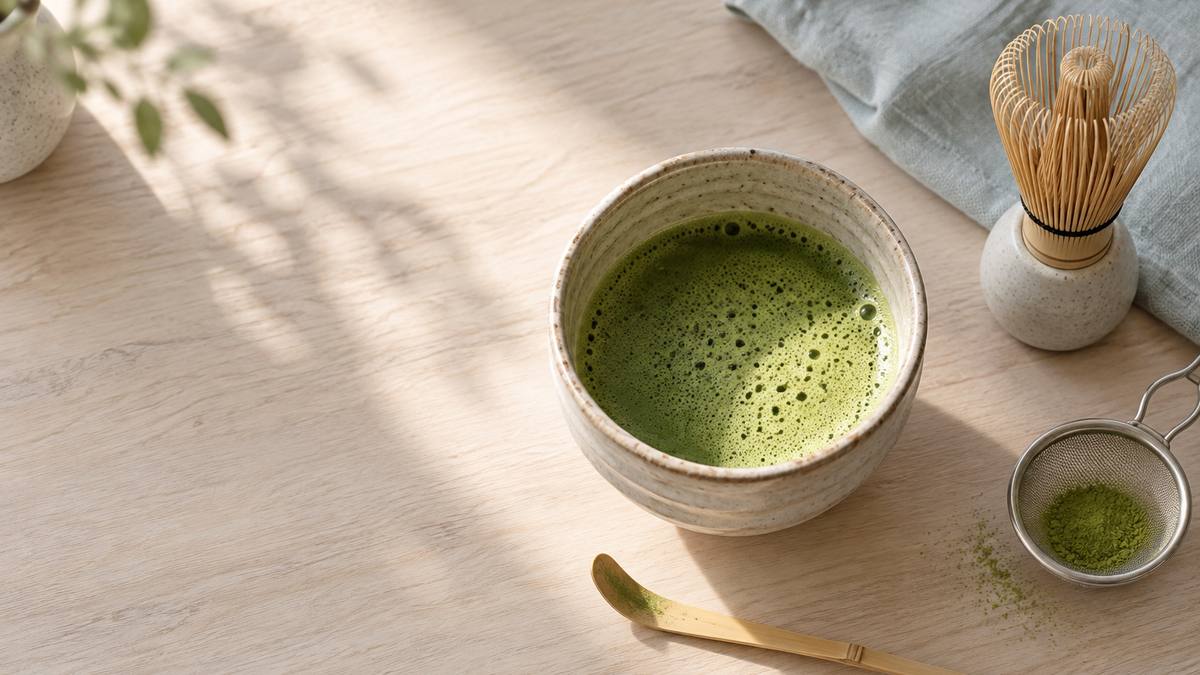
A bowl of matcha at home takes about two grams of powder, about a quarter cup of hot (not boiling) water, a sifter and 15 seconds of quick wrist work. Here is how to make ceremonial matcha at home, with published ratios and the tools that matter.
Some brands we cover are clients of our publisher. What we recommend is decided by our editors, and prices are read on the date noted in each article. Our standards.
Quick take
- Everyday bowl (usucha): sift about 1.2–2 g of matcha, add 60–80 ml of water at roughly 70–90°C (158–194°F), and whisk briskly for around 15 seconds.
- Thick tea (koicha): about twice the powder in half the water, kneaded slowly rather than whipped.
- Tools that make the biggest difference: a fine sifter and a bamboo whisk (chasen). A scoop and a proper bowl help, but a measuring spoon and a wide bowl will work.
- “Ceremonial” is a label, not a regulated grade. Judge powder by freshness, color, origin details and how it tastes in plain water.
Most people looking up how to make ceremonial matcha at home already have a tin of powder and a bowl that came out lumpy, bitter or flat. Common causes are small: water that is too hot, unsifted powder, or a whisk stirred in circles.
The guidance below draws on preparation pages published by two Japanese tea companies, Ippodo Tea and Marukyu Koyamaen, and on educational articles from the Global Japanese Tea Association and the Shizuoka-based World Green Tea Association. Where their numbers differ, we show the range rather than picking one. Prices and specs read 9 October 2026.
What “ceremonial” does and doesn’t tell you
“Ceremonial grade” is a marketing term, not a regulated grade with an official definition, so two tins with the same label can be quite different. We cover the history in our explainer on what “ceremonial grade” actually means. For preparation, the useful point is that Japanese makers such as Marukyu Koyamaen grade their matcha by named blends, not by a ceremonial/culinary split.
Marukyu Koyamaen’s guide to matcha says any of its matcha can be made as thin tea, but only its higher grades, “Kinrin” and up, are suited to thick tea, because koicha needs a less astringent powder. The same page says leaves for matcha are harvested once a year, from shaded bushes, by hand in early to mid May. The Global Japanese Tea Association’s koicha article describes high grades as coming from plants shaded for around four weeks and always picked in the spring harvest.
So when a label says “ceremonial,” look for supporting details such as region, harvest and a packing or best-by date, and treat those as the brand’s own claims.
The tools: what each one actually does
Chasen (bamboo whisk)
The whisk does most of the work. The Global Japanese Tea Association’s history of the chasen says 80- or 100-tine whisks are standard for usucha because they make a fine, airy foam, while fewer tines suit koicha. It recommends soaking the tines briefly in warm water before use and keeping a light touch, so the tines skim the liquid instead of scraping the bowl. Afterward, rinse the whisk under cool water with no soap and no dishwasher, then dry it tine-side down on a holder (chasen naoshi).
Chashaku (scoop)
A chashaku is a slender bamboo scoop, typically around 18 cm long, according to the association’s guide to the tea scoop. Scoop sizes vary: Ippodo equates 2 g with 1.5 heaped scoops, Marukyu Koyamaen about 1.5 g with two. A scale reading 0.1 g removes the guesswork.
Sifter
Matcha is a very fine powder that clumps over time. Marukyu Koyamaen recommends sifting through a fine-mesh strainer before every bowl. Press the measured powder through the mesh with a scoop or spoon, straight into a warmed, dry bowl.
Bowl (chawan)
You need room to whisk. A wide, flat-bottomed bowl lets the chasen move freely. The World Green Tea Association’s note on tea bowls for matcha says there are few rules for everyday thin tea and that a small food bowl can stand in.
How to make ceremonial matcha at home, step by step
- Heat and cool the water. Bring water to a boil, then let it cool. Marukyu Koyamaen recommends soft water and suggests filtering tap water.
- Warm the bowl and soften the whisk. Pour a little hot water into the bowl, stand the chasen in it for a short time, then discard the water and dry the bowl.
- Sift the matcha into the bowl. Measure first, then press the powder through the sifter.
- Add a splash of water first. The Global Japanese Tea Association’s preparation guide suggests pouring in a little water and gently working the powder into a paste before adding the rest. That makes stubborn lumps less likely.
- Whisk briskly from the wrist. Keep the whisk just off the bottom and move it quickly back and forth, in a zigzag or “W” pattern, rather than stirring in circles. Ippodo gives about 15 seconds.
- Refine the foam. Marukyu Koyamaen suggests slowing down once a creamy foam forms and skimming the surface to break up larger bubbles.
- Drink it promptly. Ippodo says preparing usucha quickly is the key to enjoying its full fragrance.
Foam is optional. The Global Japanese Tea Association notes that tea schools differ, with some preferring foam and some not.
Ratios and water temperature, compared
The published figures differ slightly. Here they are side by side, as read on 9 October 2026:
| Source | Style | Matcha | Water | Temperature |
|---|---|---|---|---|
| Ippodo Tea | Usucha | 2 g | 60 ml | 80°C (176°F) |
| Ippodo Tea | Koicha | 4 g | 30 ml | 80°C (176°F) |
| Marukyu Koyamaen | One bowl (thin) | approx. 1.5 g | 70 ml | 75–85°C in winter; 70–80°C in summer |
| Global Japanese Tea Association | Usucha | approx. 1.2 g | 70–80 ml | around 90°C (194°F) |
| Global Japanese Tea Association | Koicha | about 2 g per guest | 30–40 ml | close to boiling, from the kettle |
A sensible starting point is 2 g of matcha in 60–70 ml of water at about 80°C. If the bowl tastes sharp, try cooler water or slightly less powder. If it tastes thin, try a little more powder. Marukyu Koyamaen and the Global Japanese Tea Association both encourage adjusting to taste.
For lattes, brands sometimes suggest much cooler water. More Than Matcha’s product pages, for example, give 1–1.5 tsp of matcha whisked into ¼ cup of filtered water at 125°F (about 52°C) as the first step of its latte. That is the brand’s own method, and it’s well below the range Ippodo and Marukyu Koyamaen publish for plain tea.
Usucha vs koicha: which one to make
Usucha (thin tea) is the everyday, frothy bowl. Koicha, or thick tea, is closer to a glossy paste. The Global Japanese Tea Association describes it as served in the full-length tea gathering (chaji) and prepared by slow kneading rather than whisking. Ippodo’s koicha method calls for 4 g in 30 ml, mixed slowly for 15 seconds.
Start with usucha. Try koicha only with a powder its maker says is suitable for thick tea.
Storage and freshness
Marukyu Koyamaen lists heat, humidity, light, air and odors as the main threats, noting that exposed powder turns a dull olive. The World Green Tea Association’s storage guidance suggests using opened tea within about a month and keeping it in a small, airtight container away from heat and light.
Both sources allow refrigeration or freezing with one rule: seal the tea well, and let a chilled container come to room temperature before opening it, so condensation doesn’t form and clump the powder.
Where More Than Matcha fits
More Than Matcha is a small matcha brand with a short catalog. On 9 October 2026 its Ceremonial Matcha Powder listed at $45 for a 40 g tin, which the brand says makes 20–25 servings. The brand describes it as organic, first-harvest, shade-grown matcha ground in Kagoshima, Japan. Those harvest and origin claims are the brand’s own. For tools, its Whisk & Sift Set listed at $22 and includes a 100-prong bamboo whisk, a dishwasher-safe stainless-steel sifter and a whisk tube. The $89 Matcha Essentials Set contains a handmade ceramic bowl with a pour spout, a ceramic whisk holder, a bamboo whisk and a stainless-steel sifter, but no matcha or teaspoon. All three showed as in stock when read. Check availability and harvest details at checkout, since both can change. For a cost-per-gram comparison across brands, see our matcha price-per-gram breakdown.
The short version
Sift about 2 g of matcha into a warmed bowl. Add a little water at around 80°C to make a paste, top up to 60–70 ml, and whisk quickly in a zigzag for about 15 seconds. Keep the powder sealed, cool and dark, and use it within weeks of opening. For how we pick sources and products, see how we choose. If you spot an error, our corrections policy explains how to flag it.